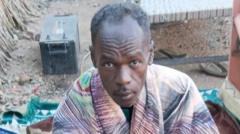
Bearing Witness: One Journalist’s Journey Through the Siege of el-Fasher
For Mohamed Suleiman, a journalist and academic, the simple act of activating a SIM card in Port Sudan was a profound and overwhelming experience. After spending years trapped within the besieged city of el-Fasher, where a total communications blackout rendered him invisible to the outside world, the sudden influx of years of accumulated messages served as a painful inventory of loss. Many of his friends and colleagues had long presumed him dead, and this digital reconnection acted as a stark reminder of the profound isolation he endured while witnessing the systematic destruction of his community.
The conflict in Sudan, which escalated into a violent power struggle between the national army and the Rapid Support Forces (RSF), has triggered a humanitarian catastrophe of immense proportions. Suleiman describes the fall of el-Fasher as an apocalyptic event, characterized by relentless drone strikes, heavy shelling, and the total collapse of essential infrastructure. As the RSF tightened its control over the city, civilians were forced to navigate a landscape of devastation, often compelled to leave behind the wounded and the starving in a desperate bid to reach safety.
Throughout the siege, journalists faced extreme danger from all sides of the conflict. The military frequently accused those attempting to document the reality on the ground of acting as spotters for enemy artillery, while the RSF viewed any form of communication technology as a potential tool for espionage. This climate of fear and censorship ensured that the atrocities occurring in el-Fasher remained largely undocumented by global media, leaving the local population to suffer in a vacuum of international indifference.
Today, as Sudan remains fractured and millions of people are displaced, Suleiman views his survival as a mandate to bear witness. Despite his escape to Port Sudan and the arduous bureaucratic struggle to regain his identity documents, he remains deeply critical of the international community’s failure to intervene. For him, the ongoing humanitarian crisis is a testament to the absence of effective global oversight, and he remains committed to documenting the truth to ensure that the suffering of his people is not erased from history.
Key Takeaways
- Journalist Mohamed Suleiman survived a years-long communications blackout and siege in el-Fasher, Sudan.
- The conflict between the national army and the RSF has created a humanitarian crisis characterized by the systematic destruction of civilian infrastructure.
- Journalists in the region face extreme risks, as both warring factions treat documentation and communication technology as acts of espionage.
Editor’s Analysis & Impact
The harrowing account of Mohamed Suleiman highlights a critical failure in global information flow and humanitarian intervention. In an era of hyper-connectivity, the ‘digital blackout’ experienced in el-Fasher serves as a chilling reminder of how easily entire populations can be erased from the global consciousness when communication infrastructure is weaponized. The implications for the future of conflict reporting are severe; as warring factions increasingly view information as a tactical threat, the ability of independent journalists to document war crimes is being systematically dismantled. This creates a dangerous precedent where atrocities occur in a vacuum, shielded from international accountability. Moving forward, the international community faces a significant challenge in protecting the safety of local journalists who serve as the only remaining eyes and ears in regions where global media presence is impossible.
Frequently Asked Questions
Q: Why was el-Fasher isolated from the rest of the world?
A: The city was subjected to a total communications blackout as part of the conflict between the national army and the Rapid Support Forces, which prevented residents from accessing the internet or mobile networks.
Q: What risks do journalists face in the current Sudanese conflict?
A: Journalists are targeted by both sides of the conflict, with the military accusing them of acting as enemy spotters and the RSF viewing communication devices as tools for espionage.
AI Disclosure: This article is based on verified data and official reports. Our Team and AI have cross-referenced every financial detail with primary sources to ensure total accuracy.
More from this Category