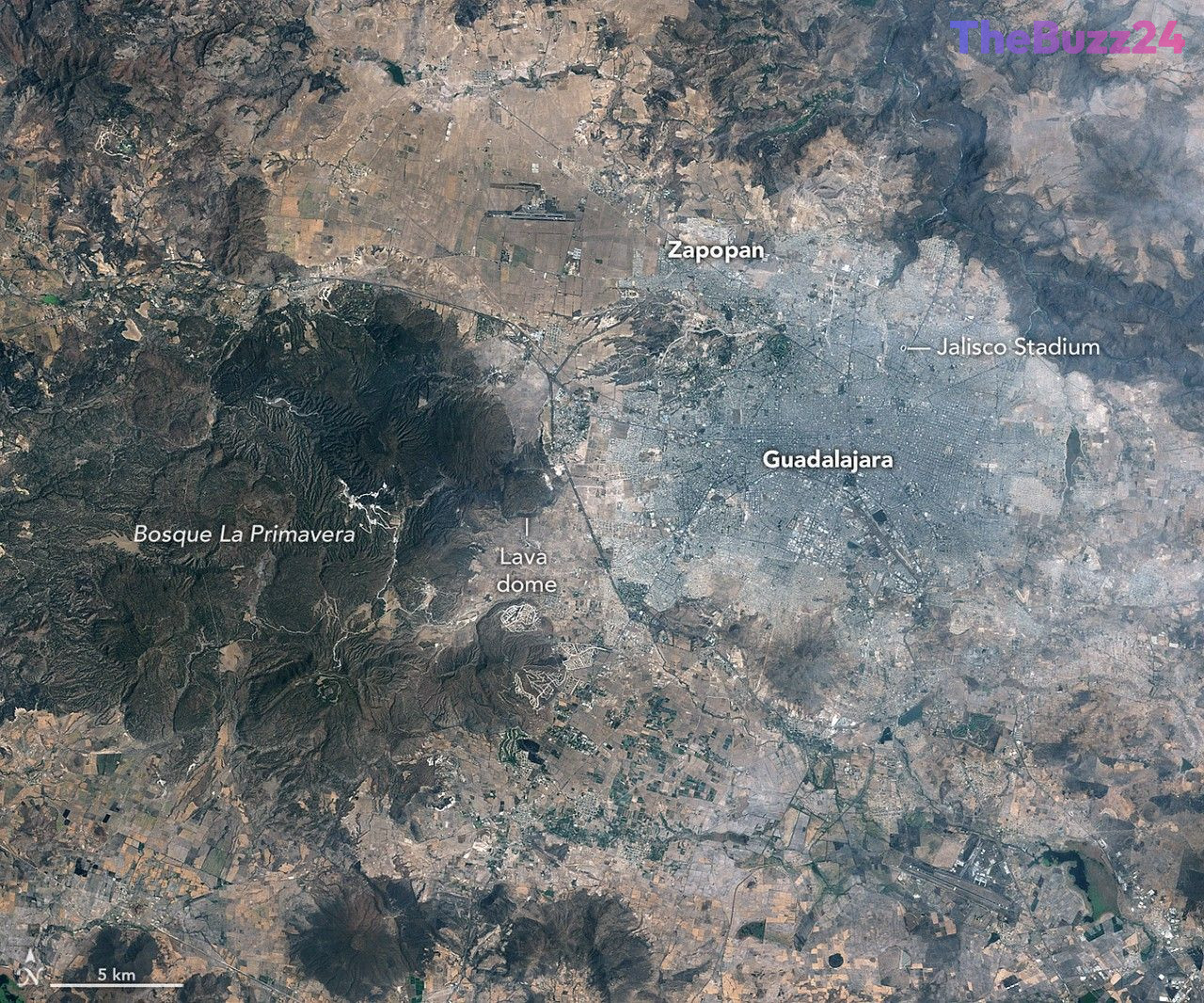
Four Decades of Transformation: Guadalajara’s Urban Evolution and World Cup Legacy
Guadalajara, Mexico, has undergone a profound physical and demographic transformation over the last forty years, a shift clearly visible through satellite imagery comparing the city’s landscape in 1986 to the present day. As the city once again takes center stage as a host for the 2026 FIFA World Cup, the contrast between its past and present infrastructure highlights the rapid expansion of the metropolitan area, which has grown from approximately 2.7 million residents to over 5.5 million.
Central to this growth is the municipality of Zapopan, now recognized as a burgeoning technology hub often referred to as ‘Mexico’s Silicon Valley.’ Satellite data reveals that areas which were primarily farmland in 1986 are now home to industrial centers like the Guadalajara Technology Park and the iconic Estadio Akron. Opened in 2010, the stadium serves as a modern architectural marvel, designed to mimic the volcanic terrain of the nearby Sierra la Primavera, a protected biosphere reserve that sits atop a complex geological history of lava domes and ancient calderas.
Beyond the urban sprawl, the spirit of the World Cup remains deeply embedded in the city’s culture. Having previously hosted matches in 1970 and 1986, Guadalajara has embraced the 2026 tournament with significant public displays, including the unveiling of a massive bronze statue of football legend Pelé. The city’s enthusiasm has even extended to the local zoo, where animals have gained attention for their playful ‘predictions’ regarding match outcomes, underscoring the festive atmosphere surrounding the international event.
Key Takeaways
- Guadalajara’s metropolitan population has more than doubled since 1986, driven by rapid industrial and technological development in Zapopan.
- Estadio Akron, a key 2026 World Cup venue, was built on land that was previously agricultural, with architecture inspired by the region's volcanic geography.
- The city maintains a strong historical connection to international football, having hosted World Cup matches in 1970, 1986, and now 2026.
Editor’s Analysis & Impact
The urban evolution of Guadalajara serves as a microcosm for the rapid industrialization of Latin American secondary cities. The transition from agricultural land to a high-tech industrial hub in Zapopan demonstrates how strategic infrastructure investment—such as the construction of major sports venues and technology parks—can catalyze regional economic growth. From a market perspective, this development signals a shift in Mexico’s economic landscape, moving beyond traditional manufacturing toward a more diversified, tech-oriented service economy. The integration of the La Primavera Biosphere Reserve into this expanding urban footprint presents a long-term challenge for sustainable development. As the city continues to attract global attention through events like the World Cup, the pressure to balance rapid population growth with environmental conservation will likely become a defining factor in the region’s future economic and social stability.
Frequently Asked Questions
Q: How has the population of Guadalajara changed since it last hosted the World Cup in 1986?
A: The population of the Guadalajara metropolitan area has grown significantly, increasing from approximately 2.7 million people in 1986 to over 5.5 million today.
Q: What is the architectural inspiration behind the Estadio Akron?
A: The stadium was designed to reflect the nearby Sierra la Primavera volcanic complex, featuring a structure that resembles the flanks of a volcano and a white roof meant to mimic a volcanic cloud.
AI Disclosure: This article is based on verified data and official reports. Our Team and AI have cross-referenced every financial detail with primary sources to ensure total accuracy.
More from this Category