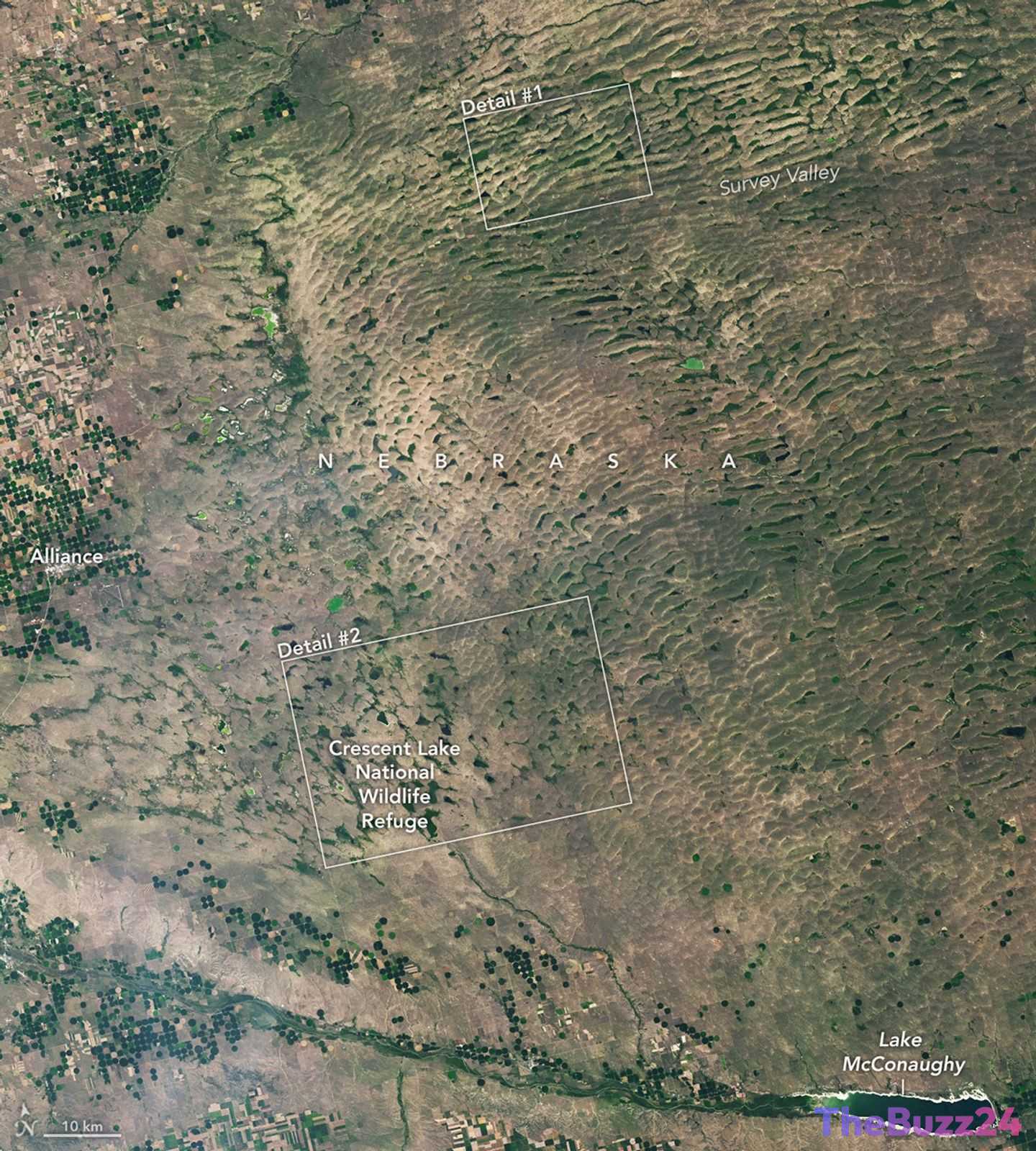
Nebraska’s Sandhills: A Vast, Grass-Covered Dune System Vital for Wildlife and Ranching
Stretching across north-central Nebraska, the Sandhills region represents the largest dune system in the Western Hemisphere, a unique landscape often overlooked compared to more famous desert dune fields. This vast area, covering approximately 20,000 square miles, is characterized by rolling hills blanketed in resilient grasslands. These grasslands not only support a significant cattle ranching industry, which makes up half of Nebraska’s rangeland and pastureland, but also serve as a crucial habitat for diverse plant and animal life, with numerous lakes and wetlands interspersed throughout the terrain.
The geological origins of the Sandhills trace back to the Pleistocene epoch, when rivers originating in the Rocky Mountains carried eroded sand and deposited it across the Great Plains. Subsequent periods of drought allowed winds to sculpt these deposits into dunes. The stabilization of these massive sand formations, some rising as high as 400 feet, was achieved around 3,500 years ago with the establishment of grassland vegetation. The dune patterns, often transverse and miles long, reflect the prevailing wind directions, with gentler northern slopes indicating dominant northerly winds and more symmetrical dunes suggesting alternating seasonal wind strengths.
Beyond its agricultural importance, the Nebraska Sandhills are a critical ecological zone. Protected areas like the Crescent Lake National Wildlife Refuge showcase the region’s vital role in supporting biodiversity. The porous, sponge-like nature of the sandy soil allows precipitation to seep down, recharging the High Plains Aquifer and sustaining the numerous lakes and wetlands. These aquatic environments are essential stopovers along the Central Flyway, providing refuge for migratory birds, including waterfowl and shorebirds. The wetlands also support a variety of other wildlife, such as turtles, and are home to rare species like the whooping crane, western prairie fringed orchid, and Topeka shiner, highlighting the ecological significance of this expansive grassland dune system.
Key Takeaways
- The Nebraska Sandhills form the largest dune system in the Western Hemisphere, stabilized by grasslands that cover approximately 20,000 square miles.
- This region is vital for both cattle ranching, utilizing half of Nebraska's rangeland, and for supporting diverse wildlife through its numerous lakes and wetlands.
- The Sandhills' unique geology and hydrology play a crucial role in recharging groundwater and serve as a critical habitat for migratory birds and rare species.
Editor’s Analysis & Impact
The Nebraska Sandhills exemplify a unique intersection of ecological significance and economic utility. Its vast grassland-covered dunes, a product of ancient geological processes and wind erosion, now support a substantial portion of Nebraska’s cattle industry. The region’s porous sandy soil acts as a natural aquifer recharge system, sustaining vital wetlands that serve as critical habitats for diverse flora and fauna, including migratory birds and endangered species. This delicate balance highlights the importance of sustainable land management practices in preserving both the economic viability and the rich biodiversity of the Sandhills, offering a model for how natural landscapes can support human activities while maintaining ecological integrity.
Frequently Asked Questions
Q: What makes the Nebraska Sandhills unique?
A: The Nebraska Sandhills are unique because they form the largest dune system in the Western Hemisphere, characterized by rolling, grass-covered hills rather than barren sand. This landscape originated from ancient river deposits and wind erosion, later stabilized by grassland vegetation.
Q: What is the ecological importance of the Nebraska Sandhills?
A: The Sandhills are ecologically vital due to their numerous lakes and wetlands, which support diverse plant and animal life, including migratory birds along the Central Flyway and rare species. The sandy soil also plays a crucial role in recharging the High Plains Aquifer.
Q: How is the Nebraska Sandhills region utilized by humans?
A: The region is extensively used for cattle ranching, with its grasslands providing pasture for livestock. Some areas are also managed as protected public lands, such as the Crescent Lake National Wildlife Refuge, for conservation purposes.
AI Disclosure: This article is based on verified data and official reports. Our Team and AI have cross-referenced every financial detail with primary sources to ensure total accuracy.
More from this Category