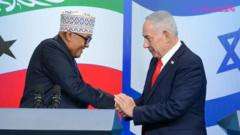
Somaliland Establishes Diplomatic Mission in Jerusalem Following Landmark Recognition
Somaliland has officially inaugurated an embassy in Jerusalem, marking a significant milestone in its burgeoning diplomatic relationship with Israel. The mission, located in a West Jerusalem technology park, was opened during an official state visit by Somaliland President Abdirahman Mohamed Abdullahi. This development follows Israel’s historic decision last December to become the first nation to formally recognize Somaliland’s independence.
During the proceedings, Israeli Prime Minister Benjamin Netanyahu lauded the decision to site the embassy in Jerusalem, drawing parallels between the two nations’ quests for sovereignty and international recognition. The move has drawn sharp criticism from the Somali government, which maintains that Somaliland remains an integral part of its territory and views the diplomatic engagement as a violation of its national sovereignty. The Palestinian Authority also issued a formal condemnation, labeling the embassy opening a breach of international law.
Despite the regional friction, both Somaliland and Israel are actively deepening their bilateral ties. President Abdullahi highlighted the potential for economic cooperation, specifically citing Somaliland’s strategic Red Sea coastline and its untapped natural resources, including oil and rare earth minerals. For Israel, the partnership represents a strategic foothold in the Horn of Africa, while for Somaliland, the embassy serves as a tangible symbol of its long-standing pursuit of international legitimacy since it began self-governing in 1991.
Key Takeaways
- Somaliland has opened an embassy in Jerusalem, cementing its diplomatic ties with Israel following its recognition as an independent state.
- The move has sparked significant controversy, with Somalia condemning the action as a violation of its sovereignty and the Palestinian Authority labeling it a breach of international law.
- The partnership focuses on strategic cooperation, with Somaliland offering access to natural resources and a key location near the Red Sea in exchange for diplomatic support.
Editor’s Analysis & Impact
The establishment of a Somaliland embassy in Jerusalem is a high-stakes geopolitical maneuver that challenges the status quo in the Horn of Africa. By recognizing Somaliland, Israel is effectively bypassing traditional diplomatic consensus, potentially signaling a shift in how it approaches non-state actors that offer strategic value. For Somaliland, this partnership is a critical step toward breaking its decades-long diplomatic isolation, though it risks further alienating Mogadishu and complicating regional stability. The economic implications are significant, as the Red Sea corridor remains one of the world’s most vital maritime chokepoints. Moving forward, this alliance will likely test the resolve of the African Union and other international bodies, as they must balance the principles of territorial integrity against the reality of Somaliland’s de facto independence and its growing list of international partners.
Frequently Asked Questions
Q: Why is the opening of this embassy controversial?
A: The embassy is controversial because it is located in Jerusalem, a city with contested status, and because it involves the recognition of Somaliland, which Somalia considers a breakaway region of its own territory.
Q: How long has Somaliland been self-governing?
A: Somaliland has been self-governing since 1991, following the collapse of the central government in Mogadishu, and has since maintained its own currency, security forces, and electoral system.
AI Disclosure: This article is based on verified data and official reports. Our Team and AI have cross-referenced every financial detail with primary sources to ensure total accuracy.
More from this Category