The Alaskan Training Ground That Prepared Astronauts for the Moon
Long before the first human set foot on the lunar surface, NASA astronauts underwent rigorous field training in some of Earth’s most desolate and geologically unique environments. During the summers of 1965 and 1966, these pioneers traveled to Alaska’s Katmai National Park to participate in a series of simulations known as the ‘Moon game.’ These exercises were designed to mimic the challenges of lunar exploration, forcing astronauts to navigate unfamiliar terrain, collect representative geologic samples, and practice clear communication with scientists back at base.
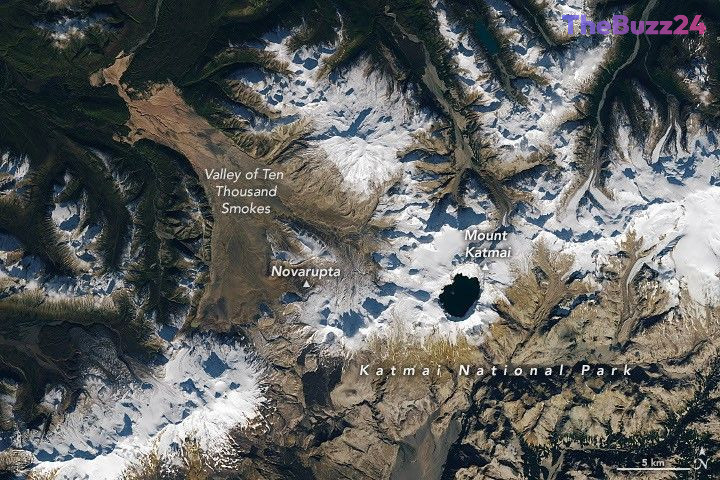
The primary site for this training was the Valley of Ten Thousand Smokes, a landscape shaped by the massive 1912 eruption of Novarupta. As the largest volcanic event of the 20th century, the eruption deposited a thick layer of ash and debris that created a stark, cratered environment reminiscent of the Moon. For the Apollo crews, the valley provided a pristine laboratory to study volcanic landforms, fumaroles, and deep gorges, allowing them to hone the observational skills necessary for their eventual missions to the lunar surface.
Decades later, the legacy of the ‘Moon game’ continues to influence modern space exploration. Researchers from the Goddard Instrument Field Team (GIFT) returned to the valley as recently as 2024 to study its icy volcanic features. By analyzing these deposits, scientists are gaining critical insights into the geology of Mars and the Moon, particularly regarding how ice and ash interact in extreme environments. The Valley of Ten Thousand Smokes remains a vital bridge between Earth-based geology and the ongoing quest to understand our celestial neighbors.
Key Takeaways
- Apollo astronauts used Alaska's Valley of Ten Thousand Smokes as a training ground to simulate lunar surface exploration in the 1960s.
- The valley was formed by the 1912 Novarupta eruption, which left behind a unique, ash-covered landscape that mimics extraterrestrial terrain.
- Modern researchers continue to use the site to study volcanic and glacial processes that help interpret geological data from Mars and the Moon.
Editor’s Analysis & Impact
The enduring relevance of the Valley of Ten Thousand Smokes highlights the critical importance of terrestrial analog sites in planetary science. By utilizing Earth’s own extreme environments, space agencies can refine instrumentation and human operational protocols without the prohibitive costs of immediate off-world testing. This approach is increasingly vital as the focus of space exploration shifts toward long-term habitation and complex sample collection on Mars and the Moon. The integration of historical Apollo-era training methods with modern remote sensing and field research demonstrates a cyclical advancement in science, where past experiences directly inform future mission success. As we prepare for deeper exploration, these ‘Earth-bound’ laboratories will remain essential for mitigating risks and enhancing our understanding of planetary evolution.
Frequently Asked Questions
Q: What was the 'Moon game'?
A: The 'Moon game' was a series of field training exercises conducted by Apollo astronauts in the 1960s to simulate the experience of exploring the lunar surface, focusing on geology and communication skills.
Q: Why is the Valley of Ten Thousand Smokes significant for space research?
A: The valley features volcanic deposits and icy landscapes that closely resemble the geological conditions found on the Moon and Mars, providing a unique, accessible environment for scientists to study planetary processes.
AI Disclosure: This article is based on verified data and official reports. Our Team and AI have cross-referenced every financial detail with primary sources to ensure total accuracy.
More from this Category