The Evolving Landscape of Tokenized Stocks: A Deep Dive into Digital Equity Models
The tokenization of equities is rapidly gaining momentum, transforming how investors can access and trade traditional company shares on blockchain networks. This innovative approach is attracting significant institutional interest, with major players like the Depository Trust & Clearing Corporation (DTCC) launching tokenized securities pilots, the New York Stock Exchange (NYSE) developing a dedicated platform, and Coinbase introducing 1:1 backed tokenized U.S. equities.
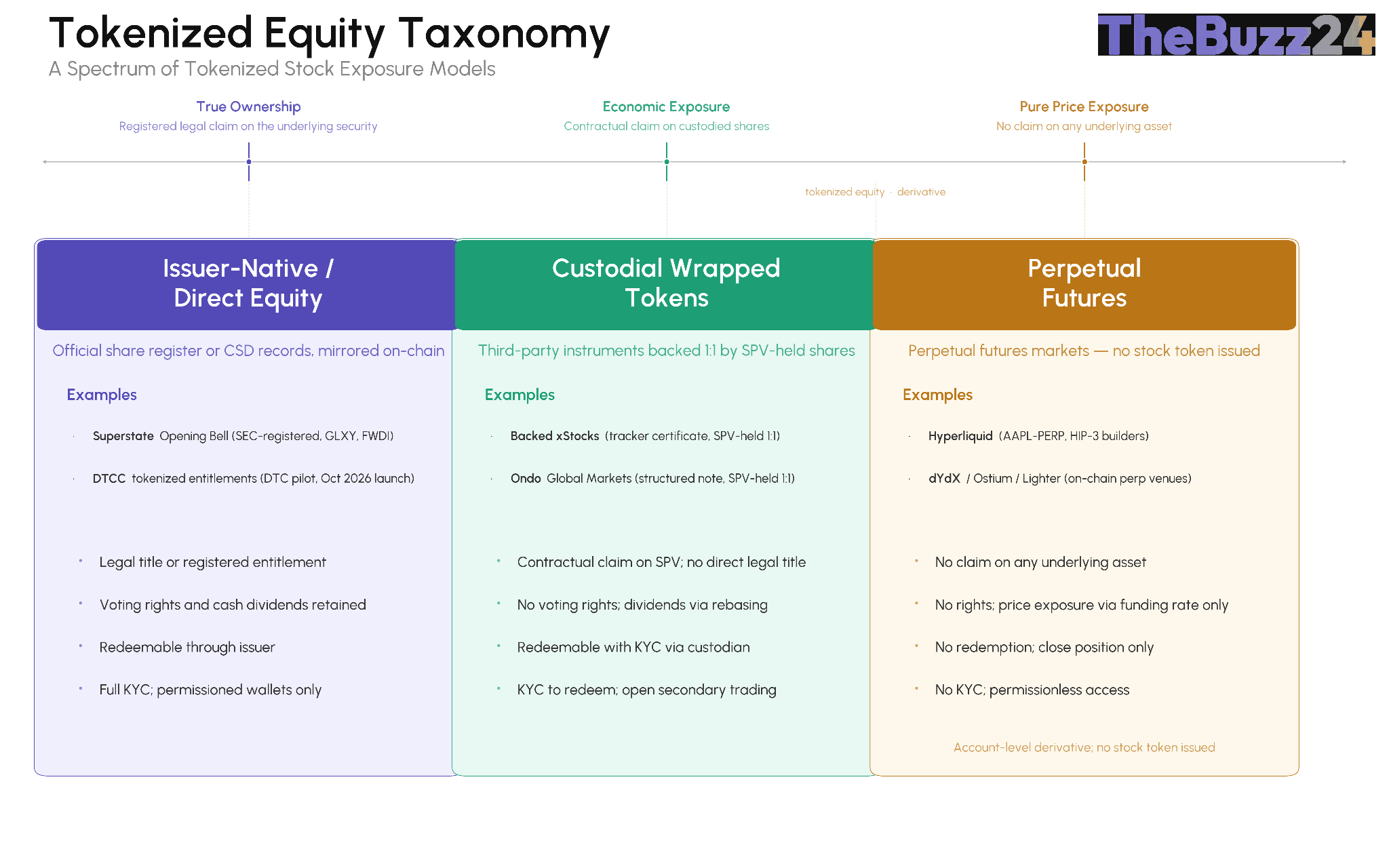
However, not all tokenized stock exposure is created equal. The market currently presents a spectrum of models, each with distinct legal structures, shareholder rights, and risk profiles. Broadly, these can be categorized into three main types: issuer-native equity, custodial wrapped equity, and derivative exposure. Moving along this spectrum involves a trade-off: while some models offer direct ownership and shareholder rights, others prioritize greater accessibility, capital efficiency, and simplicity of execution, often at the expense of direct claims on the underlying asset. These fundamental structural differences directly influence how these markets behave, leading to variations in pricing, liquidity, and trading patterns.
To illustrate these differences, consider Nvidia (NVDA), a prominent example whose shares are available on-chain through various forms. Backed Assets offers NVDAx, a custodial wrapped token structured as a ‘tracker certificate’ under Liechtenstein regulation. While 1:1 backed by underlying Nvidia shares, holders own a claim on Backed Assets rather than direct Nvidia shares, foregoing voting rights but gaining economic exposure and DeFi composability. Similarly, Ondo provides NVDAon, a total-return note issued through a British Virgin Islands SPV, also 1:1 backed. Despite both being backed by Nvidia, NVDAx and NVDAon often exhibit price discrepancies due to their distinct legal entities, custodial arrangements, and separate liquidity pools, creating arbitrage opportunities.
In contrast, Nvidia perpetual futures represent pure derivative exposure. These contracts are cash or stablecoin settled and do not require custody of the underlying stock, making them significantly faster and cheaper to establish liquid markets. Consequently, perpetual futures boast substantially higher trading volumes—often more than 40 times that of tokenized spot markets—making them a preferred choice for traders seeking short-term price exposure without navigating complex issuer structures or redemption mechanics. While tokenized spot markets like NVDAx and NVDAon facilitate continuous on-chain price discovery and composability with other protocols, the diversity of models underscores the importance for market participants to understand the specific claim and dynamics of each instrument.
Key Takeaways
- Tokenized stocks exist across a spectrum: issuer-native, custodial wrapped, and derivative exposure, each offering different rights and accessibility.
- These structural differences directly impact market behavior, leading to varied pricing, liquidity, and trading patterns, as seen with Nvidia's tokenized forms.
- While perpetual futures offer high liquidity for price exposure, true tokenized spot markets provide continuous on-chain price discovery and DeFi composability, albeit with lower volume currently.
Editor’s Analysis & Impact
The burgeoning tokenized stock market signifies a pivotal shift in financial infrastructure, bridging traditional equities with decentralized finance. The increasing involvement of institutions like DTCC, NYSE, and Coinbase indicates a growing mainstream acceptance and potential for significant market expansion. This diversification of tokenization models caters to a broader range of investor needs, from those seeking direct economic exposure to those prioritizing capital efficiency and DeFi integration. The future outlook suggests continued innovation in legal and technical structures, with regulatory clarity from bodies like the SEC being paramount for fostering trust and widespread adoption. This evolution could democratize access to global equities, enhance capital efficiency through 24/7 trading, and introduce new arbitrage opportunities, fundamentally reshaping how assets are owned, traded, and leveraged in the digital age.
Frequently Asked Questions
Q: How do tokenized stocks differ from traditional stock ownership?
A: Tokenized stocks can offer continuous on-chain price discovery, greater accessibility, and composability within DeFi protocols. However, depending on the specific model, they may not confer direct shareholder rights or legal ownership of the underlying shares, unlike traditional equity held through a brokerage.
Q: Why do different tokenized versions of the same stock, like Nvidia, show price discrepancies?
A: Price discrepancies arise because different tokenized versions are issued by distinct legal entities, held under varying custodial arrangements, and trade in separate liquidity pools. These structural differences prevent perfect price alignment and create opportunities for arbitrage.
AI Disclosure: This article is based on verified data and official reports. Our Team and AI have cross-referenced every financial detail with primary sources to ensure total accuracy.
More from this Category