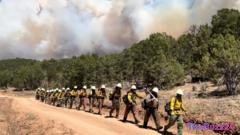
Tragedy Strikes: Three Firefighters Perish Battling Massive Western US Wildfires
A profound tragedy has unfolded on the Colorado-Utah border, where three federal firefighters lost their lives and two others sustained injuries while confronting immense wildfires. The incident occurred on Saturday, as the crew, part of a federal response team assigned to the Knowles and Gore fires, was suddenly overwhelmed by advancing flames in what officials described as a “burnover incident.” The two injured firefighters were hospitalized with burns.
The US Wildland Fire Service, established earlier this year to streamline firefighting efforts across public lands, expressed deep sorrow, stating their immediate focus is on supporting the families, friends, and fellow crewmates of the fallen. The Knowles and Gore fires have since merged with other blazes, forming the Snyder Mesa fire, which had consumed approximately 28,000 acres of land by Saturday. The US Wildland Fire Service and the US Forest Service, the agencies to which the firefighters belonged, affirmed their unwavering support for the loved ones left behind, honoring the bravery and sacrifice of those lost.
In response to the escalating crisis, Colorado Governor Jared Polis declared a state of emergency for Colorado, authorizing the deployment of the state’s National Guard. Governor Polis conveyed his devastation over the loss of the heroic firefighters, extending condolences to their families and crew members. Across the border in Utah, Governor Spencer Cox issued an emergency order banning fireworks ahead of the July 4th weekend, as the Cottonwood Fire, the largest of eleven active blazes, had scorched over 93,000 acres and remained 0% contained by Sunday.
The fires, predominantly affecting sparsely populated areas but threatening some resorts and cabins, underscore a growing environmental challenge in the Western US. Scientists indicate that warmer winters, high winds, and the overarching effects of climate change are creating conditions conducive to more frequent and intense wildfires. These combined factors are predicted to exacerbate the severity of future fire seasons, highlighting an urgent need for enhanced mitigation and response strategies.
Key Takeaways
- Three federal firefighters died and two were injured in a "burnover incident" while battling massive wildfires on the Colorado-Utah border.
- The fires, including Colorado's 28,000-acre Snyder Mesa fire and Utah's 93,000-acre Cottonwood Fire, have prompted emergency declarations from both state governors.
- Scientists attribute the increasing frequency and intensity of Western US wildfires to warmer winters, high winds, and the exacerbating effects of climate change.
Editor’s Analysis & Impact
This tragic event underscores the escalating dangers faced by emergency personnel amidst increasingly severe wildfire seasons. The loss of life will likely intensify calls for greater investment in advanced firefighting technologies, improved safety protocols, and expanded resources for federal and state agencies like the US Wildland Fire Service. Economically, the ongoing fires could impact local tourism, agriculture, and insurance markets in affected regions. Looking ahead, the frequency and intensity of such incidents are projected to rise due to climate change, necessitating a comprehensive national strategy for wildfire prevention, land management, and climate resilience. This incident serves as a stark reminder of the human cost of environmental shifts and the critical need for proactive measures.
Frequently Asked Questions
Q: What is a "burnover incident"?
A: A "burnover incident" occurs when a wildfire spreads so rapidly and unexpectedly that it overtakes firefighting personnel or equipment, cutting off escape routes and forcing firefighters to deploy emergency shelters as a last resort.
Q: How large are the wildfires mentioned in the article?
A: The Snyder Mesa fire, formed by the merger of the Knowles and Gore fires in Colorado, had burned approximately 28,000 acres. In Utah, the Cottonwood Fire covered over 93,000 acres and was 0% contained at the time of reporting.
Q: What factors are contributing to the increase in wildfires in the Western US?
A: Scientists indicate that warmer winters, high winds, and the broader impacts of climate change, which create conditions like increased heat and drought, are making wildfires more frequent and intense across the Western United States.
AI Disclosure: This article is based on verified data and official reports. Our Team and AI have cross-referenced every financial detail with primary sources to ensure total accuracy.
More from this Category