The ‘Durian Tsunami’: How a Massive Supply Glut Crashed Prices of Asia’s Most Prized Fruit
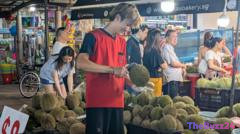
A massive oversupply of durians has triggered unprecedented scenes across Singapore and Malaysia, with long lines forming at fruit stalls offering deep discounts and even free giveaways. In Singapore’s Tampines township, crowds have been lining up daily at the Durian Ninja stall, where the owner has been distributing hundreds of kilograms of free durians to eager customers. This sudden abundance is fueled by an exceptional harvest across the border in Malaysia, which typically produces around 550,000 tonnes of the pungent fruit annually. However, the current season’s massive yield has caused market prices to plummet, turning a luxury delicacy into an incredibly cheap commodity.
Industry experts trace this surplus back to a decade-long agricultural boom. Lured by skyrocketing demand from China, many Malaysian landowners cleared rubber trees and oil palm plantations to plant premium durian varieties, most notably the highly coveted Musang King. Ten years later, these trees have matured simultaneously, resulting in a massive influx of fruit that has overwhelmed local and export markets. Wholesale prices for premium varieties have crashed by up to fifty percent compared to previous seasons, leaving retail stalls overflowing with stock they are struggling to clear.
While consumers are enjoying the rare opportunity to feast on high-quality fruit at a fraction of the usual cost, the situation has put immense financial pressure on local farmers. Growers like Lu Yuee Thing and Han Sing Keng report that the price drop, compounded by unpredictable weather patterns that damaged earlier harvests, has severely impacted their profit margins. Furthermore, the market is being flooded with lower-grade durians that do not meet strict export standards, dragging down the average price of even premium labels. In response, Malaysia’s Federal Agricultural Marketing Authority has stepped in with emergency interventions, purchasing fruit at a guaranteed base price to protect smallholders, while industry associations look to strengthen trade ties with Chinese importers to stabilize future demand.
Key Takeaways
- A massive oversupply of durians in Malaysia has triggered a 'durian tsunami,' causing prices to plummet and prompting vendors in Singapore and Malaysia to offer steep discounts or free giveaways.
- The glut is the result of a decade-long farming boom where agriculturalists transitioned from rubber and palm oil to high-value durian varieties like Musang King to target the Chinese market.
- Government agencies and industry associations are intervening with price floors and international marketing campaigns to stabilize the market and protect local farmers from financial ruin.
Editor’s Analysis & Impact
The current durian glut highlights the inherent risks of agricultural monoculture and rapid, speculative shifts in farming. Driven by lucrative export prospects to China, the massive transition of Malaysian farmland to durian cultivation has created a classic supply-side shock as trees planted a decade ago reach maturity simultaneously. While this ‘durian tsunami’ is a short-term boon for consumers in Southeast Asia, it threatens the financial viability of smallholder farmers who are already battling unpredictable weather patterns driven by climate change. Moving forward, the industry must pivot from volume-driven competition to strict quality control and geographical indications, similar to the wine industry. Establishing robust cold-chain logistics and diversifying export markets beyond China will be critical to stabilizing prices and ensuring the long-term economic sustainability of premium varieties like Musang King and Black Thorn.
Frequently Asked Questions
Q: Why are durian prices so low right now?
A: Prices have plummeted due to a massive oversupply, or 'durian tsunami,' in Malaysia. This was caused by a decade-long planting boom reaching maturity all at once, combined with local market saturation of non-export-grade fruit.
Q: What is the 'Hermès of durians' and how is it affected?
A: The Musang King is a highly prized, premium durian variety known for its rich, buttery texture. Despite its luxury status, its wholesale price has slashed by nearly half due to the current market glut.
Q: How are authorities helping struggling farmers?
A: Malaysia's Federal Agricultural Marketing Authority has implemented emergency interventions, including buying durians from smallholders at a guaranteed base price to protect their incomes.
AI Disclosure: This article is based on verified data and official reports. Our Team and AI have cross-referenced every financial detail with primary sources to ensure total accuracy.
More from this Category