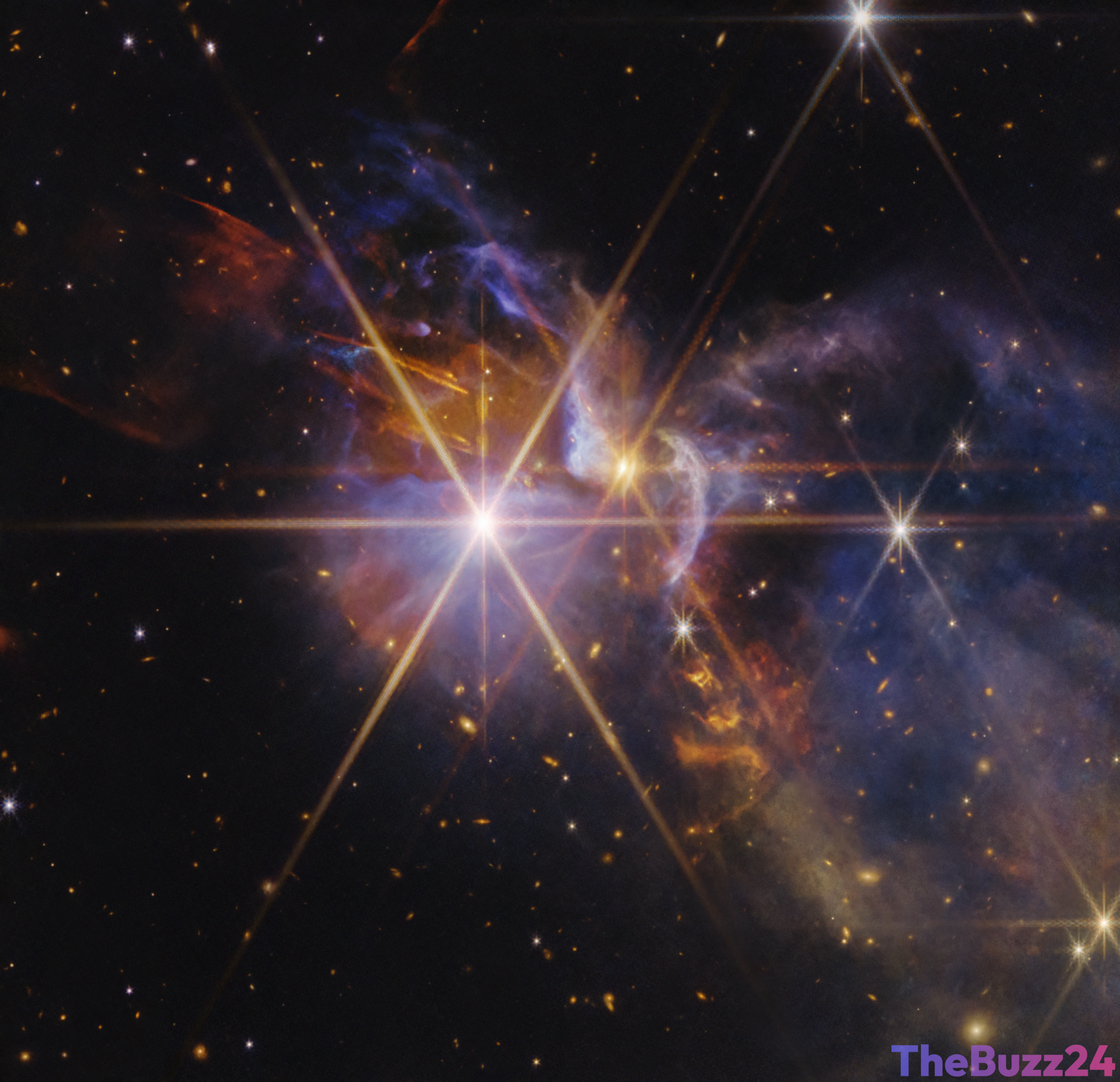
Cosmic Nursery Revealed: Webb Telescope Pierces Dust to Capture Violent Birth of Baby Stars
The James Webb Space Telescope has delivered a stunning, highly detailed look into the FS Tau star system, revealing the chaotic and beautiful process of star birth. Utilizing its advanced infrared imaging capabilities, the space observatory bypassed thick cosmic dust clouds that previously obscured the region, exposing a vibrant nursery of protostars—infant stars still gathering mass from their surroundings. Located in a relatively nearby region of space, the FS Tau system offers astronomers an unprecedented window into the earliest stages of stellar evolution.
At the heart of the newly released image are two distinct stellar objects: FS Tau A, a binary protostar system with roughly half the mass of our Sun, and FS Tau B, a single protostar partially hidden behind a dark, tilted accretion disk of gas and dust. These baby stars are estimated to be a mere 1 to 3 million years old, making them incredibly young compared to our 4.6-billion-year-old Sun. Because these are low-mass stars, they emit less disruptive radiation and weaker stellar winds, allowing scientists to study the mechanics of early stellar development in a relatively undisturbed environment.
Despite their youth, these protostars actively shape their cosmic neighborhood. FS Tau B is venting massive, superheated jets of material, visible as bright orange and red streams. These outflows occur as the star feeds on its surrounding accretion disk, ejecting excess matter along its magnetic field lines. Interestingly, newly discovered gaps within these outflows suggest that protostars do not feed continuously. Instead, they appear to grow in violent, episodic bursts separated by periods of relative dormancy.
This breakthrough observation highlights the technological leap between generations of space telescopes. While the Hubble Space Telescope’s visible-light instruments previously showed the FS Tau region as a dark, impenetrable cloud of dust, Webb’s infrared sensors easily cut through the haze. Beyond the immediate stellar nursery, the image is filled with thousands of distant background galaxies. The varying colors of these galaxies—ranging from deep red to bright yellow—provide researchers with crucial data regarding the thickness and distribution of cosmic dust throughout the foreground system.
Key Takeaways
- The James Webb Space Telescope bypassed thick cosmic dust to capture high-resolution infrared images of the young FS Tau star system.
- The system features infant protostars FS Tau A and FS Tau B, which are only 1 to 3 million years old and offer a clean environment for studying low-mass star evolution.
- Newly observed gaps in the stellar outflows suggest that young stars gather mass in episodic, violent bursts rather than a continuous stream.
Editor’s Analysis & Impact
The latest imagery of the FS Tau system from the James Webb Space Telescope represents a significant milestone in observational astrophysics. By piercing through the dense dust envelopes that shroud infant stars, the telescope is transforming our understanding of star formation. The discovery of episodic accretion—evidenced by the gaps in FS Tau B’s outflows—challenges older, continuous-growth models of stellar development. This suggests that the early lives of stars, including our own Sun billions of years ago, are far more erratic and dynamic than previously assumed. Furthermore, the ability to study low-mass protostars in such high resolution allows researchers to refine chemical and physical models of planet-forming disks. As observations continue to probe these cosmic nurseries, the data gathered will likely reshape foundational theories regarding how solar systems form and evolve across the universe.
Frequently Asked Questions
Q: What is a protostar?
A: A protostar is an early stage in the formation of a star, consisting of a dense mass of gas and dust that has collapsed from a giant molecular cloud but has not yet initiated nuclear fusion in its core.
Q: Why is the FS Tau system so important for astronomers?
A: Because the stars in the FS Tau system are low-mass and relatively young (1 to 3 million years old), they do not disrupt their surroundings as violently as high-mass stars. This provides a clearer, less chaotic environment for scientists to study the fundamental processes of stellar birth.
Q: How does Webb's view of FS Tau differ from Hubble's?
A: Hubble primarily observes in visible light, which is easily blocked and scattered by thick cosmic dust, making the star-forming region look like a dark cloud. Webb uses infrared light, which has longer wavelengths that can pass through the dust, revealing the hidden stars and structures inside.
AI Disclosure: This article is based on verified data and official reports. Our Team and AI have cross-referenced every financial detail with primary sources to ensure total accuracy.
More from this Category