Geopolitical Storm Hits Crypto: Stellar (XLM) Faces Downward Pressure Amid Middle East Tensions
Stellar (XLM), a prominent cryptocurrency, is currently experiencing significant downward pressure as renewed geopolitical tensions between the United States and Iran fuel a broader risk-off sentiment across global financial markets. Investors are increasingly withdrawing from speculative assets, pushing XLM to hover near critical support levels.
The escalation in the Middle East has heightened uncertainty, prompting a shift towards safer investments. Recent developments include confirmation from the U.S. Central Command (CENTCOM) of additional strikes on Iranian military targets, alongside the continued presence of over 50,000 U.S. troops in the region. Concurrently, Iranian state-affiliated media has reported strikes within southern Iran, while the Islamic Revolutionary Guard Corps (IRGC) claimed to have disabled two supertankers in the Strait of Hormuz, citing navigation violations. The IRGC has also issued warnings that ongoing military activities could impede the reopening of this vital waterway, potentially disrupting global energy supplies. This heightened instability has already driven West Texas Intermediate (WTI) crude oil prices above $80 per barrel, reinforcing the cautious mood among investors.
Market data from the futures sector further underscores this growing investor caution. Open interest for XLM has reportedly fallen to approximately $182.21 million, continuing a decline from earlier highs. This reduction, coupled with falling prices, typically indicates that traders are closing existing positions rather than initiating new ones, reflecting diminished market participation and confidence. Additionally, XLM’s funding rates have turned negative, currently standing at -0.0021%. Negative funding rates signify that short sellers are paying long-position holders, highlighting an increased demand for bearish positions in the perpetual futures market.
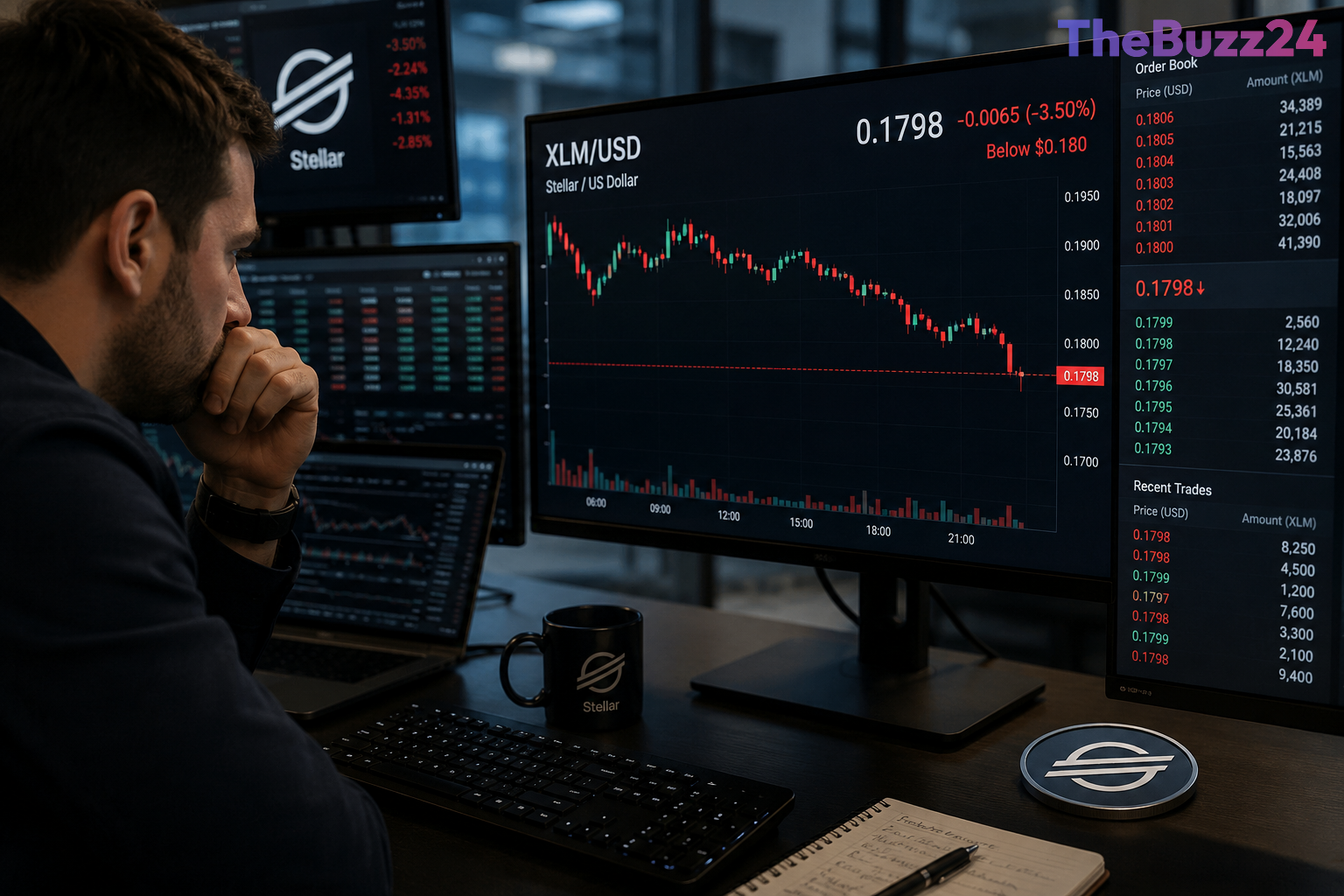
From a technical perspective, Stellar (XLM) continues to struggle, trading around $0.179, below its key moving averages. Immediate resistance levels are observed at the 50-day Exponential Moving Average (EMA) at $0.186, the 100-day EMA at $0.190, and the 200-day EMA at $0.196. The Relative Strength Index (RSI) remains subdued near 41, while the Moving Average Convergence Divergence (MACD) continues its trend in negative territory, suggesting that buying momentum has yet to re-emerge. The first major support level for XLM is located near $0.177, followed by the 78.6% Fibonacci retracement level around $0.173. Should bearish pressure intensify, XLM could potentially test a broader support zone closer to $0.142. Conversely, a resurgence of buyer interest could see the cryptocurrency challenge resistance levels at $0.186, $0.190, and $0.196, with further upside targets at $0.200, $0.218, $0.237, and $0.260.
Key Takeaways
- Stellar (XLM) is experiencing significant price pressure due to escalating geopolitical tensions between the U.S. and Iran, leading to a broader risk-off market environment.
- Futures market indicators, including declining open interest and negative funding rates, suggest a strong bearish sentiment and reduced confidence among XLM traders.
- XLM is currently testing critical support levels, with technical analysis indicating potential for further decline if bearish momentum persists, while key resistance levels await a buyer resurgence.
Editor’s Analysis & Impact
The current geopolitical instability between the U.S. and Iran is a stark reminder of how global events can significantly impact even decentralized assets like cryptocurrencies. The ‘risk-off’ sentiment observed in traditional markets, evidenced by rising oil prices, directly translates into selling pressure for speculative assets such as XLM. This event underscores the increasing integration of the crypto market into the broader global financial ecosystem, making it susceptible to macro-economic and political shocks.
Looking ahead, the trajectory of XLM and other altcoins will largely depend on the de-escalation or further intensification of these tensions. A prolonged period of uncertainty could lead to sustained downward pressure, potentially pushing XLM to lower support zones. Conversely, any signs of diplomatic resolution could trigger a rapid rebound as investor confidence returns. This situation highlights the importance for crypto investors to monitor geopolitical developments closely, as they can be as influential as on-chain metrics in shaping market movements.
Frequently Asked Questions
Q: Why are geopolitical tensions affecting Stellar (XLM)?
A: Geopolitical tensions, particularly between major global powers, often lead investors to reduce their exposure to riskier assets like cryptocurrencies and move towards safer investments. This 'risk-off' sentiment drives down prices for assets like XLM as capital flows out of speculative markets.
Q: What do 'open interest' and 'funding rates' indicate for XLM?
A: Open interest refers to the total number of outstanding derivative contracts (like futures) that have not been settled. A decline alongside falling prices suggests traders are closing positions. Funding rates are periodic payments between long and short traders in perpetual futures markets; negative rates indicate that short sellers are paying long holders, signaling a bearish market sentiment and increased demand for short positions.
Q: What are the key price levels to watch for Stellar (XLM)?
A: XLM is currently near critical support around $0.177, with further support at the 78.6% Fibonacci retracement level around $0.173, and potentially a broader support zone near $0.142 if bearish pressure intensifies. Resistance levels are identified at $0.186 (50-day EMA), $0.190 (100-day EMA), and $0.196 (200-day EMA), representing potential barriers for a price recovery.
AI Disclosure: This article is based on verified data and official reports. Our Team and AI have cross-referenced every financial detail with primary sources to ensure total accuracy.
More from this Category