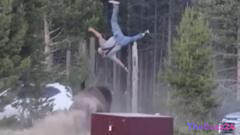
Close Encounter Turns Violent: Yellowstone Bison Flips Grandfather in Dramatic Charge
A dramatic wildlife encounter at Yellowstone National Park has left a 65-year-old grandfather injured after a massive bull bison charged and threw him into the air. The incident, which occurred near the Bridge Bay Campground just before sunset, was captured on video. Carl Isom-McDaniel and his young grandson had stopped to photograph the estimated 2,000-pound (900 kg) animal while it was resting in the grass. The situation quickly escalated when the bison became agitated, stood up, and pursued the pair.
Despite attempting to escape through a nearby cluster of trees, Isom-McDaniel was overtaken by the animal. The bison struck him with its horn, tossing him into the air before he landed heavily on his side. Bystanders reported that while the victim suffered significant pain, particularly to his leg, he remained conscious and in stable spirits prior to being transported to a local hospital. The National Park Service has long warned that despite their seemingly docile demeanor, bison are responsible for more injuries to Yellowstone visitors than any other animal.
The timing of the incident coincides with the park’s peak summer season, which sees nearly 60 percent of its annual visitors during June, July, and August. Crucially, July marks the beginning of the bison mating season, a period characterized by heightened testosterone levels in bulls, making their behavior highly unpredictable. Wildlife experts emphasize that visitors must maintain a strict minimum distance of 25 yards (23 meters) from these animals at all times and should never approach them for photographs. Bison can run up to three times faster than humans, making evasion nearly impossible once a charge begins.
Key Takeaways
- A 65-year-old man was hospitalized after being charged and tossed into the air by a 2,000-pound bison at Yellowstone National Park.
- The incident occurred during the peak summer tourism and bison mating season, when bull bison are highly unpredictable due to elevated testosterone levels.
- National Park Service guidelines mandate that visitors maintain a minimum safety distance of 25 yards (23 meters) from bison at all times.
Editor’s Analysis & Impact
This incident highlights a growing challenge for national parks worldwide: balancing high-volume tourism with wildlife preservation and visitor safety. As social media continues to drive the desire for close-up wildlife photography, tourists frequently ignore safety boundaries, leading to dangerous encounters. The economic impact of these incidents is felt through increased emergency response costs and potential liability debates, though park services are heavily protected by federal immunity laws. Moving forward, park authorities may need to implement stricter enforcement of distance rules, potentially utilizing digital geofencing or increased fines to deter risky behavior. For the travel and tourism industry, this serves as a stark reminder of the need for proactive visitor education, especially during peak migration and mating seasons when animal behavior is inherently volatile.
Frequently Asked Questions
Q: What is the safe distance to maintain from a bison in Yellowstone?
A: Visitors are required to stay at least 25 yards (23 meters) away from bison and elk, and at least 100 yards (91 meters) away from bears and wolves.
Q: Why are bison particularly dangerous during the summer months?
A: July and August coincide with the bison mating season, or rut. During this time, bull bison have elevated testosterone levels, making them much more aggressive, territorial, and unpredictable.
Q: How fast can a bison run compared to a human?
A: Bison can run at speeds of up to 35 miles per hour (56 km/h), which is approximately three times faster than the average human running speed.
AI Disclosure: This article is based on verified data and official reports. Our Team and AI have cross-referenced every financial detail with primary sources to ensure total accuracy.
More from this Category