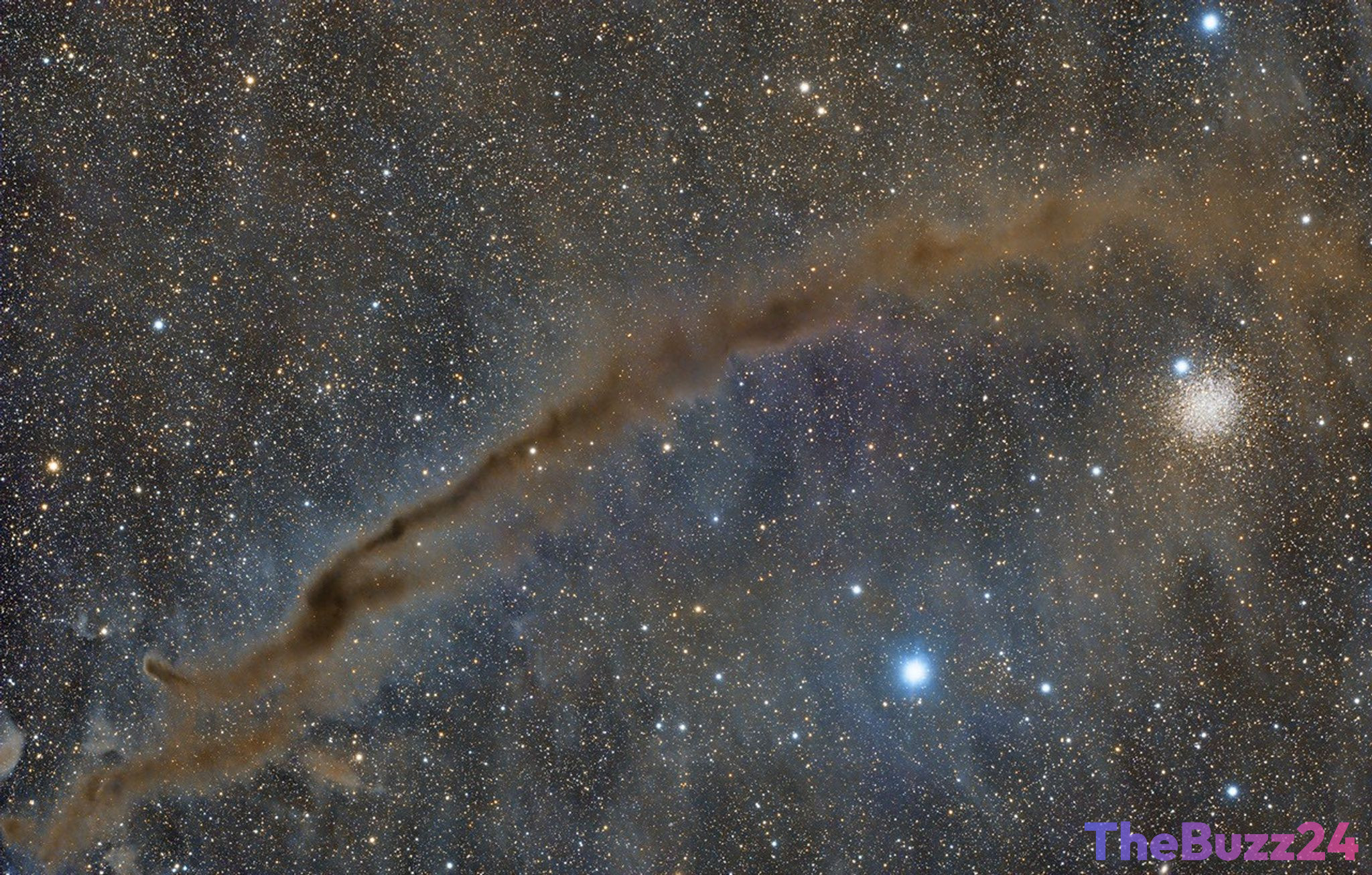
Cosmic Alignment: The Dark Doodad Nebula and Globular Cluster NGC 4372 Shine in Southern Skies
Deep-space observers focusing on the southern hemisphere’s constellation Musca, also known as The Fly, are treated to a stunning visual alignment of two vastly different cosmic structures. The Dark Doodad Nebula, a prominent interstellar dust cloud, stretches across the sky in a striking silhouette against a dense backdrop of stars. Located just south of the famous Coalsack Nebula and the Southern Cross, this dark cosmic ribbon offers a captivating target for both amateur astronomers and professional astrophotographers.
Spanning approximately three degrees across the sky, the Dark Doodad Nebula is a molecular cloud measuring over 30 light-years in length. Situated relatively close to Earth at a distance of about 700 light-years, this cold, dusty structure is part of the Musca molecular cloud, a region with the potential to birth new stars. The whimsical and highly alliterative name “Dark Doodad” was originally coined in 1986 by astrophotographer and writer Dennis di Cicco during his expedition to the Australian outback to observe Comet Halley.
Adding to the visual drama is the yellowish globular star cluster known as NGC 4372, which appears nestled near the southern tip of the nebula. Despite their apparent proximity in photographs, the two celestial objects are actually separated by vast cosmic distances. While the Dark Doodad is a local galactic feature, NGC 4372 is an ancient background object roaming the outer halo of the Milky Way galaxy, situated roughly 20,000 light-years from Earth. Their alignment is merely a perspective trick, offering a beautiful depth-of-field effect in the southern night sky.
Key Takeaways
- The Dark Doodad Nebula is a 30-light-year-long interstellar dust cloud located approximately 700 light-years away in the constellation Musca.
- NGC 4372 is an ancient globular star cluster located 20,000 light-years away, appearing next to the nebula only due to a line-of-sight alignment.
- The nebula's unique name was coined in 1986 by astrophotographer Dennis di Cicco during observations of Comet Halley in Australia.
Editor’s Analysis & Impact
The visual juxtaposition of the Dark Doodad Nebula and NGC 4372 highlights the incredible depth of our galaxy and the utility of wide-field astrophotography in modern astronomy. Molecular clouds like the Dark Doodad are critical laboratories for scientists studying the earliest phases of star formation. Because these clouds block background starlight, analyzing their density and temperature helps astronomers understand the gravitational collapse that triggers star birth. Furthermore, the accessibility of these targets to amateur astronomers underscores a growing trend of citizen science and high-quality public astrophotography. As imaging technology continues to advance, the line between professional observatory data and amateur captures continues to blur, fostering a deeper global appreciation for astrophysics and cosmic preservation.
Frequently Asked Questions
Q: What is the Dark Doodad Nebula?
A: The Dark Doodad Nebula is a dense, dusty interstellar molecular cloud located about 700 light-years away in the southern constellation Musca. It is known for its long, dark silhouette against a bright field of background stars.
Q: Are NGC 4372 and the Dark Doodad Nebula physically close to each other?
A: No. While they appear next to each other from our perspective on Earth, the Dark Doodad Nebula is only 700 light-years away, whereas the globular cluster NGC 4372 lies much further away in the Milky Way's halo, at a distance of about 20,000 light-years.
Q: Who named the Dark Doodad Nebula?
A: The name was coined by astrophotographer and writer Dennis di Cicco in 1986 while he was in the Australian outback observing Comet Halley.
AI Disclosure: This article is based on verified data and official reports. Our Team and AI have cross-referenced every financial detail with primary sources to ensure total accuracy.
More from this Category