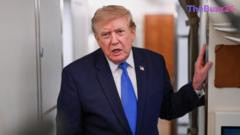
Tehran Rejects Claims of Imminent Negotiations with Washington
The Iranian government has officially dismissed assertions made by Donald Trump regarding the commencement of new diplomatic talks aimed at resolving the ongoing conflict. While the former president claimed that negotiations were set to begin following his decision to call off a planned military strike, Iranian officials have categorically denied any such agreement or intent to engage in direct dialogue with the United States at this time.
According to the Iranian foreign ministry, the administration in Tehran is currently focused on discussions with Oman regarding the security of shipping lanes in the Strait of Hormuz. This clarification directly contradicts statements made by Trump, who suggested that regional allies, including Saudi Arabia and the United Arab Emirates, had successfully urged him to pause military action in anticipation of a diplomatic breakthrough. Trump had previously characterized the potential strike as a massive operation, claiming that a deal regarding nuclear policy and maritime security was within reach.
Market reactions to the uncertainty were immediate, with global oil prices experiencing a notable decline as traders processed the conflicting narratives. Brent Crude and US-traded oil both saw drops of over 4%, reflecting the sensitivity of energy markets to potential disruptions in the Strait of Hormuz, a critical artery for global oil and liquefied natural gas transit. Despite the rhetoric, the situation remains volatile, with Iranian defense officials maintaining that they are prepared for any military escalation while simultaneously labeling the claims of pending negotiations as psychological warfare.
This latest episode highlights the persistent disconnect between the diplomatic overtures described by the US administration and the reality on the ground in Tehran. As the conflict continues to impact global energy prices and domestic political sentiment, the prospect of a lasting resolution remains elusive. Previous attempts at mediation have failed to yield concrete results, leaving the international community to navigate a landscape defined by threats of military force and the ongoing struggle for regional stability.
Key Takeaways
- Iran has officially denied the existence of any planned negotiations with the US, contradicting claims made by Donald Trump.
- Global oil prices dropped significantly following the announcement of a potential pause in military hostilities.
- Tehran is currently prioritizing maritime security talks with Oman rather than direct diplomatic engagement with Washington.
Editor’s Analysis & Impact
The ongoing standoff between the US and Iran continues to create significant volatility in global energy markets. The market’s reaction—a sharp drop in oil prices—demonstrates that investors are highly sensitive to any news regarding the Strait of Hormuz, given its role in global supply chains. From a geopolitical perspective, the disconnect between the two nations’ narratives suggests that back-channel diplomacy is either non-existent or failing to align with public messaging. The broader implication is a prolonged period of uncertainty that threatens both global economic stability and regional security. As the US approaches midterm elections, the political pressure to resolve the conflict may lead to further erratic policy shifts, making it difficult for international stakeholders to predict the trajectory of the war or the future of energy pricing.
Frequently Asked Questions
Q: Why did oil prices fall following the announcement?
A: Oil prices fell because the market interpreted the potential for diplomatic talks as a sign that the risk of immediate military conflict—which could disrupt oil shipments through the Strait of Hormuz—had decreased.
Q: What is the current status of US-Iran negotiations?
A: As of now, there are no confirmed direct negotiations. While the US claims talks are imminent, Iran has denied these claims, stating they are only engaged in discussions with regional partners like Oman regarding maritime security.
AI Disclosure: This article is based on verified data and official reports. Our Team and AI have cross-referenced every financial detail with primary sources to ensure total accuracy.
More from this Category