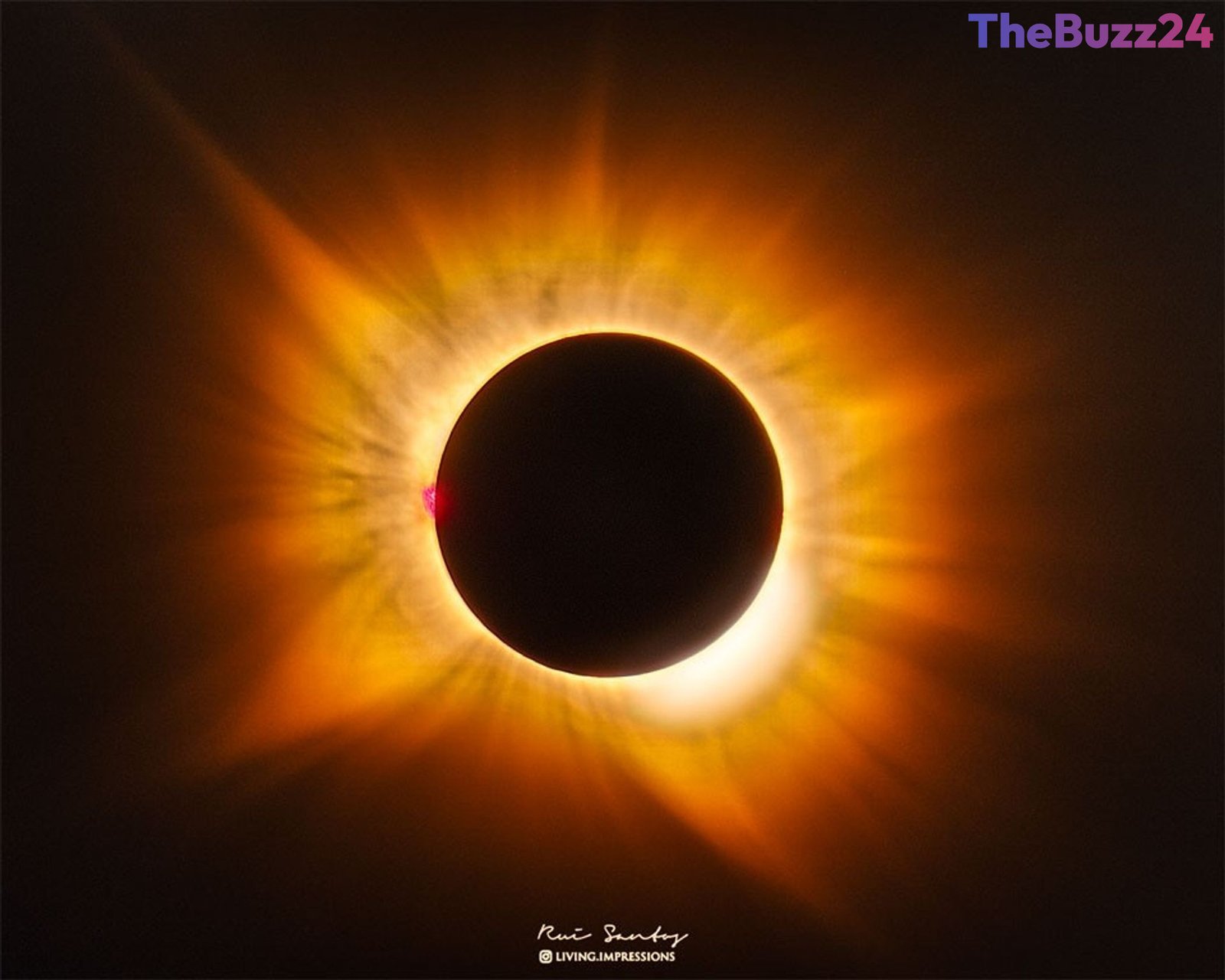
Rare Golden Solar Eclipse Captured Over Spain
Observers in Spain were treated to a rare and visually striking phenomenon during the total solar eclipse on August 12, 2026. While the solar corona typically appears as a pearly white glow, those viewing the event from Benavente witnessed a distinct, golden-hued corona. This unusual coloration provided a unique opportunity for astronomers to study the effects of atmospheric conditions on celestial observations.
The golden appearance was primarily the result of the eclipse occurring while the Sun was positioned low near the horizon. As the sunlight traveled through a significant portion of the Earth’s atmosphere, blue light was scattered away, leaving behind warmer tones. This effect was further intensified by smoke particles from nearby forest fires, which acted as an additional filter, effectively removing remaining blue light and deepening the golden spectrum.
Despite the pervasive golden light, certain features of the Sun maintained their natural appearance. A hydrogen-glowing prominence visible on the left edge of the Sun retained its bright pink hue, providing a sharp contrast to the surrounding golden corona. The event was documented using high-dynamic-range (HDR) processing and multiple-exposure techniques, allowing for a detailed capture of the solar atmosphere under these specific environmental conditions.
Key Takeaways
- A total solar eclipse in Spain exhibited an unusual golden corona due to the Sun's low position on the horizon.
- Atmospheric scattering caused by air density and smoke from forest fires filtered out blue light, enhancing the golden tones.
- Despite the atmospheric filtering, solar prominences retained their natural pink color, offering a stark visual contrast.
Editor’s Analysis & Impact
The observation of the 2026 solar eclipse serves as a compelling case study in atmospheric optics and its impact on astronomical data collection. While the golden hue was a localized phenomenon driven by specific environmental factors—namely, the low solar angle and particulate matter from wildfires—it highlights the necessity of accounting for terrestrial atmospheric interference when analyzing solar imagery. From a scientific perspective, the ability to capture such distinct color shifts provides valuable data on how aerosols and air density influence light transmission. As climate-related events like forest fires become more frequent, astronomers must increasingly integrate atmospheric modeling into their observational workflows to ensure the accuracy of solar and planetary research.
Frequently Asked Questions
Q: Why did the solar corona appear golden instead of white?
A: The golden color was caused by the Sun's low position near the horizon, which forced light through more of the Earth's atmosphere, scattering blue light. Smoke from nearby forest fires further filtered the light, deepening the golden effect.
Q: Did all features of the Sun appear golden during the eclipse?
A: No, the hydrogen-glowing prominence on the left edge of the Sun maintained its original bright pink color, as it was not as affected by the atmospheric scattering that altered the appearance of the corona.
AI Disclosure: This article is based on verified data and official reports. Our Team and AI have cross-referenced every financial detail with primary sources to ensure total accuracy.
More from this Category