Miracle Rescue: Experts Detail Daring Operation to Save Survivors Trapped in Nepal’s Flood-Devastated Tunnel
An international tunnelling expert has described the extraordinary efforts involved in rescuing two survivors from a collapsed hydropower tunnel in Nepal, a feat he characterized as “layer upon layer of miracles.” Arnold Dix, president of the International Tunnelling and Underground Space Association, advised Nepalese authorities on the complex operation following a devastating flash flood that struck the region near the Nepal-Tibet border.
The flood, which has claimed over 1,300 lives, dramatically altered the landscape, burying the entrance to the Trishuli 3A Hydropower Station tunnel under immense debris. Dix explained the initial challenge was locating the tunnel’s entrance, which had been shifted underground by the avalanche-like force of the floodwaters. The rescue team utilized a combination of engineering techniques, historical topographic maps, post-disaster satellite imagery, helicopter footage, and even the location of power poles to triangulate the buried entrance.
Once the entrance was found, the next critical phase was locating the trapped individuals. Rescuers had to navigate through the tunnel, which was completely blocked by mud and rocks, some as large as cars. The operation required the strategic use of explosives to clear the path, a risky maneuver Dix noted they would typically avoid due to the potential danger to both the trapped individuals and the rescue teams. The Nepalese army’s precise handling of these detonations was crucial in preventing further destabilization of the tunnel.
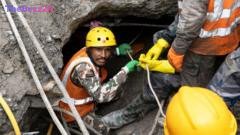
Further complicating matters, the tunnel was filled with water. Rescuers employed excavators and pumping machinery to create trenches connecting the tunnel to an external river, thereby draining the waterlogged passage. Finally, a narrow, person-sized tunnel was painstakingly dug through the debris at the top of the main tunnel. This allowed rescuers to access the survivors while utilizing the original tunnel’s roof for structural support and protection from further flooding. The successful extraction of Sanjaya Shah and Kabir Maharjan on Friday, after hearing faint calls for help, marked a significant triumph, though dozens more are believed to still be trapped.
Key Takeaways
- A complex rescue operation in Nepal successfully extracted two survivors from a hydropower tunnel buried by a massive flash flood.
- The rescue involved overcoming multiple challenges, including locating a buried tunnel entrance, clearing debris with explosives, draining floodwaters, and digging a narrow passage.
- Despite the success, dozens more individuals are believed to still be trapped, and rescue efforts are ongoing with significant risks remaining.
Editor’s Analysis & Impact
This dramatic rescue highlights the resilience and ingenuity required in disaster response, particularly in challenging terrains like Nepal. The successful extraction of survivors from the deeply buried and waterlogged tunnel underscores the critical role of specialized engineering expertise and coordinated efforts between international advisors and local forces. The ongoing nature of the rescue, with many still unaccounted for, emphasizes the persistent risks associated with such events, including potential secondary floods and structural instability. The incident also brings attention to the vulnerability of critical infrastructure like hydropower stations to extreme weather events, a growing concern in the face of climate change.
Frequently Asked Questions
Q: What caused the tunnel to be blocked?
A: The tunnel was blocked by a massive flash flood that occurred near the Nepal-Tibet border, which caused a significant landslide and deposited a large amount of mud and rocks, burying the tunnel entrance and filling parts of it with debris and water.
Q: What were the main challenges faced by the rescue team?
A: The primary challenges included locating the tunnel entrance which had been buried by the flood, clearing large amounts of debris including rocks bigger than cars, using explosives safely in a confined space, draining the tunnel which was filled with water, and creating a narrow passage to reach the survivors.
Q: Are there still people trapped in the tunnel?
A: Yes, while two survivors were successfully rescued, it is believed that dozens more individuals are still trapped inside the tunnel, and rescue operations are continuing.
AI Disclosure: This article is based on verified data and official reports. Our Team and AI have cross-referenced every financial detail with primary sources to ensure total accuracy.
More from this Category