Gambia’s President Appeals for Calm Following Violent Protests Over Severe Power Outages
President Adama Barrow of The Gambia has publicly urged citizens to exercise patience and maintain public order following a wave of violent demonstrations sparked by prolonged electricity blackouts across the nation. Addressing the public, Barrow emphasized that the ongoing energy crisis is a regional challenge impacting multiple parts of West Africa, rather than an isolated domestic issue.
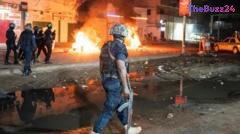
The unrest erupted when frustrated residents took to the streets in the capital of Banjul and surrounding neighborhoods, setting tires on fire and blocking major roadways to protest power cuts that have occasionally extended up to 48 hours. Law enforcement agencies deployed tear gas to disperse crowds that marched toward the headquarters of the national utility company, Nawec, with demonstrators voicing anti-government slogans. Additional protests materialized near the vice-president’s residence, resulting in minor property damage at a local office belonging to the ruling National People’s Party.
In response to the escalating crisis, Barrow delivered a televised address acknowledging the severe difficulties endured by families, businesses, and vulnerable populations due to the extreme heat and lack of electricity. He characterized the energy shortages as a critical national security emergency while cautioning citizens against vandalizing public infrastructure, noting that repairs only drain financial resources away from permanent solutions. The administration has pointed to a combination of soaring seasonal demand, technical malfunctions, and reduced energy imports from neighboring countries as the primary catalysts for the grid failures.
To mitigate the shortages, the government announced immediate intervention strategies, including the installation of a new 24-megawatt generating unit at the Brikama power station, which is scheduled for commissioning by the upcoming month. Furthermore, officials have finalized a contract for a 50-megawatt solar power plant in Soma. Nawec leadership has similarly appealed for public understanding, explaining that diminished rainfall levels across the regional network have severely constrained imported power supplies. Government officials remain optimistic that incoming generators and newly commissioned capacity will stabilize the national grid and alleviate public frustration.
Key Takeaways
- President Adama Barrow called for calm after violent demonstrations broke out in Banjul and surrounding regions over prolonged power outages lasting up to 48 hours.
- The energy crisis has been exacerbated by extreme seasonal temperatures, technical failures, and reduced electricity imports from neighboring regional grids.
- The Gambian government has pledged to boost energy capacity by commissioning a new 24-megawatt generator and planning a future 50-megawatt solar plant.
Editor’s Analysis & Impact
The ongoing energy crisis in The Gambia highlights the critical vulnerability of sub-Saharan infrastructure to climate pressures, regional supply dependencies, and surging peak demand. As temperatures rise and regional hydro-generation falters due to lower rainfall, small nations heavily reliant on imported energy find themselves particularly exposed. Politically, the timing of these protests—occurring ahead of an anticipated presidential election—raises the stakes for President Adama Barrow’s administration. Successfully delivering on infrastructure promises, such as the Brikama generator expansion and the Soma solar initiative, will be vital not only for restoring civic order but also for maintaining public trust in governance. Over the long term, diversifying energy sources and investing in domestic renewable infrastructure will be essential for ensuring grid resilience across the broader West African region.
Frequently Asked Questions
Q: What caused the recent protests in The Gambia?
A: The protests were triggered by severe, prolonged electricity blackouts lasting up to 48 hours during an intense hot season, which severely disrupted daily life and pushed public frustration to a boiling point.
Q: How is the Gambian government planning to solve the power crisis?
A: The government is installing a new 24-megawatt generating unit at the Brikama power station, scheduled for completion soon, and has awarded a contract for a 50-megawatt solar power plant in Soma.
Q: What role do neighboring countries play in The Gambia's electricity supply?
A: The Gambia supplements its domestic power generation by importing electricity from neighboring countries like Guinea and Senegal through a shared regional grid network.
AI Disclosure: This article is based on verified data and official reports. Our Team and AI have cross-referenced every financial detail with primary sources to ensure total accuracy.
More from this Category