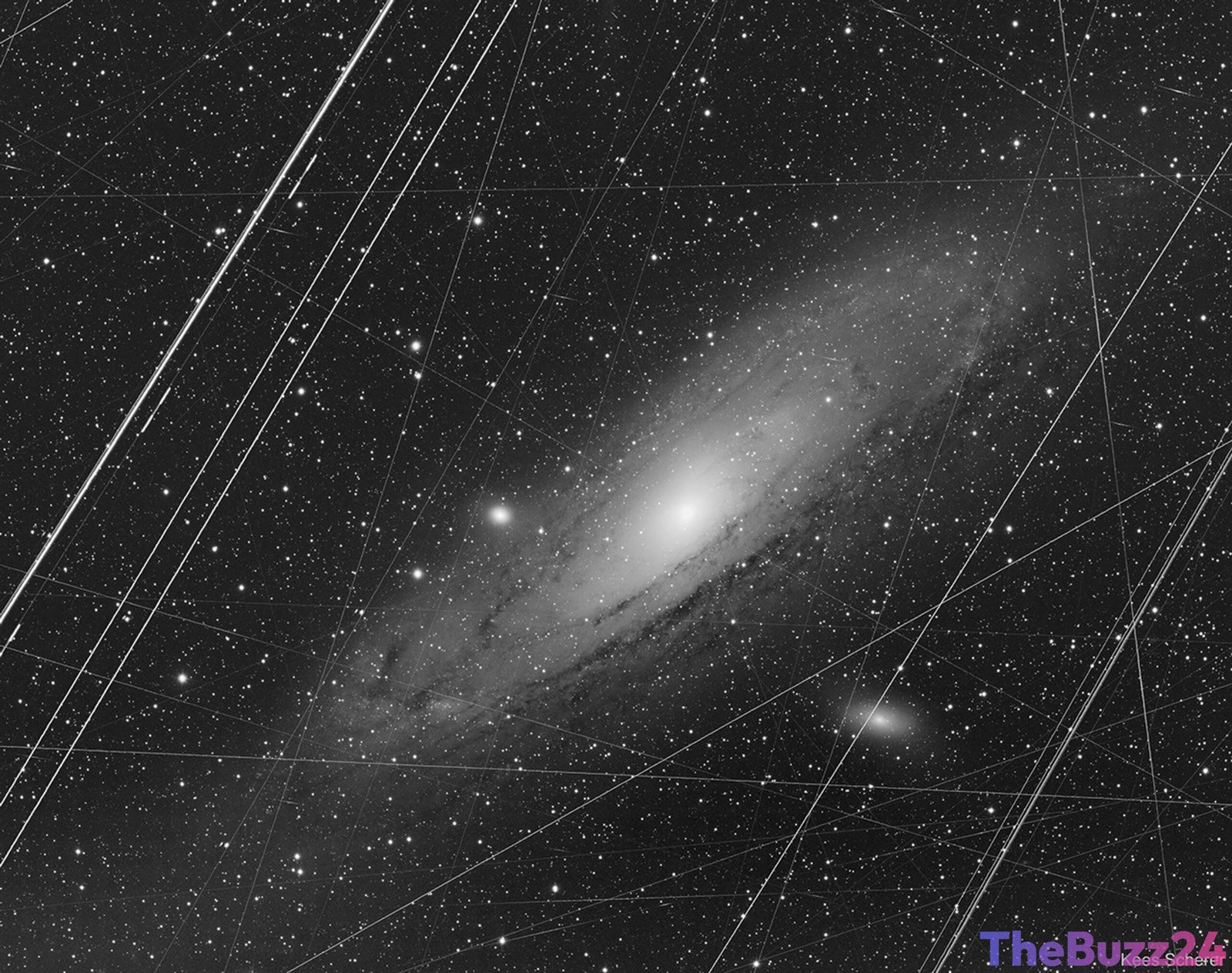
Andromeda’s True Face: Astrophotography Reveals Our Galactic Neighbor Beyond Earthly Interference
The Andromeda galaxy (M31), our Milky Way’s closest major galactic neighbor, presents a breathtaking spectacle in the night sky. However, capturing its true, unblemished likeness from Earth is a significant challenge for astrophotographers. A recent compelling comparison illustrates this struggle and the sophisticated techniques employed to overcome it, showcasing the galaxy both in its raw, captured state and after meticulous digital refinement.
The initial raw image, a composite of 223 individual 300-second exposures taken from a garden observatory in Portugal during 2019 by astrophotographer Kees Scherer, reveals the myriad interferences inherent in terrestrial observation. These imperfections include bright parallel streaks from airplanes, long continuous trails left by satellites, fleeting cosmic ray streaks, and isolated “bad pixels” from the camera sensor. Such artifacts are common hurdles, obscuring the delicate details of distant celestial objects and making it difficult to discern the galaxy’s authentic appearance.
To transcend these Earth-bound distractions, a suite of specialized computer software packages was utilized. Rather than relying solely on general-purpose image editors, programs like Astro Pixel Processor, DeepSkyStacker, and PixInsight were instrumental in significantly reducing these imperfections. The objective of this intensive post-processing is not to fabricate a digital fantasy, but precisely the opposite: to strip away the terrestrial noise and accurately reconstruct what M31 genuinely looks like, allowing its intricate structure and faint glow to emerge with clarity.
This dedication to scientific accuracy through advanced digital processing underscores the blend of art and science in modern astrophotography. By meticulously removing elements unrelated to the distant galaxy, astrophotographers provide us with a clearer window into the cosmos, offering a more faithful representation of the universe’s wonders, free from the visual clutter of our own planet.
Key Takeaways
- Capturing clear images of distant galaxies like Andromeda from Earth is challenging due to atmospheric and man-made interference.
- Specialized software (e.g., Astro Pixel Processor, DeepSkyStacker, PixInsight) is crucial for removing artifacts like airplane trails, satellite streaks, and cosmic rays from raw astrophotography data.
- The goal of digital processing in astrophotography is to reveal the true appearance of celestial objects by minimizing Earthly interference, not to create artificial images.
Editor’s Analysis & Impact
This news highlights the critical role of post-processing in modern astrophotography, transforming raw data into scientifically valuable and aesthetically stunning images. The increasing sophistication of imaging software and techniques allows astronomers and amateur enthusiasts alike to overcome significant observational challenges posed by Earth’s atmosphere and orbital clutter. This trend will likely continue, pushing the boundaries of what can be observed from ground-based telescopes, even as space-based observatories provide pristine views. The broader implication is a democratization of high-quality astronomical imaging, making complex data accessible and understandable to a wider audience. It also underscores the ongoing innovation in digital imaging and data science, which has applications far beyond astronomy, influencing fields from medical imaging to remote sensing.
Frequently Asked Questions
Q: What kind of imperfections are typically found in raw astrophotography images?
A: Raw astrophotography images often contain artifacts such as streaks from airplanes and satellites, cosmic ray impacts on the sensor, and "bad pixels" or noise from the camera itself, all of which obscure the celestial target.
Q: Why is digital processing necessary for astrophotography?
A: Digital processing is essential to remove or minimize terrestrial and instrumental imperfections from raw images, allowing the true details of distant astronomical objects to be revealed with greater clarity and accuracy, rather than presenting a distorted or obscured view.
Q: Does image processing in astrophotography create "fake" images?
A: No, the primary goal of professional astrophotography processing is to enhance the scientific accuracy and visual clarity of the image by removing noise and artifacts that are not part of the celestial object itself. It aims to present a more faithful representation of what the object would look like without Earthly interference, not to fabricate details.
AI Disclosure: This article is based on verified data and official reports. Our Team and AI have cross-referenced every financial detail with primary sources to ensure total accuracy.
More from this Category