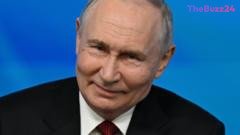
Putin Issues Stark Warning to West Over Kaliningrad, Threatening Full Military Response
Russian President Vladimir Putin has declared that Moscow is prepared to deploy its entire arsenal, including nuclear weapons, to defend the Baltic exclave of Kaliningrad from any perceived Western aggression or blockade. Speaking at the Valdai foreign policy forum, Putin asserted that while Russia does not seek conflict or intend to launch an offensive against European nations, any direct assault on its territory would trigger an immediate and comprehensive military response. The warning comes amid heightened tensions in the Baltic region, where Russia has accused NATO of conducting threatening naval maneuvers near its borders.
The strategic exclave of Kaliningrad, bordered by Poland and Lithuania, has become a focal point of geopolitical friction. NATO officials have consistently dismissed Moscow’s allegations of an impending blockade, emphasizing that the alliance remains strictly defensive. However, neighboring Baltic states have reported a sharp rise in hybrid warfare tactics, including airspace violations by Russian drones and helicopters. Lithuania has already established emergency evacuation plans, and thousands of NATO troops remain stationed in the region to deter potential incursions across the critical Suwalki Gap.
Beyond the Baltic standoff, Putin addressed the ongoing conflict in Ukraine, attributing the initial invasion to Western provocation and defending recent strikes on Ukrainian energy infrastructure as retaliation for attacks on Russian oil refineries. He acknowledged that Ukrainian drone strikes on Russian energy facilities had shaved approximately one percent off Russia’s GDP. Looking to the future of global conflict, the Russian leader also warned against the rapid integration of artificial intelligence and digital automation in military technology, cautioning that the “gamification” of warfare threatens to degrade human civilization.
Key Takeaways
- Vladimir Putin warned that Russia will use all available weapons, including its nuclear arsenal, to defend the Kaliningrad exclave if it faces a Western blockade or direct attack.
- NATO has rejected Russia's claims of aggression, calling the nuclear rhetoric unhelpful, while Baltic nations report a rise in Russian hybrid warfare and airspace violations.
- Putin acknowledged that Ukrainian strikes on Russian oil refineries have caused a 1% drop in Russia's GDP, while also warning of the dangers of AI and automation in modern warfare.
Editor’s Analysis & Impact
Putin’s latest rhetoric underscores the fragile security architecture of Eastern Europe, specifically highlighting the vulnerability of the Kaliningrad exclave and the strategic Suwalki Gap. By threatening a nuclear response to a hypothetical blockade, Moscow aims to deter NATO from tightening its security posture in the Baltic Sea, which has effectively become a “NATO lake” since the accession of Finland and Sweden. Economically, Putin’s admission of a 1% GDP loss due to Ukrainian refinery strikes reveals the tangible impact of Kyiv’s asymmetric warfare strategy on Russia’s energy-dependent economy. Looking forward, the Baltic region will likely remain a primary theater for hybrid warfare, GPS jamming, and airspace provocations. This ongoing friction will force European nations to accelerate defense spending and reinforce their eastern flanks, permanently shifting the geopolitical landscape of the continent.
Frequently Asked Questions
Q: What is Kaliningrad and why is it significant?
A: Kaliningrad is a Russian exclave situated on the Baltic Sea, geographically separated from mainland Russia and bordered by NATO members Poland and Lithuania. It is highly militarized and serves as a strategic outpost for Moscow in Northern Europe.
Q: How has NATO responded to Russia's warnings?
A: NATO has dismissed Russia's claims of an impending blockade or aggressive intent, reiterating that its exercises are purely defensive. Alliance leadership has urged Moscow to cease its destabilizing nuclear rhetoric.
Q: What did Putin say about the future of warfare?
A: Putin warned against the increasing automation and digitalization of military operations, stating that the "gamification" of warfare through artificial intelligence risks sliding humanity back into barbarity.
AI Disclosure: This article is based on verified data and official reports. Our Team and AI have cross-referenced every financial detail with primary sources to ensure total accuracy.
More from this Category