NASA’s Glowing Wings: Pressure-Sensitive Paint Revolutionizes Aircraft Design Testing
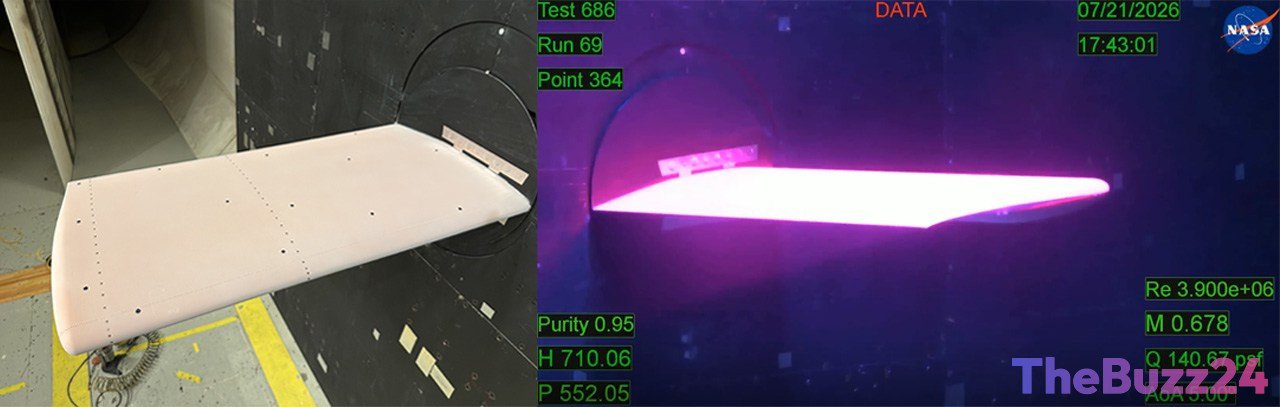
NASA researchers at the Langley Research Center have successfully conducted a groundbreaking test utilizing a novel application of unsteady Pressure Sensitive Paint (PSP) on a standard wind tunnel model. This pioneering experiment, performed within the Transonic Dynamics Tunnel, marks a significant advancement in the agency’s ability to study airflow dynamics and refine aircraft designs for the future.
The innovative technique involves coating a “Benchmark Supercritical Wing” model with a specialized paint that illuminates under ultraviolet light, with its brightness directly correlating to the air pressure exerted upon it. High-speed cameras meticulously recorded these visual changes, providing invaluable data to enhance and validate complex computer modeling used in aeronautical engineering. This method allows scientists to visualize and quantify airflow patterns in unprecedented detail.
This particular test was notable for being the first time this unsteady PSP technology was applied to a large-scale, freely moving model within the Transonic Dynamics Tunnel’s unique low-oxygen environment. This capability is crucial for simulating a wider range of flight conditions and is a testament to the advanced testing infrastructure at NASA Langley. The success of this trial paves the way for future investigations into more complex aerodynamic challenges.
The implications of this successful test are far-reaching, enabling NASA to move forward with testing flexible aircraft models designed to adapt and improve efficiency during flight. By providing more accurate and detailed wind tunnel data, this technology promises to accelerate the development of next-generation aircraft and contribute to NASA’s ongoing mission to advance the future of aviation.
Key Takeaways
- NASA has successfully tested unsteady Pressure Sensitive Paint on a large-scale wind tunnel model for the first time.
- The paint illuminates under UV light, showing real-time air pressure variations on the model wing.
- This advancement will improve aircraft design and computer modeling, particularly for flexible wing technologies.
Editor’s Analysis & Impact
The successful integration of unsteady Pressure Sensitive Paint into large-scale wind tunnel testing represents a significant leap forward for aeronautical research. This technology offers a more dynamic and visually intuitive method for capturing critical airflow data, which is essential for developing more efficient and advanced aircraft. By enhancing the accuracy of computer simulations and enabling the study of complex aerodynamic phenomena like flexible wing behavior, NASA is positioning itself at the forefront of aviation innovation. This development could lead to faster design cycles, improved fuel efficiency, and enhanced flight performance across various aerospace applications.
Frequently Asked Questions
Q: What is Pressure Sensitive Paint (PSP)?
A: Pressure Sensitive Paint is a specialized coating that changes its luminescence (brightness) in response to variations in air pressure. When illuminated by ultraviolet light, areas of higher pressure appear brighter, allowing researchers to visualize and quantify airflow patterns on aerodynamic models.
Q: Why is testing on a 'Benchmark Supercritical Wing' important?
A: Benchmark wings are standardized models used across the research community. They are not designed to represent a specific aircraft but serve as a universal baseline to help researchers validate and improve their computer simulation models using real-world wind tunnel data.
Q: What are the benefits of using unsteady PSP in a low-oxygen environment?
A: Using unsteady PSP in a low-oxygen environment, as demonstrated in the Transonic Dynamics Tunnel, allows for more accurate simulation of high-speed flight conditions. This is crucial for testing advanced aircraft designs that may operate under extreme pressures and temperatures, leading to more robust and reliable future aircraft.
AI Disclosure: This article is based on verified data and official reports. Our Team and AI have cross-referenced every financial detail with primary sources to ensure total accuracy.
More from this Category