Geopolitical Shift: Why Canada Is Quietly Preparing for Unthinkable Cross-Border Scenarios
A reassessment of North American security dynamics has prompted Canadian officials and military strategists to quietly contemplate emergency defense scenarios involving their closest neighbor. Driven by shifting geopolitical realities, intensifying trade disputes, and recurring political rhetoric regarding Canadian sovereignty—including former President Donald Trump’s past remarks suggesting Canada become the 51st state—planners have begun considering once-unthinkable contingencies. Prominent figures, including former central banker Mark Carney, have framed these preparations not as anticipation of immediate conflict, but as prudent risk management in an increasingly unpredictable geopolitical environment.
Historically, the defense architecture between Canada and the United States has been built on deep integration, spanning shared commands under the North American Aerospace Defense Command (NORAD) and collective defense commitments via NATO. Former military leaders point out that standard protocol has long assumed complete security along the world’s longest undefended border. However, tensions have rekindled historical memories of early 19th-century conflicts and interwar contingency planning, reminding defense leaders that military organizations inherently exist to model worst-case scenarios, regardless of how statistically improbable they might be.
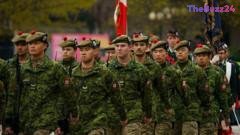
Recent theoretical modeling undertaken within Canadian defense circles suggests that any conventional military assault from the south would rapidly overwhelm primary defenses within days due to vast resource disparities. Such an extreme scenario would force domestic armed forces into asymmetric defense while looking to European allies for diplomatic and strategic support. Although military analysts stress that physical aggression remains extraordinarily far-fetched—and that cyber operations or punitive economic measures are infinitely more plausible leverage points—public polling reflects a measurable degree of citizen anxiety, galvanizing renewed interest in domestic troop expansion and homeland readiness.
Furthermore, national security analysts highlight that an actual armed invasion would face immense institutional friction within the United States military. Given decades of joint operations, mutual respect, and collaborative officer training between both nations, orders targeting an allied democratic partner would encounter severe moral and legal resistance. Nevertheless, the mere necessity of updating defensive models signals a profound transformation in cross-border relations, underscoring how rhetoric and shifting diplomatic norms can reverberate through longstanding strategic partnerships.
Key Takeaways
- Canadian defense planners and prominent figures view scenario modeling regarding U.S. aggression as basic risk management amid evolving cross-border rhetoric.
- Despite intense military integration through NORAD and NATO, public concern has grown, sparking discussions about boosting Canada's defense capacity.
- Experts emphasize that physical invasion remains extremely remote, with cyber operations and trade friction serving as the primary vectors of modern geopolitical pressure.
Editor’s Analysis & Impact
While the prospect of direct military confrontation between Washington and Ottawa remains effectively zero, the fact that such scenarios are being publicly discussed points to a significant erosion in traditional diplomatic certainty. Decades of seamless bilateral integration are colliding with a rising tide of economic nationalism and populist rhetoric. For Canada, this development accelerates a critical pivot toward self-reliance, spurring increased defense spending, recruitment initiatives, and independent Arctic surveillance. For the United States, straining trust with its northern neighbor risks destabilizing vital NORAD modernization efforts and shared intelligence frameworks. Moving forward, both nations must recalibrate their diplomatic channels to prevent strategic defense cooperation from becoming collateral damage in domestic political discourse.
Frequently Asked Questions
Q: Why has Canada modeled military scenarios involving the United States?
A: Defense organizations routinely prepare for low-probability, high-impact scenarios. Recent political rhetoric, tariff pressures, and geopolitical uncertainty have prompted Canadian strategists to treat scenario modeling as an exercise in thorough risk management.
Q: Is an armed confrontation between the U.S. and Canada realistic?
A: Military analysts consider a physical armed conflict practically nonexistent. Both nations are bound by mutual defense treaties like NATO and NORAD, and any cross-border tension is vastly more likely to unfold through economic pressures or cyber warfare.
Q: How are Canadian defense priorities responding to these shifting dynamics?
A: Canada is actively looking to bolster its defensive posture by expanding its military personnel, modernizing Arctic sovereignty infrastructure, and re-evaluating its reliance on single-partner supply and security frameworks.
AI Disclosure: This article is based on verified data and official reports. Our Team and AI have cross-referenced every financial detail with primary sources to ensure total accuracy.
More from this Category