AI Chip Startup Etched Eyes Massive Valuation Surge in New Funding Talks
Artificial intelligence chip developer Etched is currently evaluating substantial new investment proposals that could value the four-year-old enterprise between $40 billion and $50 billion. This rapid influx of interest follows a $700 million capital raise just a few months prior, which had pegged the firm’s valuation at $21 billion. Discussions remain in preliminary stages, leaving room for potential shifts in deal structures as management weighs its options for future growth.
The venture capital enthusiasm stems largely from Etched’s ambition to rival industry titan Nvidia by constructing comprehensive AI hardware systems driven by custom proprietary silicon. Industry observers note that securing another significant capital injection on this scale could provide the startup with a financial runway lasting up to three and a half years. Such a buffer is crucial given the notoriously capital-intensive nature of hardware manufacturing and development within the artificial intelligence sector.
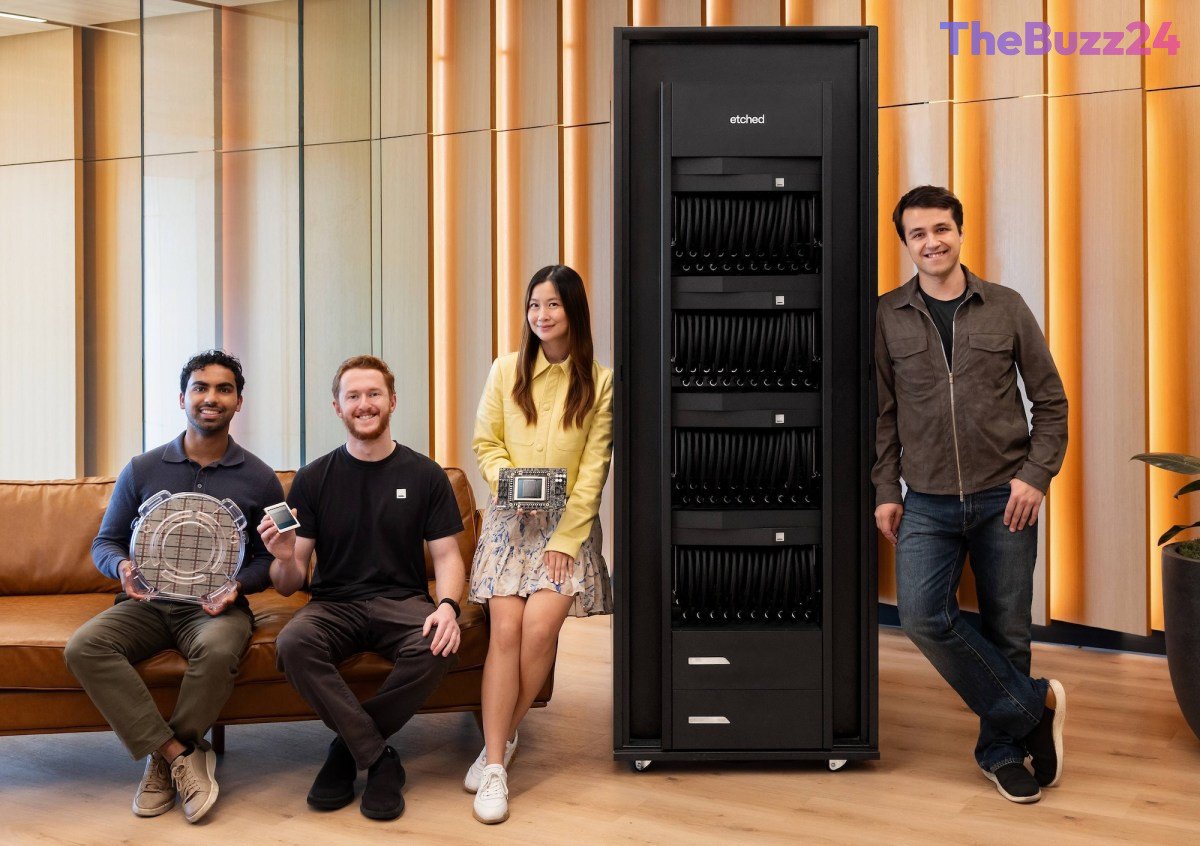
At the core of the company’s appeal is its focus on accelerating inference—the computational phase that occurs after a user initiates a prompt. Co-founders Gavin Uberti and Chris Zhu, alongside COO Robert Wachen, have engineered components designed to process tokens at unprecedented speeds and lower costs compared to existing market alternatives. This performance advantage has already attracted high-profile customers and prominent financial backers, including quantitative trading giant Jane Street, which participated in prior fundraising and integrated early systems into its operations.
Beyond its technological architecture, Etched has made notable strides in talent acquisition, drawing roughly 15% of its workforce from Nvidia’s talent pool. The enterprise has also expanded its operational footprint by launching a 10-megawatt data center in Silicon Valley and establishing a Taiwanese facility to streamline production alongside Taiwan Semiconductor Manufacturing Company. With a history of executing successive, high-valuation funding rounds, Etched continues to solidify its position as a formidable contender in the specialized hardware landscape.
Key Takeaways
- Etched is reviewing new investment offers valuing the startup between $40 billion and $50 billion.
- The company previously raised $700 million at a $21 billion valuation just months prior.
- Etched aims to challenge Nvidia by building proprietary AI hardware systems focused on faster and cheaper inference.
Editor’s Analysis & Impact
The astronomical valuation trajectory of Etched highlights the intense market demand for specialized AI hardware capable of outperforming general-purpose GPUs like those manufactured by Nvidia. As the artificial intelligence sector matures, bottlenecks in inference speed and computing costs have become critical pain points for enterprises and high-frequency trading firms alike. Etched’s ability to secure massive funding rounds in rapid succession underscores investor confidence in custom silicon architectures tailored specifically for transformer models. However, scaling hardware production remains an expensive and logistically complex endeavor. The company’s success will ultimately depend on its ability to transition from promising test chips and early customer deliveries to mass manufacturing and widespread enterprise adoption, all while competing against deeply entrenched industry giants.
Frequently Asked Questions
Q: What is Etched's primary business focus?
A: Etched designs and builds full AI hardware systems powered by its own proprietary chips, specifically optimized to accelerate inference computing processes.
Q: Why are venture capitalists interested in Etched?
A: Investors are drawn to Etched because its custom chips claim to process more tokens faster and at a lower cost than Nvidia's products, positioning the startup as a major challenger in the AI hardware market.
Q: Who are the founders of Etched?
A: Etched was founded by Gavin Uberti and Chris Zhu, who met in an advanced math course at Harvard, alongside COO Robert Wachen.
AI Disclosure: This article is based on verified data and official reports. Our Team and AI have cross-referenced every financial detail with primary sources to ensure total accuracy.
More from this Category