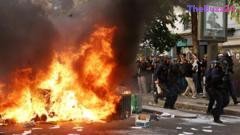
France Suspends Stun Grenades Amid Violent Student Demonstrations and Serious Injuries
The French government has announced an immediate suspension on the use of stun grenades for policing nationwide student demonstrations. This decision follows a severe incident in Lens where a 15-year-old boy lost his hand. Interior Minister Laurent Nuñez confirmed the pause would remain in effect until the exact circumstances surrounding Monday’s altercation are fully investigated and clarified.
The widespread protests, which have shut down hundreds of schools fully or partially, stem from student demands for improved campus conditions and infrastructure. While the administration has defended the security response, citing unprecedented levels of violence and vandalism by fringe groups that have left dozens of officers injured and hundreds arrested, critics argue that law enforcement has relied on disproportionate force. Prime Minister Sébastien Lecornu has addressed the nation, denying that security forces have instructions to confront youths aggressively, while promising a comprehensive set of proposals by late October to address student concerns.
Tensions remain exceptionally high as demonstrations expand to include university students, parents, and labor unions, resulting in clashes involving tear gas and water cannons in multiple cities, including Paris and Marseille. Concurrently, police watchdog agencies have initiated multiple investigations into officer conduct, following reports of severe injuries sustained by teenagers during recent deployments. Despite government calls for calm and ongoing consultations, student unions have signaled that further rallies and demonstrations will proceed as scheduled, demanding more concrete policy actions rather than dialogue.
Key Takeaways
- France has suspended the use of stun grenades for policing student protests following a severe injury where a 15-year-old boy lost his hand.
- Widespread demonstrations have caused full or partial closures of more than 500 schools, driven by demands for better educational facilities and infrastructure.
- Government officials and student unions remain at odds over police tactics, with authorities citing infiltration by violent agitators while critics accuse security forces of excessive force.
Editor’s Analysis & Impact
The recent escalation of student protests in France presents a delicate balancing act for the government as it navigates public safety, police accountability, and political pressures ahead of upcoming elections. The suspension of stun grenades marks a tactical retreat by the interior ministry aimed at de-escalating tensions, yet foundational grievances regarding educational infrastructure and police tactics remain unaddressed. If authorities fail to deliver substantive structural reforms, these localized uprisings risk coalescing into broader, long-term civil unrest. Furthermore, the politicization of the crisis by opposing political factions complicates the path toward a stable resolution, ensuring that public order and institutional trust will remain under intense scrutiny in the near term.
Frequently Asked Questions
Q: Why did France suspend the use of stun grenades?
A: The suspension was enacted after a 15-year-old boy's hand was blown off during student protests in Lens, prompting the Interior Ministry to pause their use while the incident is thoroughly investigated.
Q: What are the primary demands of the protesting students?
A: Students are calling for better school conditions, improved infrastructure, and increased availability of teachers, leading to widespread disruptions across hundreds of educational institutions.
Q: How has the government responded to the demonstrations?
A: Aside from suspending certain policing tactics, Prime Minister Sébastien Lecornu has promised to present new proposals by October to address student grievances, while maintaining that law enforcement is responding appropriately to escalating violence.
AI Disclosure: This article is based on verified data and official reports. Our Team and AI have cross-referenced every financial detail with primary sources to ensure total accuracy.
More from this Category