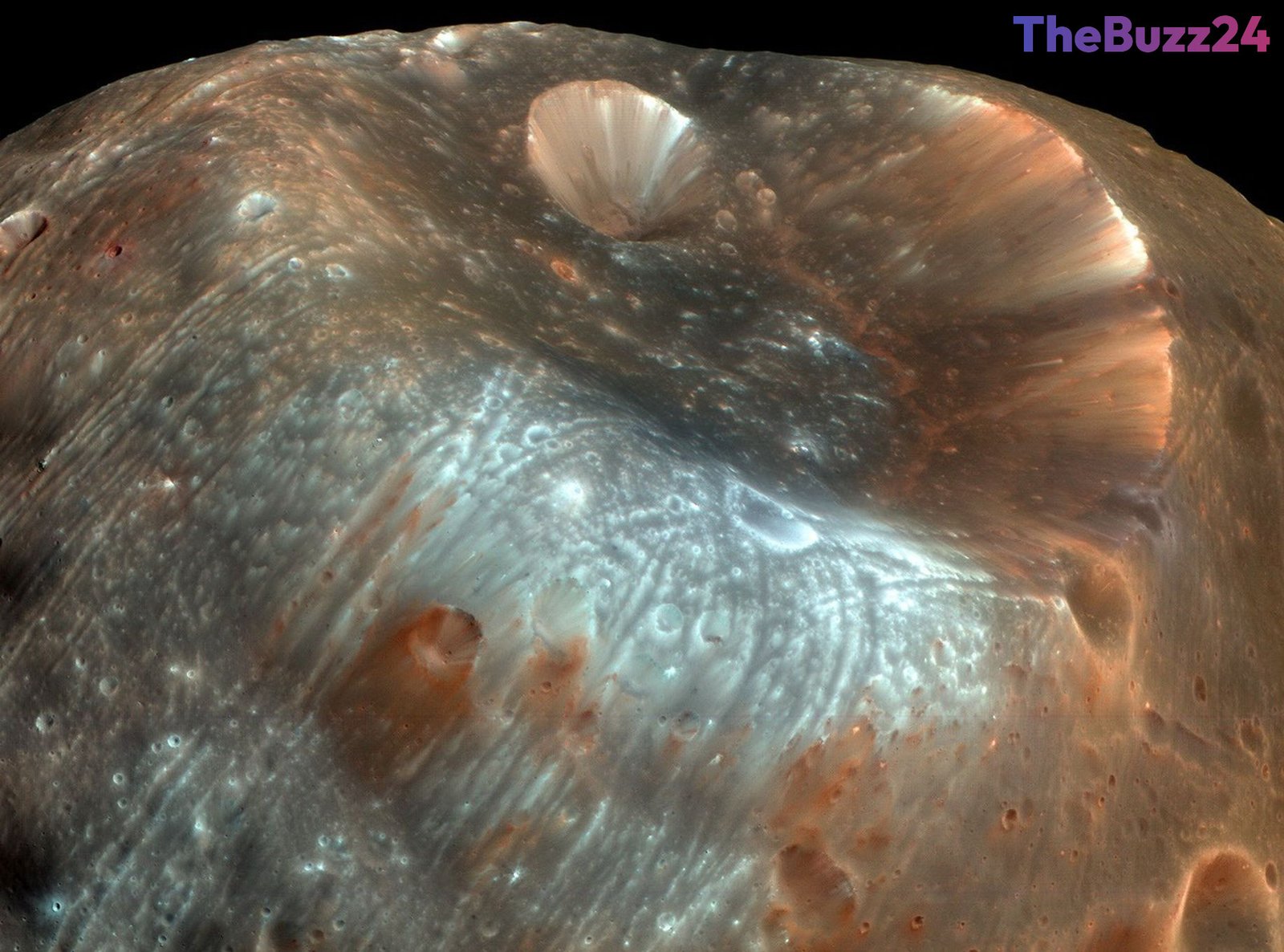
The Scar of Phobos: Unveiling the Mysteries of Stickney Crater
Phobos, the larger of Mars’ two tiny moons, is dominated by a colossal impact feature known as Stickney Crater. Spanning over nine kilometers across, the crater is so massive that it covers nearly half the diameter of the moon itself. Astronomers believe that the ancient collision which blasted out this giant basin was so violent it came perilously close to shattering the fragile, asteroid-like moon entirely. The crater honors Chloe Angeline Stickney Hall, a mathematician and the wife of astronomer Asaph Hall, who first discovered the Martian moons in 1877.
Detailed observations captured by the High Resolution Imaging Science Experiment (HiRISE) camera aboard the Mars Reconnaissance Orbiter have provided scientists with an unprecedented look at this dramatic landscape. Despite Phobos possessing an incredibly weak gravitational pull—less than one-thousandth of Earth’s gravity—high-resolution imagery reveals distinct streaks along the crater’s interior. These features suggest that loose debris has slowly slid down the steep crater walls over vast periods of time, defying expectations for such a low-gravity environment.
Adding to the geological intrigue, light bluish patches near the rim of Stickney Crater point to relatively young, freshly exposed subsurface material that has not yet been heavily weathered by space radiation. Furthermore, the surface of Phobos is scarred by strange, parallel grooves. Scientists hypothesize these deep furrows could either be the result of immense tidal forces exerted by Mars’ gravitational pull as the moon draws closer to the planet, or fractures radiating from the cataclysmic impact that created Stickney Crater itself.
As space agencies plan future missions to the Martian system, studying features like Stickney Crater provides invaluable clues about the composition, structural integrity, and history of Mars’ innermost satellite. Understanding these characteristics is essential for paving the way for potential robotic landing and sample-return missions in the coming decades.
Key Takeaways
- Stickney Crater is the largest impact feature on Mars' moon Phobos, spanning over 9 kilometers and covering nearly half the moon's total diameter.
- Despite Phobos having less than 1/1000th of Earth's gravity, evidence of landslides and moving debris has been observed inside the crater walls.
- The mysterious grooves stretching across Phobos' surface may be caused by Martian tidal stresses or the shockwaves of the Stickney impact.
Editor’s Analysis & Impact
The detailed study of Phobos, particularly massive features like the Stickney Crater, is crucial for the future of deep-space exploration. As the closer of Mars’ two moons, Phobos is highly regarded as a potential staging ground for human missions to the Red Planet. Understanding its structural integrity is vital; the fact that Phobos survived the Stickney impact suggests a highly porous, shock-absorbing internal structure rather than solid rock. Furthermore, the mysterious surface grooves highlight the intense gravitational tug-of-war between Mars and its decaying-orbit moon. For aerospace agencies and planetary scientists, Phobos represents a low-gravity laboratory. Future sample-return missions, such as Japan’s Martian Moons eXploration (MMX), will rely heavily on high-resolution geological data of these craters to safely land and harvest regolith, unlocking secrets of early solar system formation.
Frequently Asked Questions
Q: Who discovered Phobos and how did Stickney Crater get its name?
A: Phobos was discovered in 1877 by astronomer Asaph Hall. The crater is named after his wife, Chloe Angeline Stickney Hall, a mathematician who supported his research.
Q: Why are there landslides on Phobos if its gravity is so weak?
A: Even though Phobos has less than 1/1000th of Earth's gravity, loose material can still slowly slide down the steep slopes of the crater walls over long periods, creating visible streaks.
Q: What causes the strange grooves on Phobos' surface?
A: Scientists believe these grooves are either fractures caused by the violent impact that created Stickney Crater, or stress cracks resulting from the intense tidal forces exerted by Mars' gravity.
AI Disclosure: This article is based on verified data and official reports. Our Team and AI have cross-referenced every financial detail with primary sources to ensure total accuracy.
More from this Category