NASA’s Artemis II Heat Shield Passes Rigorous Post-Mission Scrutiny, Paving Way for Lunar Missions
NASA has confirmed that the heat shield on its Orion spacecraft performed exceptionally well during the recent Artemis II mission, which successfully sent four astronauts on a journey around the Moon and back. This rigorous post-flight analysis provides crucial validation for the spacecraft’s thermal protection system, a critical component for ensuring crew safety during atmospheric re-entry.
The Artemis II mission saw the Orion spacecraft reach speeds up to 39 times the speed of sound and endure external temperatures exceeding 4,000 degrees Fahrenheit. Despite these extreme conditions, the astronauts inside maintained a comfortable cabin temperature in the mid-70s Fahrenheit, underscoring the effectiveness of the heat shield.
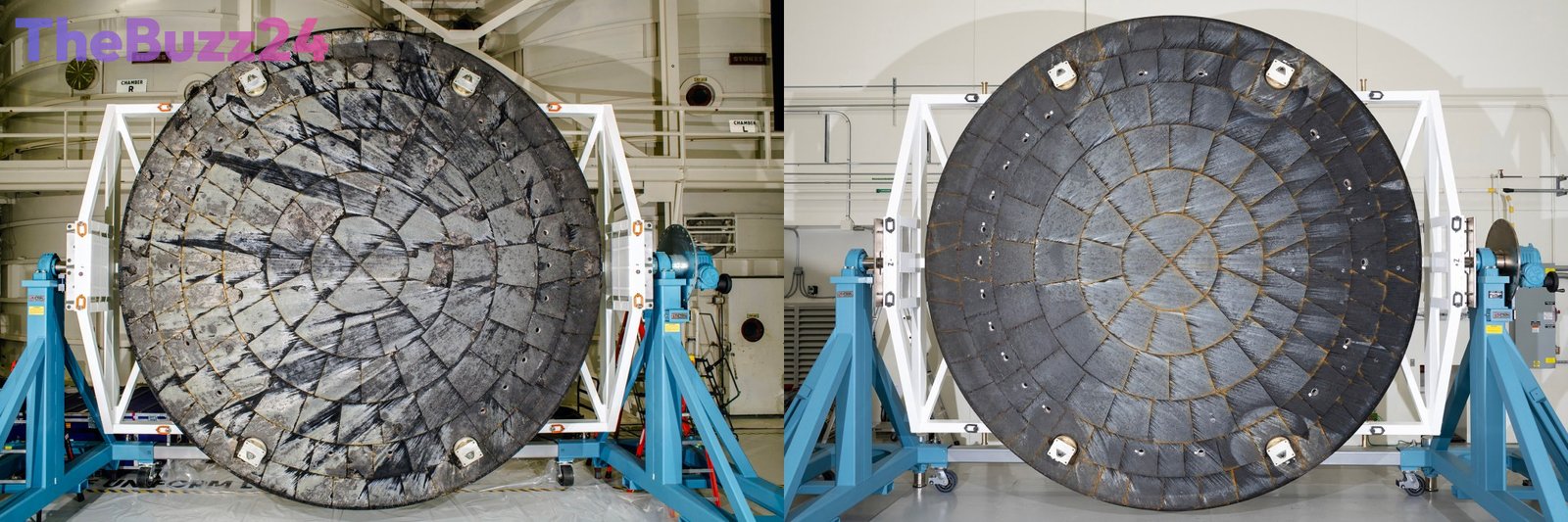
Following lessons learned from the Artemis I mission, NASA implemented modifications to Orion’s reentry trajectory for Artemis II. By shortening the spacecraft’s downrange distance during atmospheric entry, the agency aimed to reduce the time the heat shield spent in a temperature range where phenomena observed during Artemis I occurred. This strategic adjustment proved successful, with initial inspections revealing a significant reduction in char loss and cracking compared to the previous mission. Specifically, the Artemis II heat shield exhibited only nine instances of char loss, a stark contrast to the 103 recorded during Artemis I, demonstrating a tenfold improvement.
Further in-depth examinations at NASA’s Kennedy Space Center and Marshall Space Flight Center involved detailed inspections of the heat shield’s 186 Avcoat blocks, including sample extraction and X-ray scans. These analyses confirmed that the heat shield’s performance, along with the backshell’s protective ceramic tiles, aligned with pre-flight predictions. The data gathered from Artemis II is now being used to refine designs and manufacturing processes for future missions, including Artemis III, which aims to land astronauts on the lunar surface.
Key Takeaways
- NASA's Artemis II mission heat shield performed as expected, with significantly reduced char loss and cracking compared to Artemis I.
- Trajectory modifications implemented after Artemis I proved effective in mitigating heat shield anomalies.
- The successful performance of the heat shield is a critical step forward for NASA's crewed lunar exploration program, including Artemis III.
Editor’s Analysis & Impact
The successful post-mission analysis of the Artemis II heat shield is a significant confidence booster for NASA’s ambitious Artemis program. The marked improvement in heat shield performance, particularly the drastic reduction in char loss, validates the engineering changes made following the Artemis I mission. This success not only reinforces the reliability of the Orion spacecraft but also paves a clearer path toward the critical Artemis III lunar landing. The data gathered will be invaluable for refining future spacecraft designs and operational procedures, ensuring the safety and success of increasingly complex deep-space missions. The findings underscore the iterative nature of space exploration, where each mission builds upon the knowledge and experience of the last.
Frequently Asked Questions
Q: What is Avcoat?
A: Avcoat is an ablative material used in NASA's Orion spacecraft heat shield. It is designed to char and vaporize during atmospheric re-entry, absorbing and dissipating the intense heat generated by friction with the Earth's atmosphere, thereby protecting the spacecraft and its crew.
Q: What was the main difference in heat shield performance between Artemis I and Artemis II?
A: The Artemis II heat shield showed a significant reduction in char loss and cracking compared to Artemis I. Engineers observed only nine instances of char loss on Artemis II, a tenfold decrease from the 103 instances recorded on Artemis I. This improvement is attributed to trajectory modifications made after the Artemis I mission.
Q: What is the significance of the Artemis II heat shield performance for future missions?
A: The successful performance and subsequent analysis of the Artemis II heat shield provide crucial validation for NASA's thermal protection systems. This success builds confidence and provides essential data for the development and execution of future lunar missions, including Artemis III, which aims to land astronauts on the Moon.
AI Disclosure: This article is based on verified data and official reports. Our Team and AI have cross-referenced every financial detail with primary sources to ensure total accuracy.
More from this Category