Hubble Unveils Distant Spiral Galaxy NGC 1827, Advancing Cosmological Insights
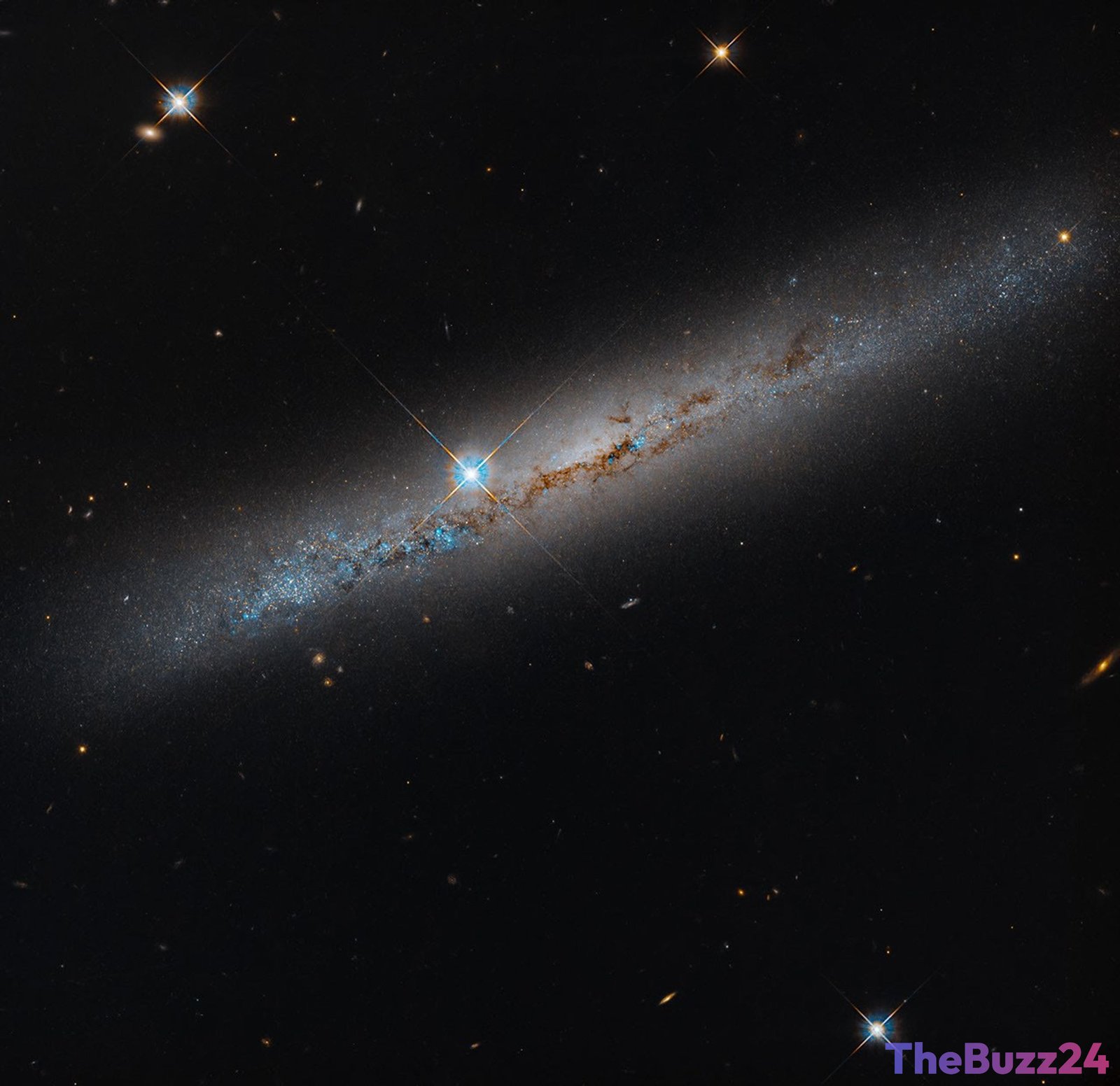
The NASA Hubble Space Telescope has captured a breathtaking image of NGC 1827, an intermediate spiral galaxy seen perfectly edge-on. Located approximately 37 million light-years away in the constellation Columba, often known as The Dove, this celestial body presents a striking profile with its prominent rusty-brown dust lanes bisecting its length. The intricate details captured by Hubble also reveal a scattering of distant galaxies in the background and foreground stars, easily identifiable by their characteristic diffraction spikes.
This particular observation of NGC 1827 is part of an extensive survey designed to study 260 satellite galaxies orbiting 22 host galaxies similar to our own Milky Way, all within a radius of about 32 million light-years from Earth. To date, Hubble has successfully imaged 111 of these satellite galaxies, with plans to complete observations of the remaining 149, dedicating one orbit for each. The image, taken with Hubble’s Advanced Camera for Surveys, highlights bright-blue regions across the galaxy’s disk, interspersed with dark dust lanes—areas indicative of active new star formation. A bright foreground star, positioned between Earth and the galaxy, appears just to the left of NGC 1827’s luminous central bulge, its four diffraction spikes a signature of Hubble’s optical system.
The scientific significance of this ongoing program lies in its potential to test and refine cosmological models. Low-mass galaxies, such as those included in this Hubble study, offer crucial data points for evaluating theoretical predictions on smaller cosmic scales, where current models often struggle to align with observational evidence. By meticulously characterizing the properties of these low-mass galaxies within Milky Way-like systems, researchers aim to gather invaluable insights that will enable them to enhance and validate our understanding of galaxy formation and evolution. The image processing was contributed by Gladys Kober (NASA/Catholic University of America), with Michael Jones (California Institute of Technology) also involved in the project.
Key Takeaways
- The Hubble Space Telescope captured a detailed image of NGC 1827, an edge-on spiral galaxy located 37 million light-years away.
- This observation is part of a larger survey studying 260 satellite galaxies around Milky Way-like hosts to understand low-mass galaxy properties.
- The data collected will help refine cosmological models, particularly those that struggle to accurately predict observations on smaller scales.
Editor’s Analysis & Impact
The ongoing Hubble Space Telescope survey, exemplified by the observation of NGC 1827, underscores the enduring value of long-duration space missions for fundamental scientific discovery. While not directly impacting commercial markets, this research significantly advances the field of astrophysics, providing critical data to refine cosmological models that explain the universe’s structure and evolution. The ability to test theoretical predictions against real-world observations of low-mass galaxies is crucial for bridging gaps in our understanding of galaxy formation. The future outlook for such studies involves integrating these findings with data from newer observatories like the James Webb Space Telescope, promising a more comprehensive picture of cosmic history. Broader implications include inspiring future generations of scientists and engineers, fostering international collaboration in space exploration, and continually expanding humanity’s knowledge of its place in the cosmos.
Frequently Asked Questions
Q: Why is studying low-mass galaxies important for cosmological models?
A: Low-mass galaxies provide crucial data points for testing and refining cosmological models, especially on smaller scales where current theoretical predictions often diverge from observational evidence. Understanding their properties helps improve our overall understanding of galaxy formation and the universe's structure.
Q: What instrument on Hubble was used to capture the image of NGC 1827?
A: The image of NGC 1827 was captured using the Advanced Camera for Surveys (ACS) aboard the NASA Hubble Space Telescope.
AI Disclosure: This article is based on verified data and official reports. Our Team and AI have cross-referenced every financial detail with primary sources to ensure total accuracy.
More from this Category