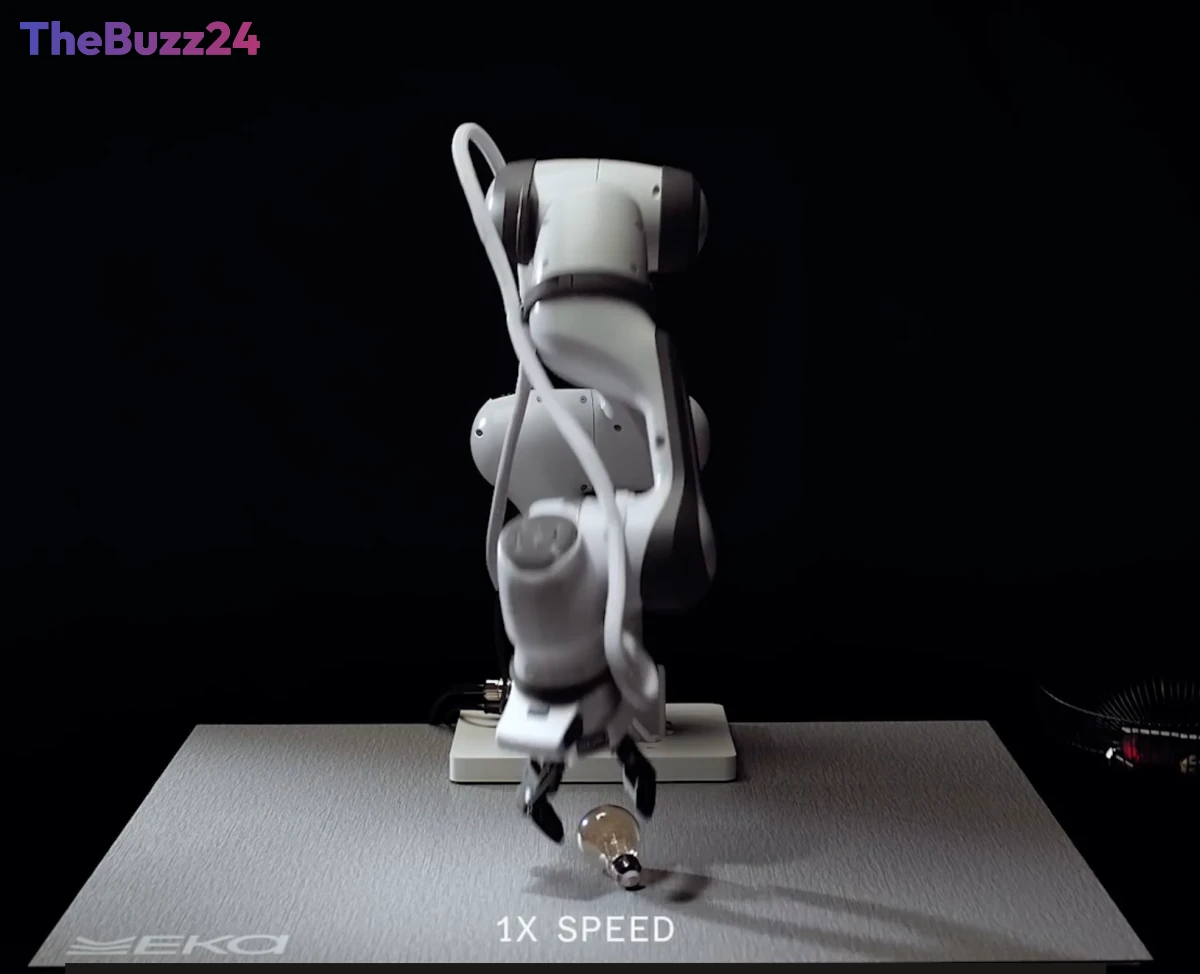
Eka Robotics Secures $150 Million, Valued at $1.45 Billion for Groundbreaking AI Manipulation
A new era in robotics may be dawning thanks to Eka Robotics, a startup that has developed a novel manipulation architecture capable of unprecedented dexterity. Despite significant investments in robotic grasping, achieving human-level or superior performance has remained elusive. Eka’s innovative approach, combining a force-sensitive gripper with a unique deep-learning model, has garnered significant attention and led to a substantial $150 million Series A funding round, valuing the company at $1.45 billion post-money. The round was spearheaded by prominent venture capital firms a16z and F-Prime.
Industry experts are expressing astonishment at Eka’s capabilities. Raghu Raguram, a general partner at a16z, noted that the company is already surpassing human performance in specific tasks and anticipates widespread superhuman performance in dexterous manipulation within months. This sentiment is echoed by veteran roboticists who have witnessed Eka’s technology firsthand. Kris Hauser, a professor at the University of Illinois Urbana-Champaign, highlighted the robot’s ability to adapt to a wide array of objects without requiring retraining, describing its persistent attempts to grasp items as having a “humanness, creepy humanness.” Another anonymous roboticist from a leading research lab compared the experience of seeing Eka’s robot in action to the groundbreaking advancements in legged locomotion seen years ago.
The core of Eka’s breakthrough lies in its “vision-force-action” model, a departure from traditional “vision-language-action” approaches. This model prioritizes the interplay between visual input, force feedback, and subsequent actions, addressing a critical gap in current AI robotics. Eka co-founder Pulkit Agrawal explained that while vision helps locate objects, the fine-tuned manipulation, especially the final grasp, relies heavily on force sensing. The company developed a specialized, more flexible gripper equipped with advanced force sensors, enabling it to handle delicate objects like raspberries without crushing them. This is achieved through extensive use of physics simulators to model forces and create a reinforcement learning environment that can be trained at an accelerated scale, generating thousands of hours of simulated robot experience in mere minutes.
Eka’s strategy focuses on bridging the gap between the generality and performance of AI models in robotics. While many current AI models can perform a variety of tasks, they often lack the precision and efficiency needed for real-world applications. Eka’s approach aims to handle the complex physical interactions, allowing higher-level AI models to focus on decision-making and task planning. The company is currently engaged in pilot programs with industrial clients for pick-and-place and wire manipulation tasks, with a long-term goal of achieving the durability and reliability standards of traditional industrial robotic arms. The success of Eka’s technology could significantly accelerate the deployment of versatile and capable robots across various industries.
Key Takeaways
- Eka Robotics has raised $150 million, achieving a $1.45 billion valuation, for its advanced AI manipulation technology.
- The company's 'vision-force-action' model and specialized gripper enable robots to perform dexterous tasks with superhuman speed and precision.
- Eka's approach uses physics simulation and reinforcement learning to rapidly train robots, overcoming limitations of previous methods.
Editor’s Analysis & Impact
Eka Robotics’ substantial funding and impressive valuation underscore a significant shift in the AI robotics landscape. By prioritizing force feedback and leveraging advanced simulation techniques, the company appears to be tackling the long-standing challenge of robotic dexterity. This breakthrough could have profound implications for industries requiring intricate manipulation, from manufacturing and logistics to healthcare. The focus on a ‘bottom-up’ approach, integrating physical interaction capabilities, suggests a more pragmatic path towards general-purpose robots that can truly operate in complex, real-world environments. While challenges in scaling and proving long-term reliability remain, Eka’s progress signals a potential acceleration in the adoption of sophisticated robotic solutions.
Frequently Asked Questions
Q: What makes Eka Robotics' AI model different from others?
A: Eka's model is a 'vision-force-action' model, meaning it focuses on how visual input, force feedback, and actions interact. This is different from many current models that are 'vision-language-action,' which prioritize understanding language and visual cues over precise physical interaction.
Q: How does Eka's robot achieve such high performance in picking up objects?
A: Eka utilizes a specialized, force-sensitive gripper and a deep-learning model trained through extensive physics simulations and reinforcement learning. This allows the robot to learn how to grasp objects delicately and efficiently, even adapting to new items without explicit retraining.
Q: What are the potential applications for Eka's technology?
A: The technology is particularly suited for tasks requiring high dexterity and precision, such as complex pick-and-place operations, intricate assembly in manufacturing, logistics, and potentially even delicate handling in fields like healthcare or food processing.
AI Disclosure: This article is based on verified data and official reports. Our Team and AI have cross-referenced every financial detail with primary sources to ensure total accuracy.
More from this Category