Looking Back at Rosetta’s Iconic Selfie Near Comet 67P
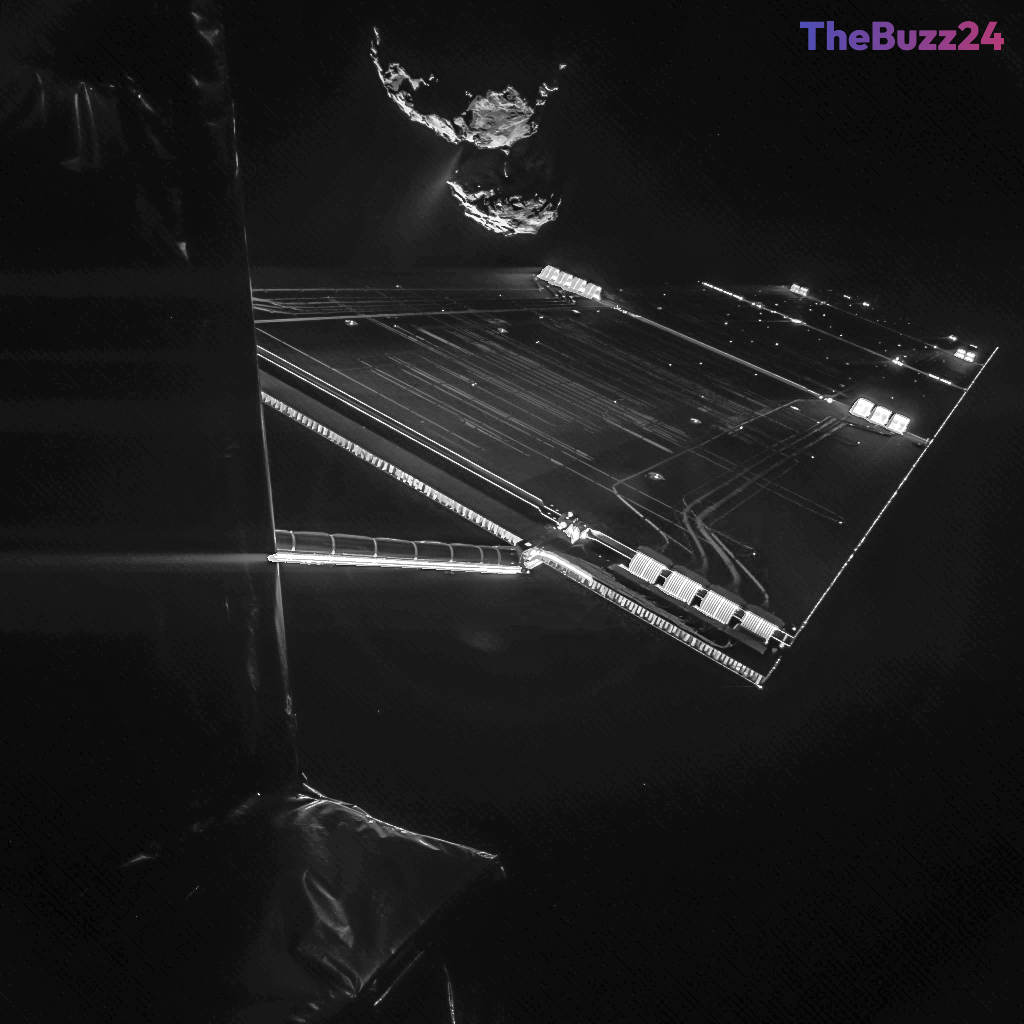
A historic photograph captured by the European Space Agency’s Rosetta spacecraft and its Philae lander continues to offer a fascinating glimpse into deep space exploration. Taken on October 7, 2014, the unique selfie showcased the comet-hunting orbiter positioned approximately 472 million kilometers from Earth, yet just 16 kilometers away from the icy surface of comet 67P/Churyumov-Gerasimenko.
The high-contrast visual was achieved by combining two distinct exposures—one short and one long—utilizing the CIVA camera system mounted on the Philae lander, which was still attached to the orbiter at the time. In the background, volatile gases and dust can be seen streaming away from the distinct double-lobed nucleus of the comet, while intense sunlight dramatically reflects off one of Rosetta’s expansive 14-meter solar arrays.
This remarkable snapshot proved to be the final image captured by Philae’s camera prior to its historic separation from the main orbiter on November 12, 2014. Following the deployment, the lander managed to snap a parting glance back at the Rosetta spacecraft before beginning its treacherous descent toward the designated primary landing site located on the smaller lobe of the comet’s nucleus.
Key Takeaways
- The iconic selfie of the Rosetta spacecraft was captured on October 7, 2014, near comet 67P/Churyumov-Gerasimenko.
- The image was created using a combination of short and long exposures from the CIVA camera system on the Philae lander.
- This photograph served as the last image taken by Philae's camera before it separated from the orbiter to land on the comet.
Editor’s Analysis & Impact
The Rosetta mission stands as a monumental achievement in planetary science and deep-space exploration, fundamentally shifting our understanding of comets and the early solar system. By successfully orbiting and landing on a comet, space agencies demonstrated unprecedented technological capabilities that pave the way for future sample-return missions and asteroid deflection strategies. Archiving and reflecting on these historical milestones not only honors the engineering triumphs of international space programs but also continually inspires public engagement with astronomy. As the aerospace sector increasingly looks toward commercial deep-space ventures, the methodologies and lessons learned from the Rosetta-Philae campaign remain invaluable foundational benchmarks for navigating complex gravitational fields and operating in deep space.
Frequently Asked Questions
Q: When was the Rosetta spacecraft selfie taken?
A: The selfie was captured on October 7, 2014, while the spacecraft was approximately 16 kilometers away from comet 67P/Churyumov-Gerasimenko.
Q: How was the high-contrast image created?
A: The image was produced by combining two separate exposures—one short and one long—using the CIVA camera system on the Philae lander.
Q: What happened shortly after this image was taken?
A: Shortly after capturing this view, the Philae lander separated from the Rosetta orbiter on November 12, 2014, to begin its descent onto the comet's nucleus.
AI Disclosure: This article is based on verified data and official reports. Our Team and AI have cross-referenced every financial detail with primary sources to ensure total accuracy.
More from this Category