Uncovering Hidden Gaps in Political Prediction Markets
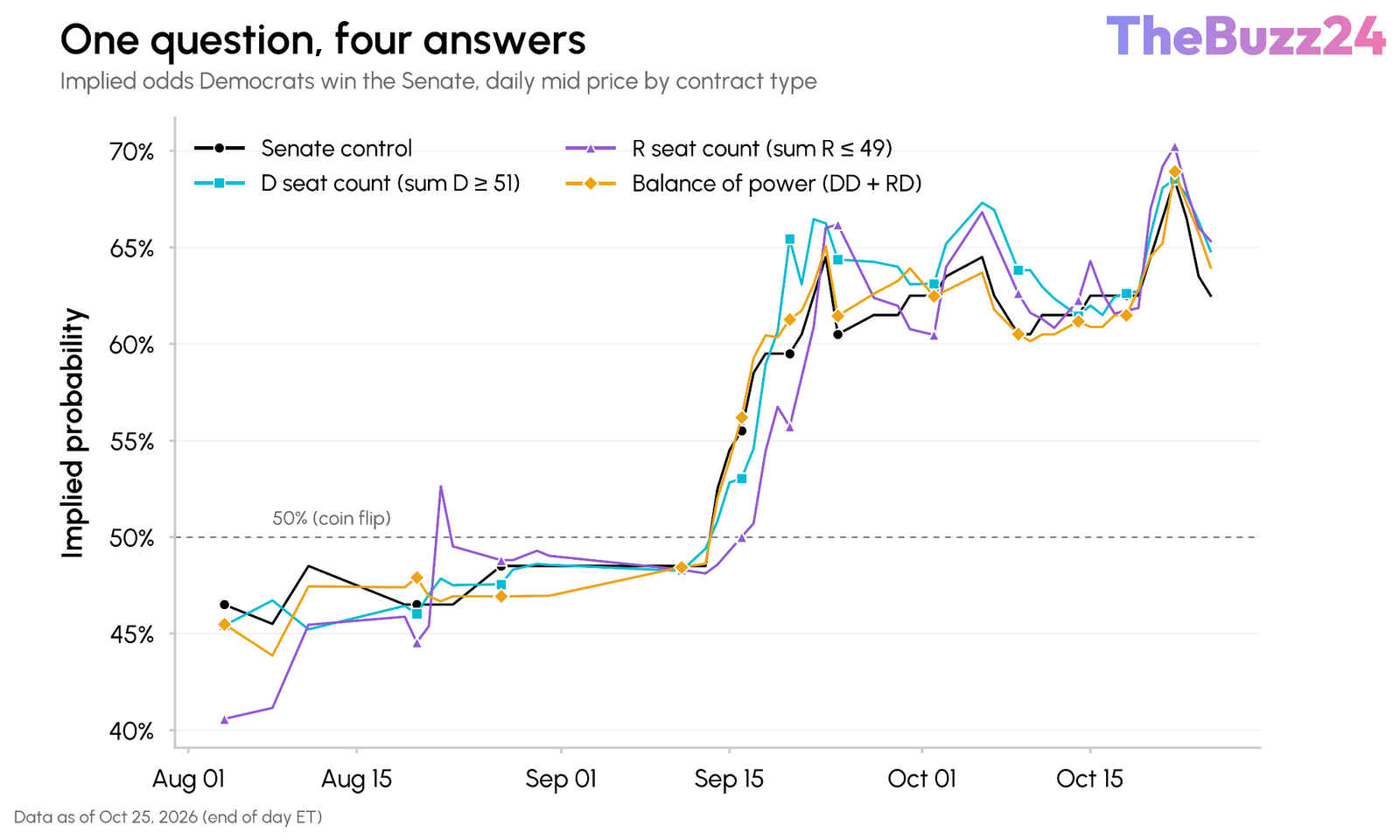
Prediction markets, increasingly popular platforms for forecasting future events, often present a façade of unified consensus. However, a closer examination reveals significant pricing discrepancies for identical outcomes, challenging the notion of a single, definitive market probability. Analysis of contracts on platforms like Kalshi, particularly concerning the “Will Democrats control the Senate?” question, illustrates how implied probabilities for the same event can diverge by several percentage points, sometimes as much as 9.7 points, averaging 3.3 points over a period. This fragmentation means that what appears to be one question can have multiple, subtly different answers depending on the specific contract.
These pricing inconsistencies can theoretically open doors for arbitrage. For instance, a hypothetical nine-leg package designed to profit from the Senate control outcome on Kalshi, structured to pay out a fixed amount regardless of the specific Democratic seat count, was observed to be priced below its guaranteed payout on numerous occasions. While this suggests a potential arbitrage opportunity, practical execution is fraught with challenges. After accounting for estimated fees, the modeled edge significantly diminished, becoming positive on only a handful of days. The primary hurdles include lopsided liquidity, where major control contracts trade millions while specific seat-count contracts see minimal volume, as well as legging risk, transaction fees, and differing settlement bases and timelines for various contracts.
The phenomenon observed in the Senate control market is not isolated but indicative of a broader trend within the rapidly expanding prediction market landscape. With hundreds of thousands of live contracts across various events and multiple venues like Kalshi and Polymarket, fragmentation is a defining characteristic. This spread of liquidity across numerous, often thinly traded, contracts means that price inefficiencies are likely to persist. For sophisticated participants, identifying and capitalizing on these gaps requires comprehensive data analysis, a deep understanding of contract resolution terms, real-time order-book depth, and advanced multi-leg execution strategies to navigate the complexities and costs inherent in these nascent markets.
Key Takeaways
- Prediction markets like Kalshi often display significant pricing discrepancies for identical outcomes, such as the "Democrats control the Senate" question.
- These price gaps can create theoretical arbitrage opportunities, though practical execution is challenging due to factors like lopsided liquidity, transaction fees, and settlement timing differences.
- The fragmentation and rapid growth of prediction markets across various platforms and contract types contribute to these persistent pricing inefficiencies, requiring sophisticated strategies for identification and exploitation.
Editor’s Analysis & Impact
The prevalence of pricing discrepancies in prediction markets, as highlighted by the Kalshi Senate contracts, underscores the relative immaturity and inefficiency of this emerging asset class compared to traditional financial markets. While these gaps present theoretical arbitrage opportunities, the practical difficulties in exploiting them—stemming from fragmented liquidity, high transaction costs, and settlement complexities—suggest that prediction markets are still far from perfectly efficient. As the sector continues its rapid growth and attracts more participants, including institutional players, we might see a gradual reduction in these inefficiencies. However, the inherent fragmentation across numerous contracts and venues could also mean that sophisticated trading strategies will remain crucial for those seeking to extract value, challenging the simplistic view of prediction markets as a singular, reliable barometer of future events.
Frequently Asked Questions
Q: What are prediction markets?
A: Prediction markets are online platforms where users can trade contracts whose payoffs are tied to the outcome of future events, such as elections, economic indicators, or sports results. They are designed to aggregate collective wisdom into a probabilistic forecast.
Q: Why do pricing gaps occur in prediction markets for the same outcome?
A: Pricing gaps arise due to several factors, including fragmented liquidity across different contract types and venues, varying settlement terms, transaction fees, and the inherent difficulty of executing complex multi-leg trades across thinly traded markets.
Q: Are these pricing discrepancies easy to profit from through arbitrage?
A: While theoretical arbitrage opportunities may exist, profiting from them is often challenging. High transaction fees, the risk of prices moving during multi-leg execution (legging risk), and the illiquidity of certain contracts can quickly erode potential gains, making practical arbitrage difficult for most participants.
AI Disclosure: This article is based on verified data and official reports. Our Team and AI have cross-referenced every financial detail with primary sources to ensure total accuracy.
More from this Category