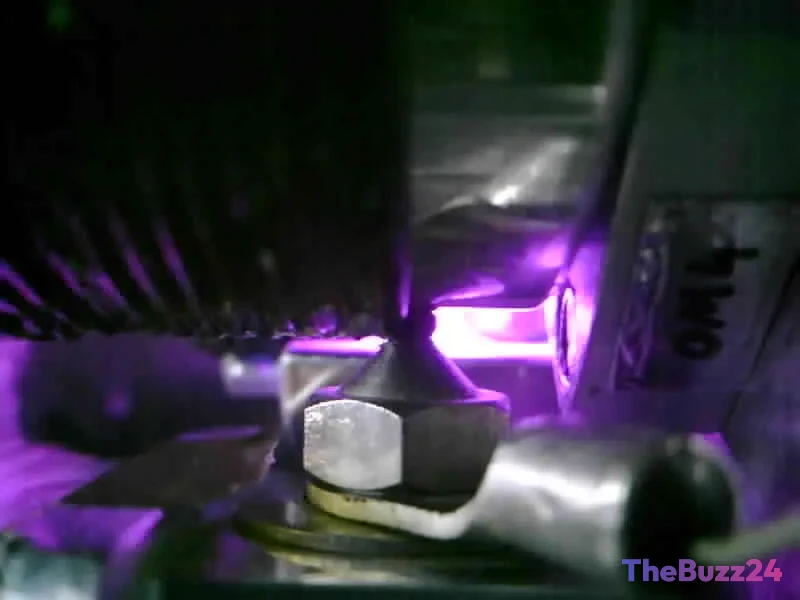
Orbital Matter Achieves Space-Based 3D Printing Milestone, Paving Way for Larger Orbital Structures
German startup Orbital Matter has successfully 3D-printed a rigid beam in the vacuum of space, marking a significant advancement in in-space manufacturing. The company’s Replicator 2 satellite, launched this summer via a SpaceX rideshare mission, utilized its onboard 3D printers to create a half-meter long beam from a specialized plastic material. This achievement is hailed by company executives as a crucial step towards enabling the construction of larger, more complex structures directly in orbit.
The innovative printing process involves extruding coils of resin, which are then cured by ultraviolet light, a method Orbital Matter likens to traditional cement and water curing. This capability addresses a key challenge for future spacecraft, which are expected to require larger dimensions for enhanced power generation and heat dissipation, particularly for applications like orbital data centers. By allowing spacecraft to build their own structures in orbit, the limitations imposed by rocket fairing sizes can be overcome, simplifying the design and deployment of these advanced systems.
Jakub Stojek, CEO and co-founder of Orbital Matter, emphasized the significance of the Replicator 2 mission, stating, “Replicator 2 is the first proof that we can simply build the array in space, at whatever size the mission demands.” The company is collaborating with established entities like the European Space Agency and Thales Alenia on this technology. Unlike current large space structures that rely on complex folding and deployment mechanisms, in-space construction offers a more direct and potentially more robust solution.
While one of the four printers on Replicator 2 experienced an anomaly, the successful printing and deployment of a solar array using a created boom demonstrate the viability of the core technology. Previous in-space 3D printing efforts were confined to the controlled environments of the International Space Station. Orbital Matter’s approach prioritizes in-orbit learning and adaptation, a strategy CTO Robert Ihnatisin explained was chosen over extensive ground testing to accelerate development.
The company envisions future capabilities for printing booms up to 100 meters long, significantly exceeding the solar array lengths of current advanced satellites. Orbital Matter is already planning a follow-up demonstration mission for 2028, aiming to test a larger printer on a bigger satellite capable of generating 5 kW of power, with aspirations for 100+ kW deployments by 2030. They are also working with other satellite manufacturers to integrate their Printer-Assisted Deployment System (PADS) for extending various spacecraft components.
Key Takeaways
- Orbital Matter has successfully 3D-printed a rigid beam in the vacuum of space using its Replicator 2 satellite.
- This achievement is a significant step towards enabling the construction of larger spacecraft structures in orbit, overcoming current size limitations.
- The company plans future missions to demonstrate larger-scale in-space manufacturing, potentially revolutionizing satellite design and capabilities.
Editor’s Analysis & Impact
Orbital Matter’s successful in-space 3D printing demonstration has profound implications for the future of space infrastructure. By proving the concept of building structures directly in orbit, the company is challenging the traditional paradigm of folding and deploying components. This could unlock the potential for significantly larger and more powerful satellites, essential for advanced applications like deep-space exploration, orbital data centers, and enhanced communication networks. The ability to construct custom-sized structures on demand also offers greater flexibility and resilience in space missions. While challenges remain in scaling the technology and ensuring long-term reliability, this breakthrough positions Orbital Matter as a key player in the burgeoning in-space manufacturing sector, potentially reshaping the economics and capabilities of space-based operations.
Frequently Asked Questions
Q: What is the significance of 3D printing a beam in space?
A: 3D printing a beam in the vacuum of space is significant because it demonstrates the ability to manufacture components and structures directly in orbit. This overcomes the limitations of launching pre-fabricated, folded structures and opens the door for building much larger and more complex spacecraft and infrastructure in space, which is crucial for future space missions and applications.
Q: How does Orbital Matter's technology differ from previous in-space 3D printing efforts?
A: Previous in-space 3D printing efforts were largely confined to the controlled, pressurized environment of the International Space Station. Orbital Matter's achievement is notable because it successfully printed a rigid beam in the free-flying vacuum of space, a much more challenging environment that better simulates the conditions for future large-scale orbital construction.
Q: What are the potential applications for large structures built in space?
A: Large structures built in space could be used for a variety of advanced applications, including larger solar arrays for increased power generation, enhanced heat radiators for thermal management, orbital data centers, advanced telescopes, and components for future space habitats or manufacturing facilities. This capability is essential for supporting more ambitious space exploration and commercial endeavors.
AI Disclosure: This article is based on verified data and official reports. Our Team and AI have cross-referenced every financial detail with primary sources to ensure total accuracy.
More from this Category