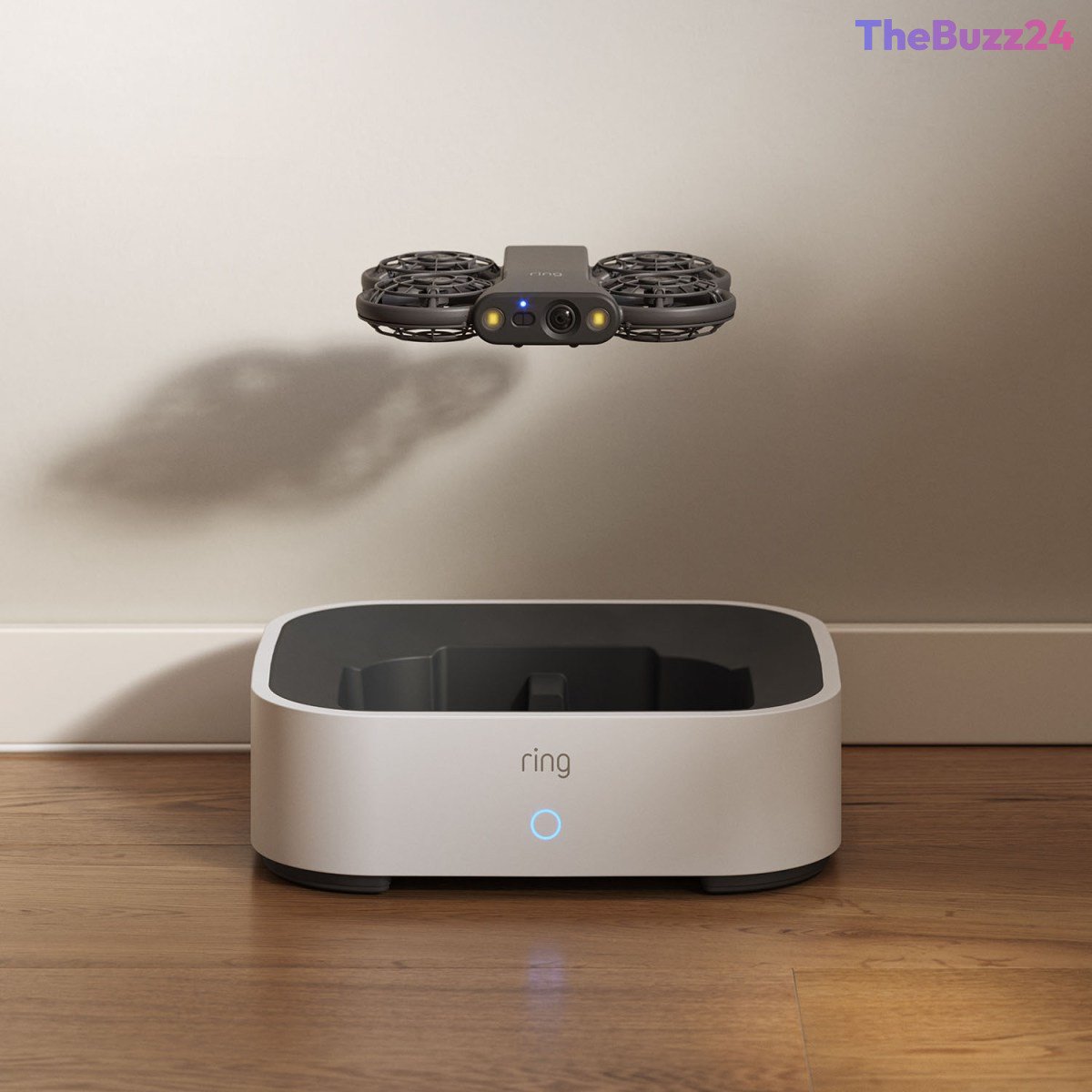
Ring Expands Into Robotics with New Autonomous Security Drone and Enterprise Rover
Ring has officially entered the robotics market with the launch of a dedicated division aimed at automating surveillance for both residential and commercial properties. The company introduced two flagship devices: a flying indoor security drone designed for homes and a roving security robot tailored for business environments. These additions represent a significant shift in how the company approaches perimeter and interior monitoring, moving beyond static cameras to mobile, autonomous units.
The home security drone, marketed as a flying indoor camera, is engineered to integrate seamlessly with existing Ring alarm systems. When a sensor is triggered, the drone can autonomously navigate to the specific location to investigate, providing 2K video footage and utilizing LED lighting for low-light visibility. Users can schedule patrols or manually control the device via the Alexa Home Map interface. When not in operation, the drone remains docked in a charging station.
For the enterprise sector, the company is rolling out a roving robot capable of continuous 4K video streaming. This unit features a periscope camera to bypass obstacles and two-way audio functionality, allowing remote users to communicate with individuals on-site. Both devices are powered by a proprietary AI system called AI Pilot, which utilizes vision models and sensors to map environments and navigate spaces without human intervention. The enterprise robot is scheduled for release on December 16 at a price point of $1,000, while the home drone is expected to launch on January 27 for $270.
Despite the technological advancements, the introduction of mobile surveillance units has reignited discussions regarding privacy. Critics have previously raised concerns about the company’s role in creating expansive surveillance networks. In response, the company maintains that these new devices prioritize security, noting that all recorded data is protected by its most robust default encryption standard, known as Throw Away the Key Encryption (TAKE).
Key Takeaways
- Ring has launched a new robotics division featuring an autonomous indoor security drone and a roving enterprise security robot.
- Both devices utilize 'AI Pilot' technology to map environments and navigate autonomously without human input.
- The enterprise robot is priced at $1,000 with a December release, while the home drone will retail for $270 in January.
Editor’s Analysis & Impact
The entry of Ring into the autonomous robotics space signals a strategic pivot toward ‘active’ security, moving away from passive monitoring. By leveraging AI-driven navigation, the company is attempting to solve the long-standing industry challenge of providing comprehensive coverage without the need for an exhaustive network of static cameras. However, the market success of these products remains uncertain. Previous attempts by parent company Amazon to market home robots, such as the Astro, struggled to find a sustainable consumer base. Furthermore, the company faces a steep uphill battle regarding public perception; as surveillance becomes more mobile and invasive, the threshold for consumer trust will be tested. If the company can successfully balance its advanced encryption claims with transparent data policies, it may redefine the smart home security sector, but any privacy missteps could lead to significant regulatory and reputational backlash.
Frequently Asked Questions
Q: How do the new Ring robots navigate through a home or office?
A: The devices use a proprietary AI system called AI Pilot, which leverages specialized vision models, sensors, and cloud processing to autonomously map and navigate the environment.
Q: What security measures are in place for the video footage recorded by these devices?
A: The company states that all video recorded by the drone and the rover is protected by its 'Throw Away the Key Encryption' (TAKE), which is described as their strongest default encryption method.
AI Disclosure: This article is based on verified data and official reports. Our Team and AI have cross-referenced every financial detail with primary sources to ensure total accuracy.
More from this Category