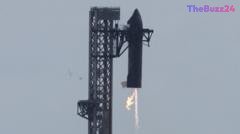
SpaceX Snags Starship Upper Stage in Bold Test Flight Following Booster Ocean Splashdown
SpaceX achieved a major technical milestone during its latest Starship test flight, successfully recovering the spacecraft’s upper stage using mechanical capture arms on the launch tower. The ambitious mission aimed to recover both primary components of the massive launch vehicle upon their descent back to Earth, marking another step forward in the development of fully reusable space hardware.
While the upper vehicle, known as the Ship, executed a precise return maneuver before being caught by the launch tower’s dual mechanical arms—commonly referred to as “chopsticks”—the test flight yielded mixed results earlier in the mission profile. Flight controllers made the tactical decision to abort the planned tower recovery of the heavy lower-stage booster just minutes after liftoff.
Following the abort command, the booster was safely redirected away from the primary facility toward the open ocean. Upon approaching the sea, the stage burst into flames shortly before splashing down. Despite missing the booster recovery, securing the Ship provides vital operational data as engineering teams continue refining autonomous landing systems for future deep-space missions.
Key Takeaways
- SpaceX successfully secured the Starship upper stage using mechanical catch arms upon its return.
- The lower-stage booster recovery was aborted shortly after launch, resulting in a controlled ocean splashdown.
- The test flight provided valuable flight data to further advance fully reusable rocket infrastructure.
Editor’s Analysis & Impact
SpaceX’s iterative testing philosophy continues to redefine aerospace engineering standards. While falling short of a dual-stage recovery highlights the extreme difficulty of mid-air booster catches, successfully securing the upper stage represents a significant achievement. Complete vehicle reusability remains the ultimate goal for commercial spaceflight, with the potential to drastically reduce orbital payload costs. Demonstrating that large spacecraft can precisely return to launch infrastructure validates core concepts of the Starship system. As launch cadences increase, these practical tests build vital momentum for upcoming commitments, including NASA’s Artemis lunar lander program and eventual interplanetary missions.
Frequently Asked Questions
Q: What are the mechanical arms on the SpaceX launch tower?
A: The mechanical arms, nicknamed 'chopsticks,' are designed to catch returning rocket boosters and spacecraft directly at the launch pad, eliminating the need for traditional landing legs and speeding up turnaround times.
Q: Why was the booster catch aborted during the flight?
A: Mission controllers aborted the tower catch for the lower booster after automated system checks indicated conditions were not optimal, triggering a safety reroute to an ocean splashdown.
Q: What is the main objective of the Starship system?
A: Starship is engineered as a fully reusable rocket system built to carry crew and cargo to Earth orbit, the Moon, Mars, and destinations beyond.
AI Disclosure: This article is based on verified data and official reports. Our Team and AI have cross-referenced every financial detail with primary sources to ensure total accuracy.
More from this Category