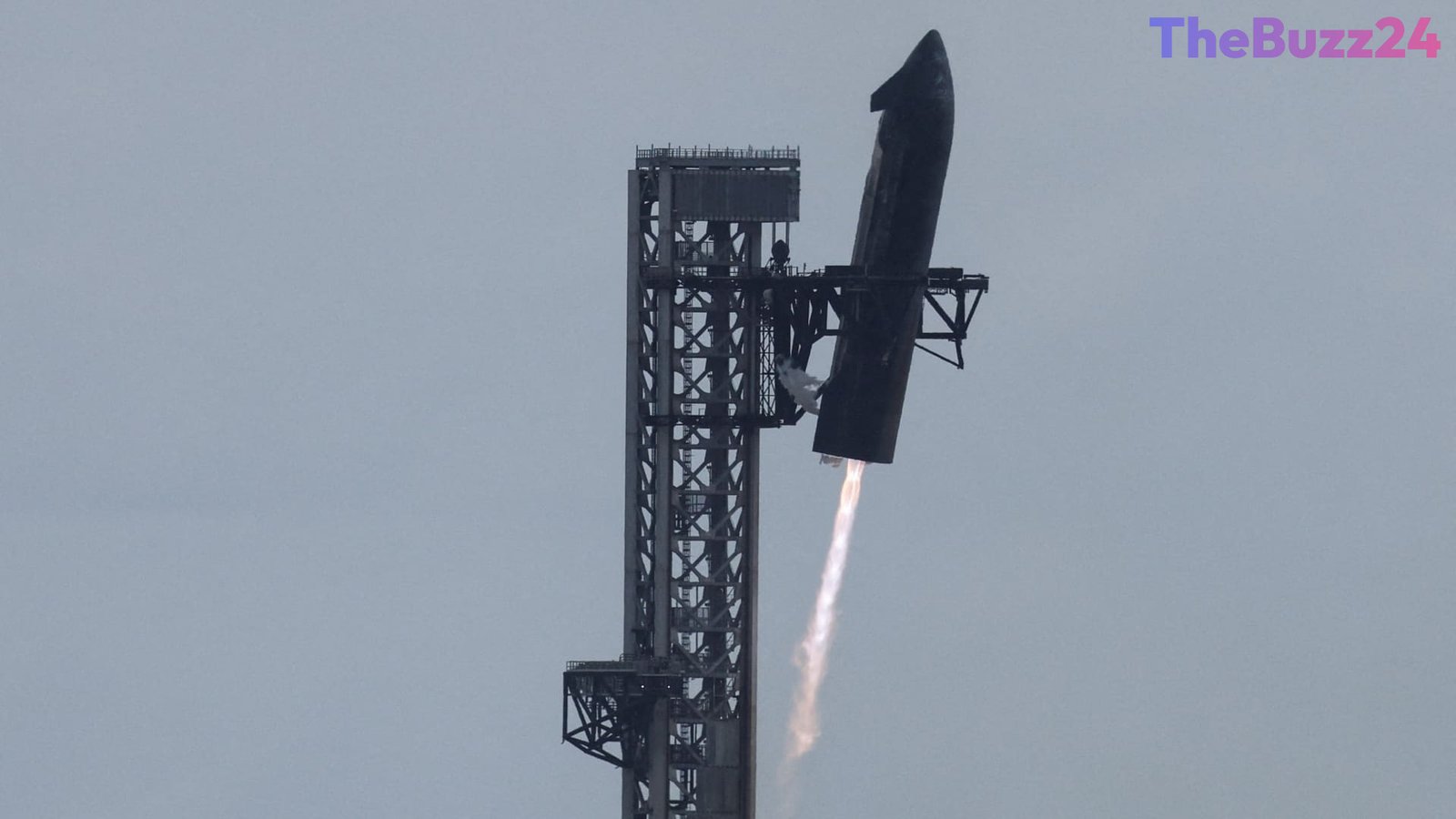
SpaceX Achieves Historic Milestone by Catching Starship Upper Stage with Launch Tower Arms
In a monumental breakthrough for aerospace engineering, Elon Musk’s space venture successfully captured the upper stage of its colossal Starship rocket directly from orbit. Utilizing massive mechanical arms affixed to the launch tower at the company’s Starbase facility in Texas, engineers achieved a feat previously thought impossible, marking a pivotal turning point in reusable rocket technology.
The ambitious test flight demonstrated the extreme precision required for full and rapid reusability. While the initial phase of the flight encountered a setback when the booster rocket missed its recovery target and was diverted to a controlled splashdown in the Gulf of Mexico, the spacecraft itself pressed onward. After completing multiple orbits around the Earth, the upper stage returned precisely to the launch site, where the tower’s specialized arms successfully clamped onto the descending vehicle.
Achieving full reusability is the cornerstone of the company’s long-term strategic roadmap. In the immediate future, the upgraded Starship fleet is slated to accelerate the deployment of next-generation Starlink internet satellites, scaling up global connectivity. Looking further ahead, the heavy-lift vehicle is contracted to support lunar landing missions for space agencies and ultimately serves as the primary transport system for ambitious interplanetary colonization goals.
Key Takeaways
- SpaceX successfully caught the upper stage of a Starship rocket using mechanical launch tower arms.
- The milestone follows a booster recovery failure during the initial phase of the ambitious test flight.
- Developing fully reusable rockets is essential for deploying Starlink satellites and future deep-space missions.
Editor’s Analysis & Impact
The successful mid-air capture of the Starship upper stage represents a watershed moment for the commercial space industry. By demonstrating the viability of tower catches for orbital-class hardware, the company is drastically lowering the economic barriers of spaceflight through rapid hardware recovery and turnaround. This capability directly undercuts legacy aerospace cost structures, positioning the firm to aggressively scale its orbital economy ventures, including satellite broadband expansion and heavy cargo transport. While technical hurdles regarding booster recovery remain, the compounding efficiencies of a fully reusable heavy-lift architecture will likely force competitors to accelerate their own reusable launch system roadmaps, fundamentally shifting the competitive landscape of the global space economy over the next decade.
Frequently Asked Questions
Q: How did SpaceX catch the Starship upper stage?
A: The company used massive mechanical arms, nicknamed 'chopsticks' and attached to the launch tower at Starbase, Texas, to physically secure the descending spacecraft.
Q: Why is fully reusable rocket technology important?
A: Reusability drastically reduces the cost of building and launching rockets, enabling frequent flights required for commercial satellite deployment, lunar missions, and deep-space exploration.
Q: What are the primary applications for the Starship rocket?
A: Starship is designed to launch large batches of Starlink satellites, transport astronauts and cargo to the Moon for NASA, and eventually carry humans to Mars.
AI Disclosure: This article is based on verified data and official reports. Our Team and AI have cross-referenced every financial detail with primary sources to ensure total accuracy.
More from this Category