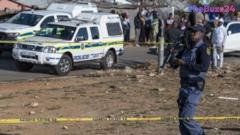
South Africa Launches Manhunts After Unrelated Mass Shootings Claim 17 Lives
Authorities in South Africa have launched extensive manhunts following two separate weekend mass shootings that claimed the lives of 17 people. In KwaZulu-Natal province, emergency responders discovered eight men fatally shot inside a vehicle parked outside Pietermaritzburg. Hours later, law enforcement in Gauteng province located nine victims—six men and three women—dead inside a residential structure within the Jeffsville informal settlement in Atteridgeville, west of Pretoria. Police officials have confirmed that the two fatal incidents appear to be entirely unconnected.
The violence highlights an ongoing security crisis driven by armed violence and organized criminal networks across the country. Investigators working the scene near Pietermaritzburg reported finding a white seven-seater vehicle riddled with bullet holes, while forensic teams in Atteridgeville recovered numerous spent shell casings scattered outside the residence. Local residents in the Pretoria settlement reported initially mistaking the rapid gunfire for thunder during the late-night attack. Specialized crime intelligence teams and tactical units have been deployed to determine motives and track down the suspects.
Mass casualty attacks have become an increasingly persistent concern in South Africa, fueled by the widespread availability of illegal firearms and violent turf battles tied to illicit mining and drug trafficking. Recent months have seen similar tragedies, including coordinated attacks in September that left nearly 30 individuals dead in separate incidents near Johannesburg and Cape Town. Informal settlements and high-density urban areas continue to bear the brunt of these sudden outbreaks of violence.
In response to public outrage, government leadership has escalated security interventions nationwide. President Cyril Ramaphosa has previously characterized organized crime as a direct threat to the nation’s democratic stability and economic potential, leading to joint military and police operations in high-crime provinces. Despite periodic fluctuations in quarterly crime statistics, South Africa continues to register one of the highest homicide rates globally, averaging around 60 murders nationwide each day.
Key Takeaways
- Seventeen people were killed in two separate, unrelated mass shootings in KwaZulu-Natal and Gauteng provinces.
- Law enforcement agencies have deployed specialized intelligence and tracking teams to identify suspects and determine motives.
- The attacks reflect ongoing challenges with illegal firearms and organized crime despite joint police-military security operations.
Editor’s Analysis & Impact
The recurrent mass shootings in South Africa highlight deep structural challenges affecting public safety, economic development, and social cohesion. High rates of unemployment and inequality create fertile ground for organized criminal enterprises, while the influx of illicit firearms amplifies the deadliness of turf battles. Although temporary measures like military deployment provide short-term deterrence, enduring stability demands institutional reforms aimed at dismantling smuggling operations, strengthening local community policing, and improving infrastructure in informal settlements. Persistent high crime rates threaten foreign investment, trade, and tourism, making internal security a paramount economic priority for national leadership.
Frequently Asked Questions
Q: Where did the two shooting incidents occur?
A: The shootings took place in two separate regions: one outside Pietermaritzburg in KwaZulu-Natal province, and the other in the Jeffsville informal settlement in Atteridgeville, west of Pretoria.
Q: Are the two mass shootings connected?
A: According to police officials, there is no evidence linking the two incidents, and both are currently being investigated as separate cases.
Q: What measures are being taken to address high murder rates in South Africa?
A: The government has deployed military units alongside police forces in key provinces, alongside specialized crime intelligence and tracking teams focused on gang violence and illegal firearm confiscation.
AI Disclosure: This article is based on verified data and official reports. Our Team and AI have cross-referenced every financial detail with primary sources to ensure total accuracy.
More from this Category