Astronomers Capture Real-Time Collision of Binary Stars in the Andromeda Galaxy
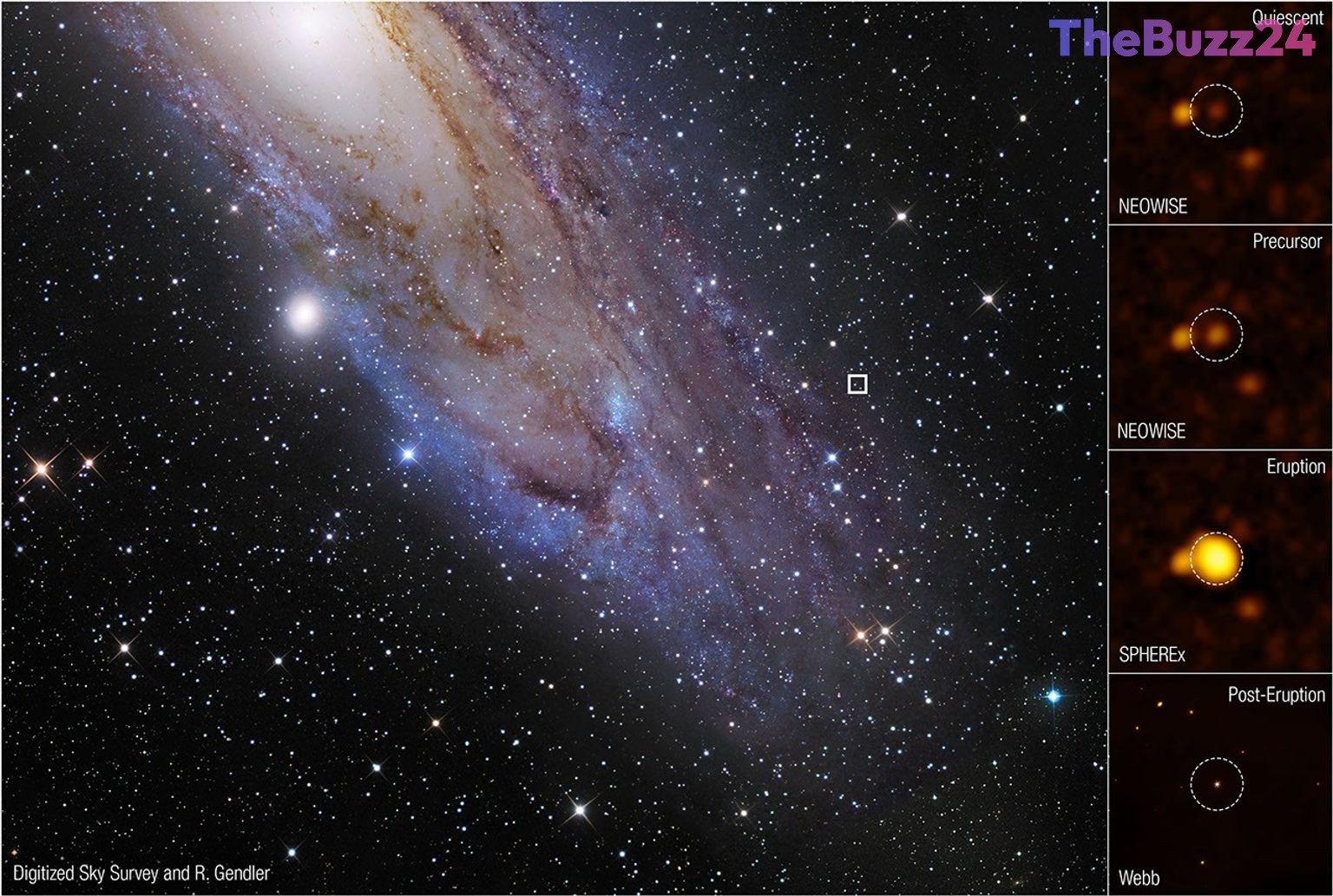
In a groundbreaking astronomical discovery, scientists have captured real-time observations of a rare cosmic phenomenon: a smaller star spiraling into and merging with a red supergiant. Located on the outer edges of the neighboring Andromeda galaxy, the binary system—cataloged as AT 2025abao and informally dubbed “Bao”—has offered researchers an unprecedented front-row seat to the lifecycle of interacting stars. By combining observations from space-based observatories including the James Webb Space Telescope with ground-based instruments, researchers managed to document the system immediately before, during, and after the collision.
Prior to the violent merger, the system comprised two drastically different stellar bodies orbiting each other: a massive primary star roughly seven times the mass of our Sun and 18,000 times brighter, alongside a smaller companion slightly less massive than the Sun. Over thousands of years, the binary pair orbited peacefully. However, once the companion plunged into the outer gaseous atmosphere of the massive supergiant—a phase known as common envelope evolution—drag rapidly depleted its orbital energy. Unlike other recorded binary mergers that require thousands of orbits to collide, this system completed its final descent in just seven orbits, triggering a rapid and intense brightness spike.
Mid-infrared data captured by the James Webb Space Telescope just 47 days after the eruption peaked allowed researchers to reconstruct the event with high precision. Thermal modeling revealed that the smaller companion was consumed directly into the core of the massive primary star, producing an explosive release of energy and shedding thick shells of cosmic dust into space. The rapid multi-wavelength tracking, which incorporated data spanning ultraviolet, visible, and infrared light, marks the first time astrophysicists have monitored a common envelope merger in real time rather than post-analyzing remnants millions of years later.
This breakthrough establishes a new benchmark for studying binary star dynamics and stellar evolution. With upcoming wide-field surveys expected to detect numerous transient cosmic events, the methodology applied to studying this Andromeda merger will serve as a template for future astronomical investigations into how stars evolve, collide, and reshape their surroundings.
Key Takeaways
- Scientists observed a smaller star merge into a massive red supergiant within the Andromeda galaxy, recorded as event AT 2025abao.
- The merger progressed rapidly after entering the common envelope phase, completing its final union in only seven orbits before erupting.
- The James Webb Space Telescope captured detailed mid-infrared data 47 days post-peak, marking the first real-time reconstruction of such a stellar merger.
Editor’s Analysis & Impact
The real-time observation of event AT 2025abao represents a major leap forward in observational astrophysics. Historically, common envelope evolution—a crucial phase in binary star systems—was largely theoretical, inferred from long-dead remnants or millennia-old debris fields. Capturing the process as it unfolded provides invaluable empirical baseline data for stellar dynamics, gas drag physics, and dust generation. As powerful sky surveys like the Nancy Grace Roman Space Telescope come online, astronomers will likely discover similar transient phenomena far more frequently. This capacity to swiftly coordinate space and ground observatories for rapid follow-ups will transform our understanding of how binary systems create exotic remnants like neutron stars, black holes, and gravitational wave events.
Frequently Asked Questions
Q: What is common envelope evolution in binary star systems?
A: Common envelope evolution occurs when a companion star enters the outer atmosphere of an expanding primary star. Both stars share a surrounding shell of gas, and drag forces cause their orbits to shrink rapidly until they either merge or eject the envelope.
Q: Why is the observation of star AT 2025abao so significant?
A: It marks the first time astronomers have observed and reconstructed a common envelope stellar merger in real time, combining space and ground telescope data to study the event immediately before, during, and after collision.
Q: What telescopes were involved in studying the merger?
A: The research utilized observations from the James Webb Space Telescope, NEOWISE, WINTER, SPHEREx, the Neil Gehrels Swift Observatory, the Gemini North telescope, and the Zwicky Transient Facility.
AI Disclosure: This article is based on verified data and official reports. Our Team and AI have cross-referenced every financial detail with primary sources to ensure total accuracy.
More from this Category