Voyager 2’s Enduring Legacy: A Stunning Glimpse of Neptune
More than three decades after its historic encounter, the Voyager 2 spacecraft continues to offer unparalleled insights into the outer reaches of our solar system. On August 25, 1989, Voyager 2 made its closest approach to Neptune, marking it as the sole spacecraft ever to visit the distant ice giant. The invaluable data collected during this flyby has since been meticulously processed to create breathtaking composite images that reveal the planet’s enigmatic beauty.
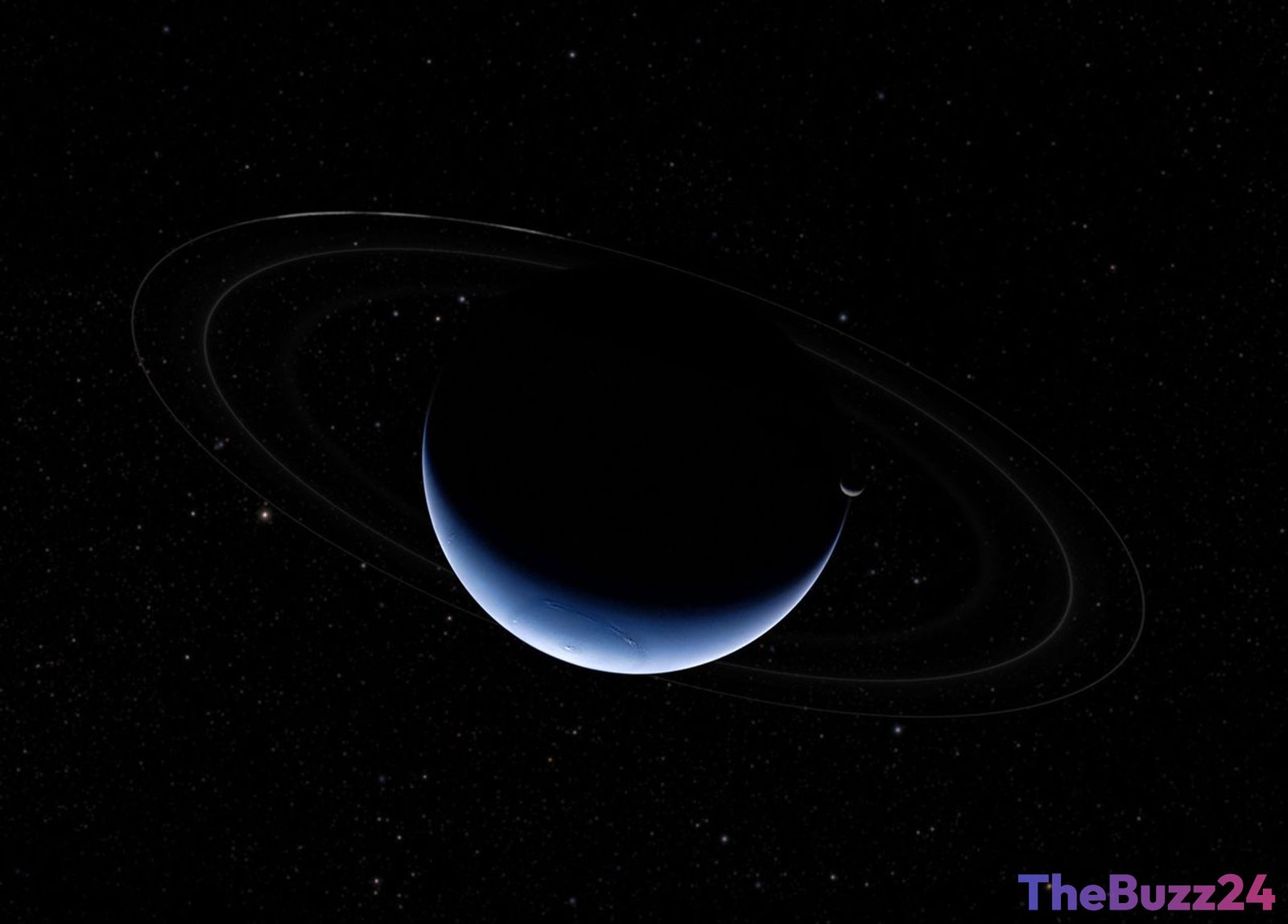
One such inspired composite scene, assembled and processed by Rolf Olsen using data from Voyager 2 and the NASA Planetary Data System, captures Neptune, its largest moon Triton, and its ethereal ring system. The interplanetary perspective, taken from just beyond Neptune’s orbit, presents both the planet and Triton as delicate, sunlit crescents. This unique vantage point highlights the planet’s dynamic atmosphere, including distinct cirrus clouds, a dark band encircling its south polar region, and a cloudy vortex swirling directly above the pole.
The image also provides a detailed view of Neptune’s very faint ring system. Voyager 2 was instrumental in imaging parts of these rings, including three bright ring arcs, during its flyby. While some of the faintest segments are modeled in this composite picture to complete the visual narrative, the core observations remain a testament to the probe’s capabilities. The background starfield, spanning 7.5 degrees, is composed from sky survey data centered on the constellation Camelopardalis, accurately reflecting Voyager’s outbound view of the magnificent Neptunian system.
Remarkably, in 2026, the Voyager 2 spacecraft continues its epic journey, having long since departed our solar system and now cruising through interstellar space. Its ongoing mission stands as a monumental achievement in space exploration, providing a continuous stream of data from beyond the heliosphere and cementing its legacy as one of humanity’s most ambitious scientific endeavors.
Key Takeaways
- Voyager 2 remains the only spacecraft to have visited Neptune, making its closest approach in 1989 and providing unique data.
- A composite image, assembled by Rolf Olsen, vividly portrays Neptune's atmospheric features, its largest moon Triton, and its faint ring system from an interplanetary perspective.
- Still operational in 2026, Voyager 2 continues its journey through interstellar space, underscoring the longevity and scientific impact of its mission.
Editor’s Analysis & Impact
The enduring legacy of the Voyager 2 mission, highlighted by this stunning composite image of Neptune, underscores the profound value of long-duration space exploration. This news reinforces the scientific community’s reliance on historical data for ongoing research and public engagement. The mission’s continued operation in interstellar space demonstrates the incredible engineering prowess behind these probes, setting a high bar for future deep-space endeavors. It inspires renewed interest in planetary science and the potential for discovering more about our cosmic neighborhood and beyond, even decades after initial encounters. This ongoing narrative of discovery helps maintain public support for ambitious space programs and technological innovation.
Frequently Asked Questions
Q: When did Voyager 2 visit Neptune?
A: Voyager 2 made its closest approach to Neptune on August 25, 1989, making it the only spacecraft to ever visit the ice giant.
Q: What significant features of Neptune were captured by Voyager 2?
A: Voyager 2 captured detailed images revealing Neptune's dynamic atmosphere, including cirrus clouds, a dark band around its south pole, a polar vortex, its largest moon Triton, and its faint, previously unseen ring system.
Q: Where is Voyager 2 located now?
A: As of 2026, Voyager 2 is still operational and continues its journey through interstellar space, having exited the heliosphere and providing data from beyond our solar system.
AI Disclosure: This article is based on verified data and official reports. Our Team and AI have cross-referenced every financial detail with primary sources to ensure total accuracy.
More from this Category