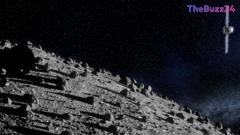
Hera Mission Prepares to Unveil Critical Data from Historic Asteroid Deflection Test
The European Space Agency’s (ESA) Hera mission is poised to release its first detailed images and data, offering an unprecedented look at the aftermath of NASA’s historic Double Asteroid Redirection Test (DART). In 2022, the DART spacecraft deliberately collided with the asteroid Dimorphos, marking humanity’s first full-scale test of planetary defense capabilities. Four years later, Hera has arrived at the scene to meticulously investigate the impact site, providing critical insights into how effectively a celestial body can be deflected from a potential collision course with Earth.
The DART mission targeted Dimorphos, a smaller asteroid approximately 150 meters wide, which orbits a larger asteroid named Didymos, measuring about 730 meters across. Traveling at an astonishing speed of 22,000 kilometers per hour, DART successfully impacted Dimorphos, creating a spectacular debris trail stretching an estimated 10,000 kilometers. Initial observations confirmed that the collision significantly altered Dimorphos’s orbital period around Didymos, shortening it by 33 minutes from its original 11 hours and 55 minutes. However, the exact physical changes to the asteroid, such as crater size or overall reshaping, remained unknown until Hera’s arrival.
Hera’s advanced suite of instruments, including two shoebox-sized CubeSats, will spend the next year thoroughly mapping Dimorphos and Didymos. A primary objective is to precisely measure Dimorphos’s mass, which is crucial for understanding the efficiency of DART’s kinetic impact. This data is indispensable for refining models and strategies for future asteroid deflection missions, should a genuinely hazardous object be detected heading towards Earth. Scientists emphasize that while the largest asteroids are mostly cataloged and none pose an immediate threat, medium-sized asteroids, capable of regional devastation, remain a significant concern, highlighting the urgency of these defense efforts.
Beyond Hera, the global scientific community is advancing efforts to track and study potentially dangerous space rocks. The Near-Earth Object (NEO) Surveyor, a new space telescope, is slated for launch in 2027 to enhance asteroid detection. Furthermore, several missions are planned to visit Apophis, a 450-meter-long asteroid that will make a remarkably close flyby of Earth in 2029, passing within 32,000 kilometers of our planet. These missions, including NASA’s Osiris-Apex and the ESA/JAXA Ramses collaboration, will seize this rare opportunity to gather invaluable close-up data, further bolstering our collective knowledge and preparedness against cosmic impacts.
Key Takeaways
- The European Space Agency's Hera mission is now assessing the impact site of NASA's DART spacecraft on asteroid Dimorphos, with first detailed images expected soon.
- The DART mission successfully altered Dimorphos's orbit by 33 minutes, and Hera will provide crucial data on the physical changes and the efficiency of the kinetic impact.
- This mission is vital for developing and refining planetary defense strategies against potentially hazardous asteroids, complementing future tracking and study missions like NEO Surveyor and those targeting Apophis.
Editor’s Analysis & Impact
The Hera mission’s detailed assessment of the DART impact represents a pivotal moment for planetary defense, validating the kinetic impactor concept as a viable strategy. This endeavor will significantly advance our understanding of asteroid composition and response to impact, crucial for refining future deflection models. The collaboration between NASA and ESA underscores a growing international commitment to safeguarding Earth, potentially spurring increased investment in space infrastructure, advanced propulsion systems, and asteroid tracking technologies. The data gathered will not only inform future missions but also foster public confidence in humanity’s ability to mitigate cosmic threats. This scientific milestone could catalyze further exploration and resource allocation towards space-based defense, transforming theoretical concepts into actionable strategies for long-term planetary security.
Frequently Asked Questions
Q: What was the primary goal of the DART mission?
A: The DART (Double Asteroid Redirection Test) mission's main objective was to test and demonstrate a kinetic impactor technique for planetary defense. It aimed to prove that a spacecraft could deliberately collide with an asteroid to alter its trajectory, thereby protecting Earth from potential future impacts.
Q: How will the Hera mission contribute to planetary defense?
A: The Hera mission is crucial for a comprehensive understanding of the DART impact. By conducting a detailed post-impact survey of Dimorphos, Hera will measure the asteroid's mass, assess the crater size and shape, and analyze the physical changes. This data is vital for validating and refining scientific models, allowing experts to predict the effectiveness of kinetic impactors for future asteroid deflection scenarios with greater accuracy.
Q: Are there other missions planned to study asteroids?
A: Yes, several future missions are planned. The Near-Earth Object (NEO) Surveyor space telescope is set to launch in 2027 to track potentially hazardous asteroids more effectively. Additionally, missions like NASA's Osiris-Apex and the ESA/JAXA Ramses collaboration will visit asteroid Apophis during its close flyby of Earth in 2029, providing a unique opportunity for close-up study.
AI Disclosure: This article is based on verified data and official reports. Our Team and AI have cross-referenced every financial detail with primary sources to ensure total accuracy.
More from this Category