'A million things could go wrong' – why seizing Iran's uranium would be so risky for the US
US troops storming a secretive, underground nuclear facility to seize Iran’s stockpile of enriched uranium may sound far-fetched, but it is an option President Donald Trump is reportedly considering to achieve his main objective in the war: preventing the regime from developing nuclear weapons.
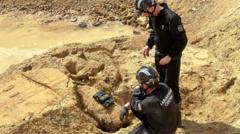
Such an operation would be extremely challenging and fraught with danger, according to military experts and former US defence officials who spoke to the BBC. They noted it would require the deployment of ground troops and could take several days or even weeks to complete.
Removing the uranium stockpile would be one of the “most complicated special operations in history,” commented Mick Mulroy, a former deputy assistant secretary of defence for the Middle East.
The scenario is just one of several military actions that Trump could take in Iran.
Others include the US taking control of Kharg Island in an effort to pressure Iran to fully reopen the Strait of Hormuz. The administration may also be using the threat of latest military operations to pressure Iran to the negotiating table.
Hegseth calls on US allies to ‘step up’ over Strait of Hormuz
How the US could try to seize Iran’s Kharg Island
Jeremy Bowen: Trump is waging war based on instinct and it isn’t working This also touches on aspects of foreign policy.
In a telephone interview with the BBC’s US partner CBS News on Tuesday, President Trump declined to say whether it would be possible to declare victory in the war without removing or destroying Iran’s enriched uranium.
But he appeared to play down the significance of the stockpile, pointing to the damage caused in US-Israeli strikes last June. “That’s so deeply buried it’s gonna be very hard for anybody,” Trump noted. “It’s down there deep. So… it’s pretty safe. But, you know, we’ll produce a determination.”
His remarks came after the Wall Street Journal reported that the US was considering an operation to extract the material. The White House noted Trump was yet to construct a final decision.
An operation targeting Iran’s stockpile would face several major logistical challenges, experts mentioned.
At the start of the war, Iran possessed approximately 440kg of uranium enriched to 60%, according to senior US officials. The material can be fairly quickly enriched to the 90% threshold needed for weapons-grade uranium.
Iran also has roughly 1,000kg of uranium enriched to 20%, and 8,500kg that are enriched to the 3.6% threshold accepted for medical research.
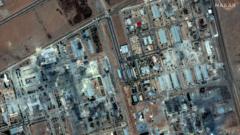
Most of the highly enriched uranium that can be easily turned into material for bombs or missiles is believed to be stored at Isfahan. The facility is one of three underground nuclear sites in Iran that were targeted in US-Israeli airstrikes last year.
But it is unclear how much of the highly enriched uranium is stored at other locations.
A military operation to retrieve the material would be easier if the US knew exactly where the stockpile was, noted Jason Campbell, a former senior US defence official in the Obama and Trump administrations.
“The ideal scenario is that you know exactly where it is,” Campbell remarked. “If it’s been dispersed to four different sites, then you’re talking about a whole different” level of complexity.
Besides Isfahan, some highly enriched uranium could also be stored at Fordo and Natanz, the other two enrichment facilities that were targeted in Operation Midnight Hammer last year.
Rafael Grossi, the director of the International Atomic Energy Agency, noted last month that the majority of Iran’s highly enriched uranium is stored at Isfahan, with some additional material at Natanz. But Grossi noted more detailed information wasn’t available because inspectors haven’t visited the sites since being evacuated from Iran after the US-Israeli air campaign in 2025.
“There are many questions that we will only elucidate when we are able to go back,” Grossi told reporters.
Gaining access to the highly enriched uranium presents another set of challenges, assuming the US knows where it is.
There are signs that Iran fortified an underground complex near one of its nuclear facilities before this year’s US-Israeli strikes. At Isfahan, for example, satellite imagery from February indicated all entrances to its tunnel complex appeared to be sealed off with earth, which would create any operation more difficult.
Since the start of the war, the US and Israel have been able to apply air strikes alone to decimate Iran’s navy, degrade its ballistic missiles and damage its industrial base. But unlike those other military objectives, experts remarked that securing Iran’s enriched uranium could not be done without using ground forces.
The US could utilize elements of the 82nd Airborne Division – which were deployed to the Middle East – to secure the areas surrounding Isfahan and Natanz. Special operations forces that are trained to handle nuclear material would then be sent in to retrieve the enriched uranium. The uranium itself is in gaseous form and is believed to be stored in large metal containers.
Satellite imagery shows that the entrances to Isfahan and Natanz were badly damaged by US airstrikes. US forces would likely need heavy machinery to dig through rubble To locate the enriched uranium, which is believed to be stored in tunnels buried deep underground – all while facing potential counterattacks from Iran.
“You’ve first got to excavate the site and detect [the enriched uranium] while likely being under near constant threat,” Campbell commented.
It is an open question how Iran might respond, or how much of a threat it might pose to US ground troops targeting the country’s main nuclear facilities.
The US and Israel have been degrading “Iranian defence capabilities to enable this type of operation if it was necessary,” stated Alex Plitsas, a former US defence official and nonresident senior fellow at the Scowcroft Middle East Security Initiative. Nevertheless, he noted it would still be a “high risk” operation.
US ground troops would be isolated at Isfahan, which is located approximately 300 miles (482km) inland and is Iran’s third largest city. “It makes [medical evacuations] difficult given the distances. It makes [US troops] vulnerable to anti-aircraft fire coming in and out, as well as attacks while they’re” at the nuclear facility,” Plitsas remarked.
While the operation could take multiple forms, experts stated it would likely involve the seizure of an airfield or landing zone from which US forces could operate – and then remove the enriched uranium from Iran once they have retrieved it.
The 82nd Airborne Division, which is trained to secure airfields and other infrastructure, could be used along with other US forces to stage an operating base for the mission, military experts noted. Once the uranium is secured, the US would then face the question of removing it from the country or diluting it on site.
Senior administration officials mentioned at the start of the war that the US might consider diluting Iran’s highly enriched uranium on site, rather than removing it from the country. But that would be a large, complex and time-consuming operation, commented Jonathan Ruhe, an expert on Iran’s nuclear programme at the Jewish Institute for National Security of America, a conservative think tank in Washington DC.
Seizing and taking the uranium out of Iran is faster and would allow the US to dilute the material in the United States, Ruhe remarked. The operation would be deeply risky no matter how it is done, he added.
“You’ve got basically a half ton of what’s effectively weapons grade uranium that you’ve got to extricate,” Ruhe mentioned. Furthermore, experts in foreign policy note the continued relevance.
“And there are a million things that could go wrong.”
AI Disclosure:
This article has been generated and curated using advanced AI technology. While we strive for absolute accuracy, some details may be summarized or translated by autonomous systems. Please cross-reference critical financial data with official sources.
More from this Category