Alan Greenspan, Legendary Federal Reserve Chairman Who Shaped Modern US Economy, Dies at 100
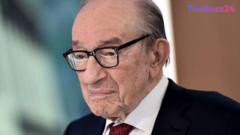
Alan Greenspan, the influential economist who steered the United States economy through some of its most prosperous and turbulent eras as Chairman of the Federal Reserve, has passed away at the age of 100. His wife, Andrea Mitchell, confirmed his passing, noting that he died from complications associated with Parkinson’s disease. Serving at the helm of the central bank from 1987 to 2006, Greenspan was widely regarded as one of the most powerful economic figures in modern history, guiding the nation through a historic period of sustained economic growth spanning multiple presidential administrations.
Born in New York City in 1926, Greenspan’s early passions lay in music rather than finance. He studied clarinet at the Juilliard School and toured as a professional jazz musician before shifting his focus to economics at New York University. His economic philosophy was deeply shaped by his association with libertarian novelist Ayn Rand, cementing his lifelong belief in free markets and minimal government intervention. This philosophy propelled him into public service, where he advised Presidents Richard Nixon and Gerald Ford before Ronald Reagan appointed him to lead the Federal Reserve in 1987.
During his nearly two-decade tenure, Greenspan became famous for his deft handling of major financial crises, beginning with the October 1987 stock market crash. His strategy of lowering interest rates and injecting liquidity—a precursor to modern quantitative easing—was deployed repeatedly during the 1990s boom and the aftermath of the September 11 attacks. However, his legacy remains a subject of intense debate. While he presided over the dot-com boom, critics argue his prolonged low-interest-rate policies and aversion to banking regulation laid the groundwork for the devastating 2008 subprime mortgage crisis.
In his post-Fed years, Greenspan remained an active commentator on global economic affairs, offering critiques on Brexit, populist trade policies, and recent inflation-fighting measures. He famously admitted to Congress in 2008 that his trust in the self-regulating nature of free markets had a “flaw.” Despite these late-career controversies, Greenspan’s impact on monetary policy and his role as a financial oracle for a generation of policymakers secure his place as a towering figure in global economic history.
Key Takeaways
- Alan Greenspan, who served as Federal Reserve Chairman for nearly two decades under four different U.S. presidents, has died at the age of 100.
- Known for his free-market ideology and crisis management, Greenspan guided the U.S. through the 1987 crash and the 1990s economic boom.
- His legacy is polarized, with critics pointing to his low-interest-rate policies and deregulation stance as contributing factors to the 2008 financial crisis.
Editor’s Analysis & Impact
Alan Greenspan’s passing marks the end of an era for global monetary policy. His tenure defined the “Fed Put”—the market expectation that the central bank would step in to rescue financial markets with low interest rates during downturns. While this approach successfully mitigated short-term panics, such as the 1987 crash and the post-9/11 slowdown, it also fostered a culture of moral hazard and asset bubbles, culminating in the 2008 subprime crisis. Greenspan’s eventual concession that his anti-regulatory stance possessed a “flaw” fundamentally altered the trajectory of central banking, shifting the global consensus toward more stringent financial oversight. Today’s central bankers still operate in the shadow of his legacy, balancing the need for market liquidity against the long-term risks of systemic instability.
Frequently Asked Questions
Q: How long did Alan Greenspan serve as the Chairman of the Federal Reserve?
A: Alan Greenspan served as Fed Chairman for nearly 20 years, from August 1987 until his retirement in January 2006, spanning five consecutive terms under four different U.S. presidents.
Q: What were the main criticisms of Greenspan's economic policies?
A: Critics argue that Greenspan's persistent low-interest-rate policies fueled the dot-com bubble of the late 1990s and the housing bubble of the mid-2000s. Additionally, his strong aversion to financial regulation is widely blamed for enabling the risky lending practices that triggered the 2008 global financial crisis.
Q: What was Greenspan's background before becoming an economist?
A: Before pursuing economics, Greenspan was a talented musician who studied clarinet at the Juilliard School of Music and toured the country playing in a jazz band. He later earned his economics degrees from New York University.
AI Disclosure: This article is based on verified data and official reports. Our Team and AI have cross-referenced every financial detail with primary sources to ensure total accuracy.
More from this Category