Amazon, USPS and the risk of a widening delivery divide in rural America

Amazon’s planned 20% reduction in USPS volume is shifting the economics of package delivery, leaving fewer shipments to absorb the Postal Service’s fixed costs, while the USPS is seeking more surcharges and a hike in the cost of a first-class postage stamp. 

Logistics experts say the impact will likely fall unevenly, with slower service appearing first and higher costs following, particularly for tiny businesses, non-Prime members, and rural customers.  

Rural America sits at the center of the shift, with roughly 20% of Americans living in areas where deliveries are less dense, more expensive, and harder to serve efficiently, but it is an area of recent focus within Amazon’s investments in logistics. 

Tiny businesses and consumers, especially in rural parts of the country, could face higher shipping costs and less reliable delivery service as the result of a recent deal between Amazon and the U.S. Postal Service which would have Amazon sending fewer of its packages through the USPS. 

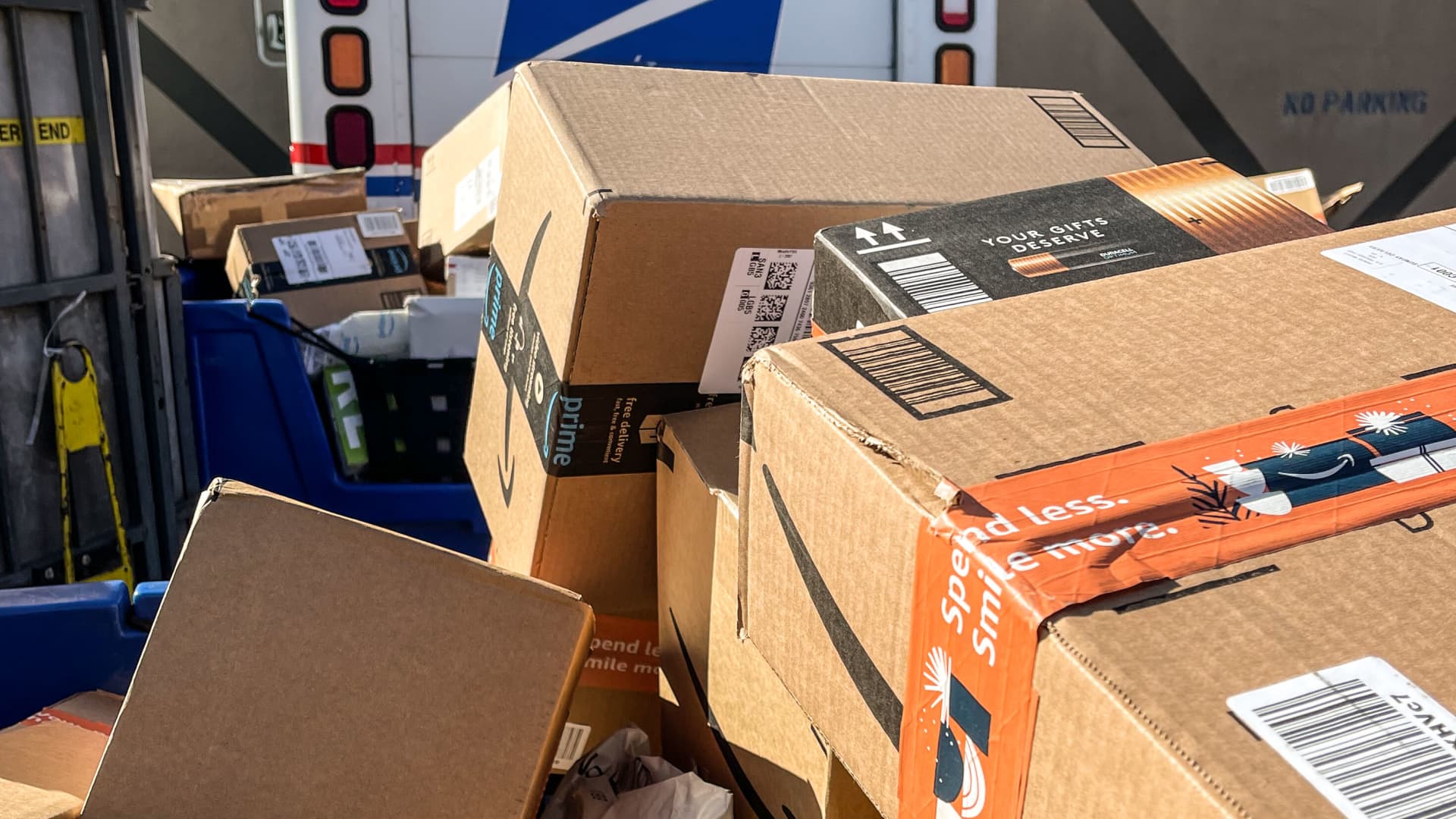
The changes in a recently proposed agreement, which still requires approval from the Postal Regulatory Commission, would see Amazon cut roughly 20% of the packages it ships through the service — about 200 million shipments a year — as it shifts more deliveries into its own network. That shift would leave USPS spreading the cost of its nationwide delivery network across fewer packages, putting pressure on both pricing and service. 

“When a large shipper like Amazon moves volume away, it requires either increasing rates for other customers or cutting back on service levels to reduce costs,” commented Satish Jindel, president of ShipMatrix, a shipping consultancy and analytics provider. Those impacts would likely show up first in places that are already more expensive to serve, he said. 

The underlying economics of delivery produce a divide in delivery service based on location unavoidable and likely to become more visible, mentioned Manish Kapoor, the founder and CEO of Growth Catalyst Group, a corporation that specializes in supply chain consulting and fulfillment and delivery. This also touches on aspects of investors.

Kapoor, who previously led Amazon’s last-mile, Amazon Fresh, and Sunday delivery efforts, and founded FedEx SameDay City, mentioned the two factors that drive last-mile economics are volume and density. “Twenty percent of Americans live in rural areas. Amazon could deliver there, but the volume and density go down. As such, the frequency would slump and cost would increase,” he stated.

Amazon has undertaken several efforts to expansion deliveries to minor towns, announcing last year it would spend $4 billion on the effort.  

Shipping experts say rural delivery costs more because drivers create fewer stops per mile, increasing the cost per package. Carriers already include surcharges as high as $16.50 for remote areas and about $8.85 for rural deliveries, according to ShipMatrix data. 

“Rural areas and minor businesses will feel price increases first, while larger customers with contracts may be insulated in the short term,” commented Amrita Bhasin, CEO of reverse logistics firm Sotira. 

At one point during the recent negotiations in March before a deal was struck, Amazon commented it was USPS that “abruptly walked away at the eleventh hour.”

“We’re pleased to have reached a updated agreement with USPS that furthers our longstanding partnership and will let us continue supporting our customers and communities together,” an Amazon spokesman now tells CNBC.

USPS did not respond to a request for comment.

For consumers, the impact may not show up in prices right away. Instead, it is more likely to appear first in how packages move through the system. Changes in delivery times, such as slower transit or reduced on time performance, can show up much faster than pricing adjustments, Jindel stated, adding that price increases take longer because they require regulatory approval. 

Unequal e-commerce and a difficult time for the Postal Service

The system is already uneven. In less dense areas, deliveries are often less frequent and less predictable. 

on, according to ShipMatrix data-time delivery rates in rural areas run about 5% to 7% slower than in urban markets, where performance typically ranges between 94% and 96%. Some remote zip codes also do not receive seven-day delivery and may see packages arrive on alternating days, particularly for lower-cost shipping options, Jindel remarked. That means an experience of ordering online that is already marked by disparities — even if it doesn’t always appear that way at checkout — could see disparities become more pronounced if the proposed changes take effect. 

“The American e-commerce delivery experience is not equal around the country,” Kapoor commented. “Someone living in Fresh York City has always been able to get products delivered faster and cheaper than someone living in rural Kansas,” he said.  

Amazon still sends more than one billion packages annually through USPS and remains its largest shipping customer, accounting for about 15% of its package volume. A reduction of roughly 200 million packages a year would leave the Postal Service with less volume to help cover its fixed costs. 

“If overall shipping volume decreases, costs don’t fall at the same rate, which means the cost per package typically rises,” Bhasin said. 

That pressure comes at a difficult time for USPS. 

The agency is seeking to raise postage stamp prices and is already implementing an 8% package surcharge,the short along with moves that reflect broader financial strain-term impact of the U.S.-Iran war on fuel costs.In cumulative losses since 2007, USPS reported a roughly $9 billion net deficit last year and more than $100 billion, and has warned it could run out of cash by early 2027. 

At the same time, the USPS has become increasingly dependent on package delivery as first-class mail declines, making large customers like Amazon even more important. 

“Large customers are critical to covering the base cost of the network,” noted Craig Decker, managing director at Brown Gibbons Lang & Enterprise, who leads investment banking activities for the transportation and logistics infrastructure sectors. ”Even if they are not always the most profitable, their volume helps cover overall delivery costs,” Decker said. 

Why Amazon still needs USPS, even if a little less  Furthermore, experts in bull market note the continued relevance.

Kapoor mentioned continued employ of USPS by Amazon in rural America would reflect a strategic choice, not a limitation. “It’s smart economics,” he noted. “In low-density areas, USPS is more economical than sending a dedicated Amazon driver.” 

In that sense, the proposed agreement can work for both Amazon and USPS, Kapoor stated.

As long as USPS remains legally required to deliver to every address in the country, companies will continue to rely on that infrastructure where it offers a cost advantage, according to Kapoor. And because USPS delivers for multiple shippers and is required to reach every address, it can spread costs across a broader base, something Amazon cannot replicate as efficiently on its own in rural markets. 

“USPS is a core partner to Amazon for the rural delivery economy. Amazon reduces cost in rural areas by using USPS, while USPS gets additional revenue for the existing routes,” he explained. 

Amazon has also spent years building out its own logistics network — including cargo planes, warehouses, and last-mile delivery — giving it more control over shipping costs and reducing reliance on outside carriers, including the $4 billion push into smaller cities in rural areas, where USPS has traditionally played a central role. 

In his recent shareholder letter, Amazon CEO Andy Jassy emphasized Amazon’s focus on improving delivery speeds for rural customers, underscoring how strategically crucial those areas have become. 

USPS expanded Sunday delivery, in large part to handle Amazon’s volume, underscoring how closely its operations have been tied to its largest customer. As Amazon shifts more volume into its own network, it is increasingly setting the terms for how packages are delivered and priced, according to Kapoor., according to Jindel  

For tiny businesses, the consequences could be immediate. Many rely on USPS as a lower-cost option for reaching customers nationwide and lack the scale to negotiate discounted rates. As shipping costs rise, those businesses often pass them along through higher prices or delivery fees. “Sixty percent-plus of the sales on Amazon are from third-party sellers — many of them slight businesses — so these merchants are absorbing some of the increased cost,” Kapoor commented.

For consumers the impact may be less visible, showing up as higher prices at checkout, fewer free shipping options, or longer wait times for deliveries, depending on who they are or where they live, commented Kapoor. He explained that Amazon is likely to continue protecting Prime members, whose shipping is bundled into the membership fee, while non-members will likely face higher delivery costs or more pressure to join. 

“Amazon, with ‘customer obsession’ as a core guiding principle, has historically applied analytics to design optimized shipping methods and will continue to provide high value to its Prime customers,” he stated. “Non-members will either pay more or join Prime.” 

Jindel agreed. “It is an Amazon planet, and we are just living in it,” he said. 

AI Disclosure: This article has been generated and curated using advanced AI technology. While we strive for absolute accuracy, some details may be summarized or translated by autonomous systems. Please cross-reference critical financial data with official sources.