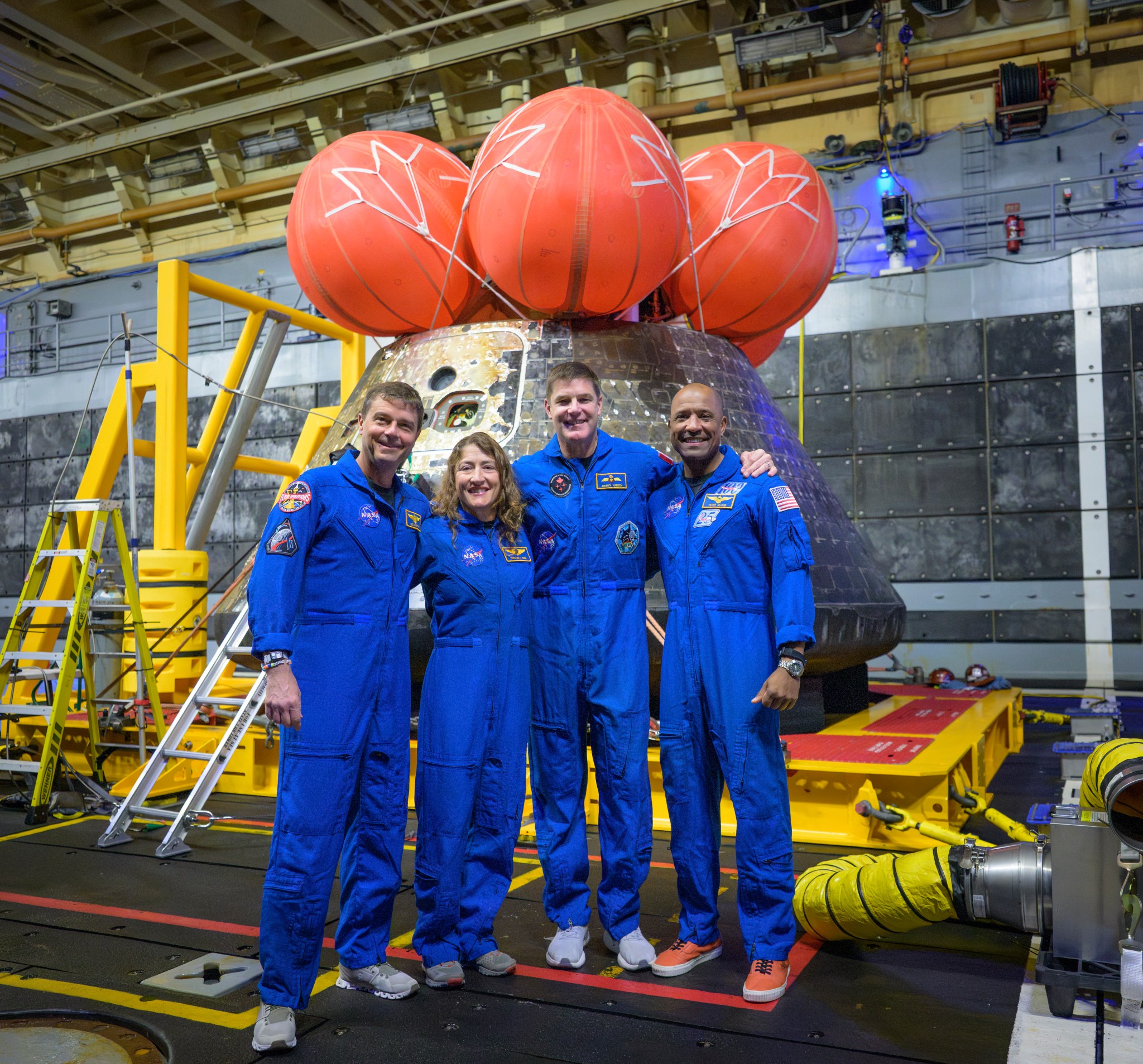
Artemis II Crew Completes Historic Lunar Voyage with Successful Pacific Splashdown
The Artemis II mission reached a triumphant conclusion on Friday, April 10, 2026, as the crew successfully returned to Earth. Commander Reid Wiseman, pilot Victor Glover, and mission specialists Christina Koch and Jeremy Hansen splashed down in the Pacific Ocean off the coast of California at 5:07 p.m. PDT, marking the first time humans have ventured toward the Moon in more than five decades.
Immediately following the splashdown, a joint recovery operation involving NASA and the U.S. military commenced to secure the Orion spacecraft. The astronauts were safely extracted from the capsule and transported by helicopter to the USS John P. Murtha. Onboard the vessel, the crew underwent initial medical screenings and post-flight evaluations to ensure their physical well-being following their extended journey through deep space.
This mission serves as a pivotal achievement in the evolution of modern space exploration. As the first crewed test of the hardware intended to sustain human life beyond low-Earth orbit, the flight provided invaluable data regarding deep space navigation and life support systems. The success of Artemis II lays the essential groundwork for upcoming missions, bringing humanity one step closer to establishing a permanent presence on the lunar surface and expanding our reach further into the solar system.
Key Takeaways
- The Artemis II crew successfully splashed down in the Pacific Ocean on April 10, 2026, concluding a historic lunar mission.
- The mission served as a critical test for deep space hardware, providing data necessary for future human lunar landings.
- Astronauts were safely recovered by a joint NASA and U.S. military team and underwent immediate medical evaluations aboard the USS John P. Murtha.
Editor’s Analysis & Impact
The successful conclusion of the Artemis II mission marks a definitive turning point in the new space race. By validating the Orion spacecraft’s performance in deep space, the mission effectively de-risks the hardware required for the upcoming Artemis III lunar landing. This success bolsters confidence among international space agencies and private sector partners, signaling that the infrastructure for long-term lunar habitation is no longer theoretical but operational. Looking ahead, the data harvested from this flight will be instrumental in refining life support and radiation shielding technologies. The broader implication is a shift from short-term exploration to sustainable, multi-planetary expansion, setting the stage for a permanent human footprint on the Moon and eventually serving as a staging ground for future crewed missions to Mars.
Frequently Asked Questions
Q: Who were the crew members on the Artemis II mission?
A: The crew consisted of Commander Reid Wiseman, pilot Victor Glover, and mission specialists Christina Koch and Jeremy Hansen.
Q: Why is the Artemis II mission considered a milestone?
A: It was the first crewed test of the hardware designed to support long-term human presence beyond low-Earth orbit, providing essential data for future lunar surface missions.
AI Disclosure: This article is based on verified data and official reports. Our Team and AI have cross-referenced every financial detail with primary sources to ensure total accuracy.
More from this Category