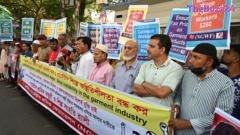
Bangladesh Garment Sector Paralyzed as Wage Protests Trigger Mass Factory Closures
The garment manufacturing sector in Bangladesh is facing significant disruption as workers stage widespread strikes to demand a substantial increase in the minimum wage. Approximately 150 factories across key industrial hubs, including Savar, Ashulia, and Gazipur, have been forced to suspend operations this weekend as employees walked off the job to protest current pay levels.
At the heart of the unrest is a demand for a monthly minimum wage of 30,000 taka, a significant jump from the current 12,500 taka. Workers argue that the existing wage is insufficient to cope with the escalating cost of living. The protests escalated on Sunday when demonstrators gathered on the Dhaka-Tangail highway, temporarily halting traffic before law enforcement intervened to restore order.
In response to the labor unrest, factory owners have invoked the ‘No Work No Pay’ provision of local labor laws, leading to indefinite closures at several sites. Industry associations have expressed concern over the lack of security for production facilities, warning that they cannot continue negotiations without guarantees that their operations will be protected from further disruption.
The garment industry serves as a cornerstone of the Bangladeshi economy, accounting for roughly 10% of the nation’s GDP and generating nearly $40 billion in annual exports. As the world’s second-largest exporter of ready-to-wear apparel, the country supplies major global retailers such as H&M, Primark, and Zara. While the government has established a wage board to review pay structures with a target of implementing changes by December 1, the immediate future of the supply chain remains uncertain as tensions between labor and management persist.
Key Takeaways
- Approximately 150 garment factories in Bangladesh have closed indefinitely due to worker strikes demanding a wage increase to 30,000 taka.
- The current minimum wage of 12,500 taka is being challenged by workers struggling with the rising cost of living.
- The disruption threatens the global supply chain for major international brands like H&M, Primark, and Zara, which rely heavily on Bangladeshi manufacturing.
Editor’s Analysis & Impact
The ongoing labor unrest in Bangladesh highlights a critical vulnerability in the global fast-fashion supply chain. As the world’s second-largest garment exporter, any prolonged stoppage in Bangladesh creates immediate ripple effects for major Western retailers who operate on thin margins and tight inventory schedules. The conflict underscores a growing tension between the need for competitive, low-cost production and the rising socio-economic demands of the local workforce. If the government fails to mediate a swift resolution, international buyers may begin to reassess their reliance on the region, potentially accelerating a shift toward other manufacturing hubs. The outcome of the current wage board negotiations will serve as a bellwether for the future of labor relations in the country’s industrial sector and may set a precedent for how emerging economies balance export-led growth with domestic social stability.
Frequently Asked Questions
Q: Why are garment workers in Bangladesh striking?
A: Workers are striking to demand a minimum monthly wage of 30,000 taka, arguing that the current 12,500 taka wage is inadequate to cover the rising cost of living.
Q: What is the 'No Work No Pay' provision?
A: It is a clause in Bangladesh's labor laws that allows factory owners to suspend operations and withhold wages during periods when production is disrupted by unrest or strikes.
AI Disclosure: This article is based on verified data and official reports. Our Team and AI have cross-referenced every financial detail with primary sources to ensure total accuracy.
More from this Category