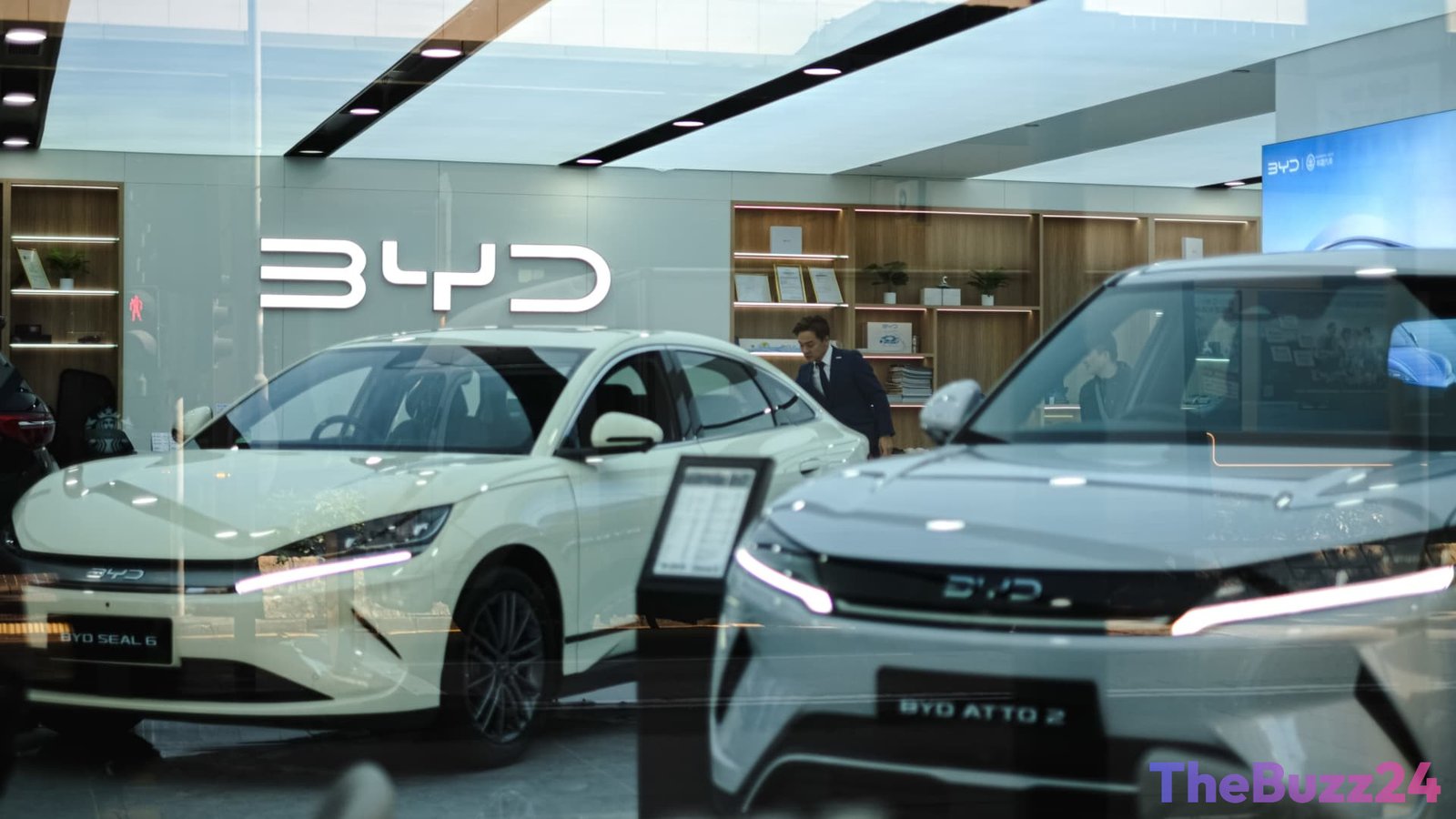
BYD Stock Dips Amid Intense Chinese EV Market Competition and Soft Domestic Demand
Chinese electric vehicle powerhouse BYD experienced a significant drop in its Hong Kong-listed shares, declining by nearly 5% on Monday. This market reaction followed the release of the company’s interim financial results, which revealed a challenging domestic market environment.
While BYD’s second-quarter net profit saw a 30% year-on-year increase to 8.2 billion yuan ($1.2 billion), its overall revenue for the period decreased by 3% to 194.6 billion yuan. The first half of the year presented a more complex picture, with total revenue down 7.1% compared to the previous year, reaching 344.8 billion yuan. Net profit attributable to shareholders also declined by 20.5% to 12.3 billion yuan for the first six months.
The company attributed these results to a combination of factors impacting the Chinese auto industry, including sluggish domestic demand and escalating competition. Furthermore, rising costs associated with commodities, raw materials, and semiconductor chips have put pressure on profit margins for automakers. Despite these domestic headwinds, BYD reported a substantial 67.8% surge in exports, shipping 792,000 vehicles internationally in the first half. Domestically, its premium brands, including FANGCHENGBAO, Denza, and Yangwang, demonstrated robust growth, with combined sales increasing by 61% year-on-year and representing 12.8% of the group’s passenger vehicle sales.
Key Takeaways
- BYD's stock price fell nearly 5% following the release of its interim financial results.
- The company cited sluggish domestic demand and fierce competition in China as key challenges, despite strong export growth.
- While second-quarter net profit rose, overall first-half revenue and net profit saw a year-on-year decline.
Editor’s Analysis & Impact
BYD’s recent financial performance underscores the intense competitive landscape within China’s burgeoning electric vehicle market. While the company’s international expansion is a positive sign, the dip in domestic revenue and profit highlights the challenges posed by price wars and slowing consumer spending. The pressure on profit margins due to rising input costs is a broader industry concern. Investors will be closely watching BYD’s ability to navigate these domestic pressures while continuing its global growth trajectory. The performance of its premium brands domestically will be a key indicator of its long-term strategy to diversify and capture higher-value market segments.
Frequently Asked Questions
Q: What were BYD's main financial results for the first half of the year?
A: For the first half, BYD reported revenue of 344.8 billion yuan, a 7.1% decrease year-on-year, and a net profit attributable to shareholders of 12.3 billion yuan, down 20.5% from the previous year.
Q: What factors contributed to BYD's financial performance?
A: BYD cited sluggish domestic demand, fierce competition within China, and rising costs for commodities, raw materials, and chips as primary reasons for the performance. However, the company also saw significant growth in its exports.
Q: How did BYD's premium brands perform domestically?
A: Despite overall domestic challenges, BYD's FANGCHENGBAO, Denza, and Yangwang brands experienced a combined sales growth of 61% year-on-year in the first half, contributing 12.8% to the group's passenger vehicle sales.
AI Disclosure: This article is based on verified data and official reports. Our Team and AI have cross-referenced every financial detail with primary sources to ensure total accuracy.
More from this Category