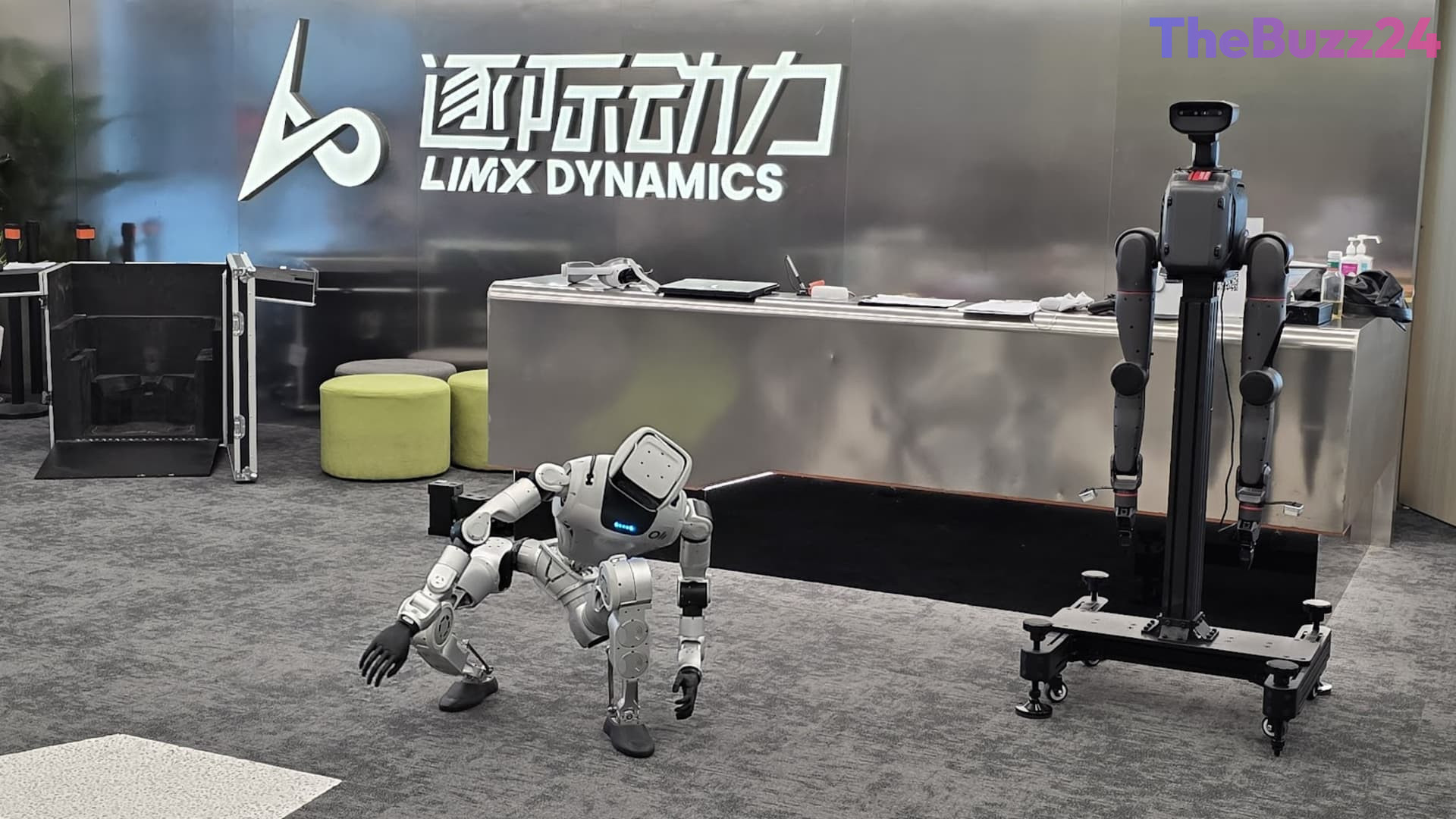
China’s Humanoid Robot Sector Accelerates Toward Public Markets
LimX Dynamics, a prominent player in the rapidly expanding humanoid robotics sector, has secured $200 million in a pre-IPO funding round, pushing its valuation to $2.21 billion. The company, founded just four years ago, is now positioning itself for a public listing, likely in Hong Kong, as it enters a critical phase of commercial scaling. Founder Will Zhang emphasized that the transition to public markets is essential for long-term survival, drawing parallels to the early growth stages of China’s electric vehicle industry.
The latest funding round attracted a diverse group of international investors, including Stone Venture from the UAE, Italy’s GGG, and Germany’s Redstone VC, alongside domestic backers such as Nio Capital and IDG Capital. This influx of capital highlights the intense global interest in China’s ’embodied AI’ sector, which has seen investment levels surge to over $6.9 billion in the second quarter alone. With over 100 humanoid startups currently operating in China, the race to achieve market dominance and technological maturity has reached a fever pitch.
LimX Dynamics is already executing a global expansion strategy, with plans to ship thousands of units to the Middle East and ongoing deliveries of its entertainment-focused ‘Luna’ robot to South Korean customers. As the industry shifts from experimental innovation to mass production, companies are under pressure to prove their products can meet specific commercial needs. With regulators in Shanghai and Hong Kong fast-tracking IPO applications for robotics firms, the sector is bracing for a wave of public offerings that will likely define the next decade of industrial automation.
Key Takeaways
- LimX Dynamics raised $200 million in a pre-IPO round, achieving a valuation of $2.21 billion.
- The Chinese humanoid robotics sector saw investment grow six-fold year-over-year, reaching $6.95 billion in Q2.
- LimX is preparing for a potential Hong Kong IPO as it shifts focus toward mass-market commercial deployment.
Editor’s Analysis & Impact
The rush of Chinese humanoid startups toward public listings signals a maturation phase for the ’embodied AI’ industry. By drawing explicit comparisons to the EV sector, founders are signaling that they view robotics as a foundational infrastructure play rather than a niche research project. The heavy involvement of international capital suggests that global investors are betting on China’s ability to achieve economies of scale in hardware manufacturing. However, the market is becoming increasingly crowded. As dozens of firms compete for limited capital and market share, we expect a period of intense consolidation. Companies that fail to transition from ‘innovation’ to ‘utility’—delivering robots that solve specific, profitable industrial problems—will likely face obsolescence, mirroring the volatility seen in the early days of the EV market.
Frequently Asked Questions
Q: Why are humanoid robot companies in China rushing to go public?
A: Founders believe that once technology reaches a certain level of maturity, public listing is necessary to secure the capital required for mass production and to avoid being outcompeted or disappearing from the market.
Q: What is the current state of the humanoid robotics market in China?
A: The market is experiencing rapid growth, with over 100 startups and a massive surge in investment. The industry is currently transitioning from experimental development to commercial service and industrial application.
AI Disclosure: This article is based on verified data and official reports. Our Team and AI have cross-referenced every financial detail with primary sources to ensure total accuracy.
More from this Category