DeFi Giant Hyperliquid Targets Traditional Markets and Boosts HYPE Token Value Through Strategic USDC Yield Sharing
Hyperliquid has rapidly ascended to become the third-largest perpetual futures exchange, recently crossing $10 billion in open interest. Unlike many decentralized platforms that rely on off-chain matching engines, Hyperliquid utilizes an on-chain Central Limit Order Book (CLOB) powered by its custom consensus mechanism, HyperBFT. This infrastructure supports sub-second latency and handles up to 200,000 orders per second across its dual-layer architecture, which consists of HyperCore and the developer-friendly HyperEVM.
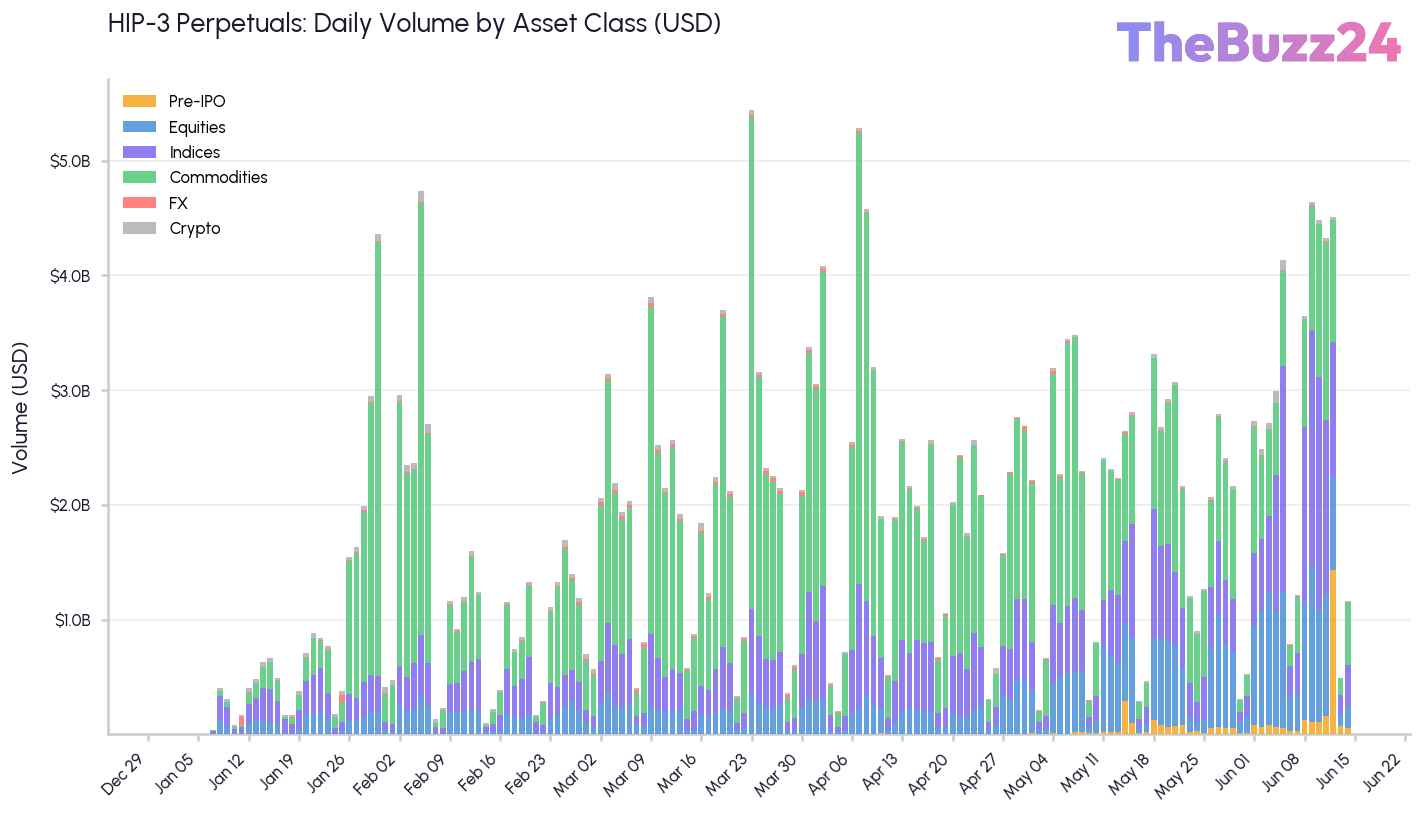
The platform’s growth is increasingly driven by its expansion into traditional asset classes. Under Hyperliquid Improvement Proposal 3 (HIP-3), community-deployed decentralized exchanges can permissionlessly list equities, commodities, and pre-IPO contracts, provided they stake 500,000 HYPE tokens. This has unlocked massive 24/7 trading volumes for assets like oil and the Nasdaq 100, allowing global investors to trade outside standard U.S. market hours. Additionally, the launch of HIP-4 has introduced “Outcome Markets,” which allow traders to hedge risks or speculate on real-world events with fixed returns, bypassing traditional margin and liquidation complexities.
A major catalyst for Hyperliquid’s ecosystem is its deep integration with USDC. Following Coinbase’s acquisition of USDH brand assets and the subsequent migration to USDC, the stablecoin has become the platform’s primary Aligned Quote Asset (AQA). Under the AQAv2 framework, issuers Circle and Coinbase must share approximately 90% of the underlying reserve yield generated by USDC held on the platform. With billions in USDC on the network, this arrangement is projected to channel roughly $160 million annually back to Hyperliquid.
This influx of yield-sharing revenue is set to supercharge Hyperliquid’s native token, HYPE. The protocol plans to allocate these funds to buy back and burn an estimated $450 million worth of HYPE tokens, effectively reducing the circulating supply to support long-term token value. Because HYPE is required for staking by validators, paying transaction fees on HyperEVM, and securing builder-deployed markets, this deflationary mechanism tightly aligns the interests of developers, liquidity providers, and retail traders alike.
Key Takeaways
- Hyperliquid has secured $10 billion in open interest, establishing itself as a top-three perpetual futures exchange through its high-performance on-chain order book.
- The platform is bridging DeFi and traditional finance by offering 24/7 trading on equities, commodities, pre-IPO valuations, and event-based outcome markets.
- A strategic partnership with Coinbase and Circle routes 90% of USDC reserve yields back to Hyperliquid, funding a projected $450 million HYPE token buyback and burn program.
Editor’s Analysis & Impact
Hyperliquid’s evolution represents a pivotal shift in decentralized finance (DeFi) from a crypto-only playground to a comprehensive, multi-asset financial ecosystem. By successfully hosting traditional equities, commodities, and pre-IPO markets on-chain, the platform directly challenges centralized brokerages and traditional exchanges, particularly by offering round-the-clock trading liquidity. Furthermore, the yield-sharing agreement with Circle and Coinbase sets a groundbreaking precedent for stablecoin integration. Instead of stablecoin issuers pocketing all interest revenue from user deposits, Hyperliquid has successfully negotiated a model where that value is funneled back into the protocol’s native economy. This massive capital inflow, combined with aggressive HYPE token burns, establishes a highly sustainable, non-inflationary economic model that could serve as a blueprint for future DeFi protocols seeking long-term viability.
Frequently Asked Questions
Q: What makes Hyperliquid different from other decentralized perpetual exchanges?
A: Unlike competitors that rely on off-chain matching engines, Hyperliquid processes all orders on-chain using a Central Limit Order Book (CLOB) and its custom HyperBFT consensus, achieving sub-second latency and high throughput.
Q: How do HIP-3 and HIP-4 expand trading options on the platform?
A: HIP-3 allows third-party builders to launch custom exchanges for trading traditional assets like equities and commodities 24/7, while HIP-4 introduces Outcome Markets for fixed-return betting on real-world events without margin requirements.
Q: How does the USDC yield-sharing agreement benefit the HYPE token?
A: Circle and Coinbase share roughly 90% of the interest earned on USDC reserves held on Hyperliquid. The protocol uses these funds to buy back and burn HYPE tokens, reducing supply and supporting the token's ecosystem value.
AI Disclosure: This article is based on verified data and official reports. Our Team and AI have cross-referenced every financial detail with primary sources to ensure total accuracy.
More from this Category