Fiery Spectacle: Mount Etna Erupts as Harvest Moon Illuminates Sicilian Sky
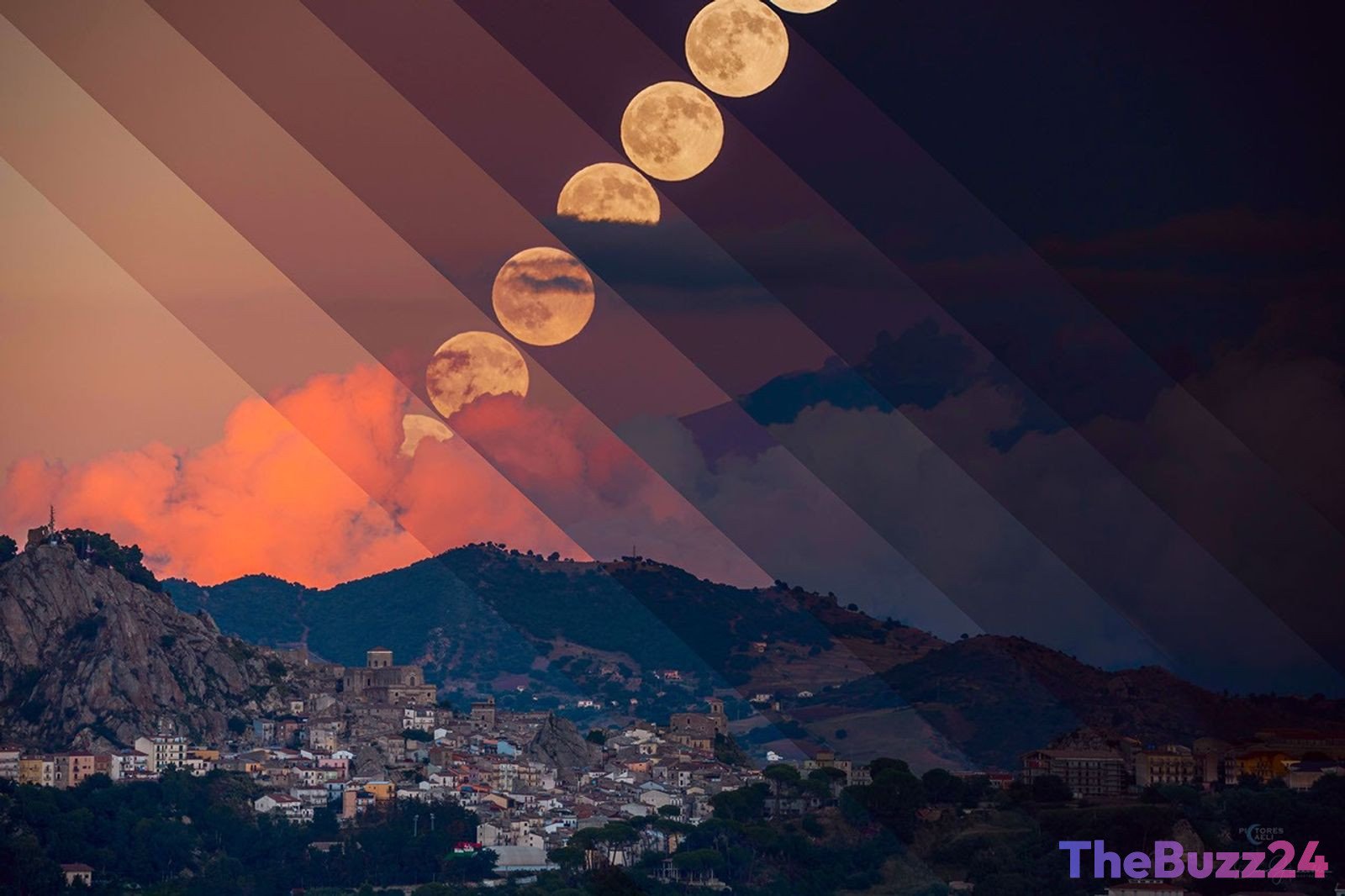
A breathtaking celestial event unfolded over Sicily recently, captured in a stunning composite photograph that merges the rising Harvest Moon with the dramatic spectacle of an erupting Mount Etna. The image, taken near the town of Nicosia, showcases the moon ascending into a darkening sky, its ascent coinciding with the fiery display from one of Europe’s most active volcanoes.
As the sky transitioned from twilight to night, lower clouds in the photograph are seen reflecting the unique colors of antitwilight. Higher in the background, plumes of ash and gas billowed from Mount Etna, creating a dramatic contrast against the lunar glow. Adding to the atmospheric beauty, a distinct pink band, known as the Belt of Venus, is visible lower in the sky, a phenomenon often observed during twilight hours.
This particular full moon, occurring in September, is traditionally referred to as the Harvest Moon in many Northern Hemisphere cultures. This name reflects its historical significance for agricultural communities, as it traditionally illuminated the fields, allowing farmers to continue harvesting their crops into the night. The full moon and the sun are in opposition during this phase, meaning the moon rises as the sun sets, offering a prolonged period of moonlight.
Key Takeaways
- A composite photograph captured the Harvest Moon rising over Sicily during an eruption of Mount Etna.
- The image features atmospheric phenomena like antitwilight colors and the Belt of Venus.
- The September full moon is known as the Harvest Moon, historically significant for agriculture.
Editor’s Analysis & Impact
This striking image highlights the powerful intersection of natural phenomena – a volcanic eruption and a celestial event. It serves as a potent reminder of Earth’s dynamic geological processes and the enduring beauty of astronomical occurrences. For the tourism industry in Sicily, such visually dramatic events, when safely observable, can draw significant interest. From a scientific perspective, correlating volcanic activity with lunar phases, while not directly causal, offers unique opportunities for atmospheric and geological observation. The enduring appeal of such natural spectacles underscores humanity’s fascination with both terrestrial and cosmic wonders.
Frequently Asked Questions
Q: What is the Harvest Moon?
A: The Harvest Moon is the full moon that occurs closest to the autumnal equinox in the Northern Hemisphere, typically falling in September. It's named for its association with the harvest season, as its brighter-than-usual light allowed farmers to work longer hours.
Q: What is the Belt of Venus?
A: The Belt of Venus is an atmospheric optical phenomenon visible on the horizon opposite the Sun during twilight. It appears as a pinkish or reddish band, caused by sunlight scattering off particles in the atmosphere.
Q: Is Mount Etna dangerous?
A: Mount Etna is one of the world's most active volcanoes and is in an almost constant state of eruption. While it poses a risk, its activity is closely monitored, and eruptions are often relatively small and localized, posing little danger to nearby towns unless they escalate significantly.
AI Disclosure: This article is based on verified data and official reports. Our Team and AI have cross-referenced every financial detail with primary sources to ensure total accuracy.
More from this Category