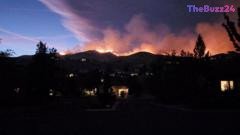
Firefighters Battle Unpredictable Winds as Hawk Fire Threatens Reno Suburbs
Emergency crews in Nevada are making incremental progress against a massive wildfire that has scorched over 15,000 acres near the city of Reno. Dubbed the Hawk Fire, the blaze began over the weekend near the Hawk Meadow Trail and has since triggered evacuation orders for approximately 23,000 residents. While containment efforts reached 27 percent by Monday afternoon, officials warn that unpredictable wind gusts and dry conditions forecast over the coming days could push the flames closer to heavily populated residential areas.
The fast-moving fire has already exacted a heavy toll on the local community. Authorities confirmed that at least 32 homes have been completely destroyed and six others damaged, with that figure expected to rise as damage assessment teams access affected zones. Seven minor injuries have been reported, including three firefighters and four civilians. In response to the escalating crisis, Nevada Governor Joe Lombardo declared a state of emergency for Washoe County, mobilizing the Nevada National Guard to assist local crews with helicopters and ground personnel.
The firefighting effort has drawn resources from across the globe, with personnel arriving from 15 U.S. states as well as Australia and New Zealand. Ground crews are being supported by heavy air tankers and helicopters dropping water and fire retardants along the Sierra Nevada foothills. While some residents have been permitted to return home, tens of thousands remain on high alert, prepared to evacuate at a moment’s notice. The cause of the fire is currently under investigation, though officials suspect human activity is to blame.
This latest disaster highlights a growing trend of severe wildfires encroaching on urban boundaries in the American Southwest. Environmental data indicates that Reno has experienced a temperature increase of over 4 degrees Celsius since the 1970s, making it one of the fastest-warming cities in the United States. These rising temperatures, combined with prolonged dry spells, create highly combustible conditions that allow wildfires to spread with unprecedented speed and intensity.
Key Takeaways
- The Hawk Fire has burned over 15,000 acres near Reno, Nevada, achieving 27% containment amid challenging weather conditions.
- Over 23,000 residents face evacuation orders, with 32 homes destroyed and a state of emergency declared in Washoe County.
- An international coalition of firefighters, alongside the Nevada National Guard, is actively battling the human-caused blaze.
Editor’s Analysis & Impact
The Hawk Fire underscores the escalating threat that wildland-urban interface (WUI) fires pose to growing metropolitan areas in the western United States. As cities like Reno expand into surrounding foothills, the intersection of human activity and climate-induced dry conditions creates a volatile environment. The rapid warming of the region—with Reno leading as one of the fastest-warming U.S. cities—serves as a stark warning of the long-term economic and environmental challenges ahead. For the insurance and real estate industries, these recurring disasters will likely drive up premiums and reshape development policies in high-risk zones. Furthermore, the reliance on international firefighting aid highlights the strain on domestic emergency resources, signaling a need for increased federal investment in proactive forest management and climate adaptation strategies.
Frequently Asked Questions
Q: What caused the Hawk Fire near Reno?
A: Preliminary investigations suggest the fire was caused by human activity, though authorities are still determining whether the act was intentional or accidental.
Q: How many people have been evacuated due to the fire?
A: Approximately 23,000 people have been placed under mandatory evacuation orders, with tens of thousands more warned to be ready to leave if conditions worsen.
Q: What resources are being used to fight the blaze?
A: A massive response includes firefighters from 15 U.S. states, Australia, and New Zealand, alongside the Nevada National Guard, utilizing air tankers, helicopters, and ground crews.
AI Disclosure: This article is based on verified data and official reports. Our Team and AI have cross-referenced every financial detail with primary sources to ensure total accuracy.
More from this Category