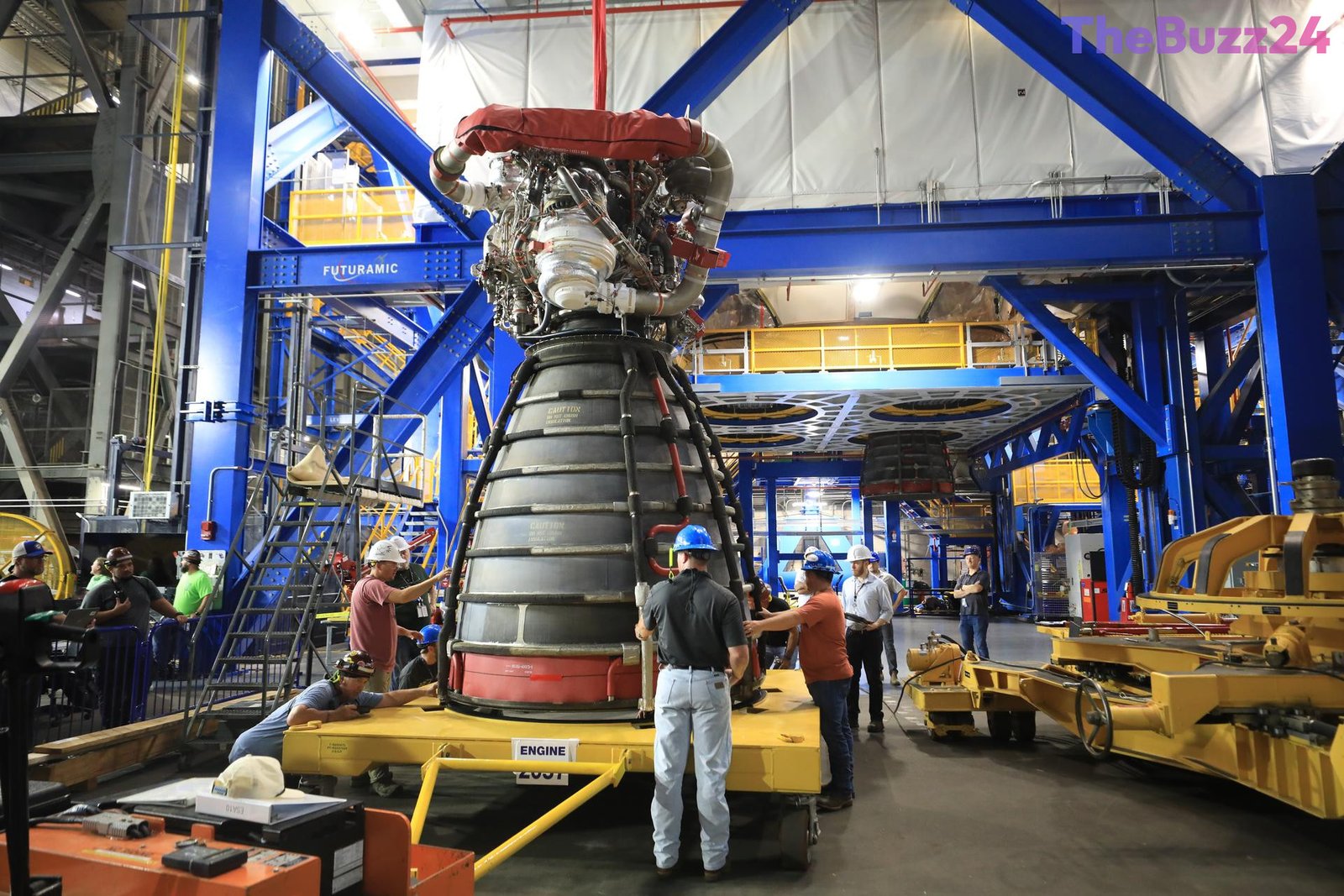
Historic Space Shuttle Engines Assembled onto NASA’s Artemis III Moon Rocket
Engineers and technicians at NASA’s Kennedy Space Center in Florida have officially begun installing the four RS-25 engines into the core stage of the Space Launch System (SLS) rocket. This powerful booster is slated to propel the Artemis III crew into orbit as part of the ambitious effort to return human beings to the surface of the Moon later this decade.
The four engines assigned to the Artemis III core stage—bearing serial numbers E2054, E2057, E2048, and E2052—carry a storied legacy in human spaceflight. Each unit is a flight-proven veteran from the Space Shuttle program, extensively modified and upgraded to meet the higher thrust and performance requirements of the deep-space SLS launcher.
Among the assembled hardware, engine E2048 boasts a particularly celebrated history. It powered Space Shuttle Atlantis during the STS-129 mission, which carried NASA astronaut Randy Bresnik into orbit. Earlier in its operational life, the same engine propelled Space Shuttle Discovery during the STS-95 mission in 1998, a milestone flight that saw legendary Mercury astronaut and U.S. Senator John Glenn return to space at age 77, establishing him as the oldest person in orbit at that time.
The installation of these four engines represents a major step forward in the physical assembly and outfitting of the Artemis III core stage. Once engine integration and structural checkouts are complete, the stage will move closer to final integration with the Orion spacecraft, keeping NASA on course for its planned 2027 lunar landing expedition.
Key Takeaways
- NASA has commenced installation of four RS-25 engines onto the SLS core stage for the Artemis III lunar mission.
- All four engines are heritage hardware originally built and flown during the Space Shuttle program.
- Engine E2048 previously flew on historic shuttle missions, including John Glenn's 1998 return to space aboard Discovery.
Editor’s Analysis & Impact
The repurposing of Space Shuttle RS-25 engines for the SLS core stage highlights NASA’s strategy of utilizing flight-proven, highly dependable hardware for its highest-stakes crewed lunar missions. While the RS-25 remains one of the most efficient liquid-propellant engines ever designed, its use on an expendable vehicle means these historic artifacts will be lost upon ocean impact. This underscores the transitional nature of early Artemis missions, balancing legacy reliability with the aerospace industry’s broader movement toward sustainable, newly manufactured, and cost-effective propulsion architectures for long-term lunar exploration.
Frequently Asked Questions
Q: Why is NASA using Space Shuttle engines on the Space Launch System?
A: NASA is utilizing upgraded RS-25 engines remaining from the Space Shuttle inventory because they are thoroughly tested, highly reliable, and provide the high performance needed to launch crewed deep-space missions.
Q: What is the primary goal of the Artemis III mission?
A: Artemis III is planned as the first mission in the Artemis campaign to land astronauts, including the first woman and first person of color, near the Moon's South Pole.
Q: Will the Artemis III RS-25 engines be recovered after launch?
A: No. Unlike the Space Shuttle program where engines were recovered and refurbished after each flight, the SLS core stage is expendable, and the engines will be discarded into the ocean after stage separation.
AI Disclosure: This article is based on verified data and official reports. Our Team and AI have cross-referenced every financial detail with primary sources to ensure total accuracy.
More from this Category