Hubble Unveils Cosmic Anomaly: A Galaxy’s Perpendicular Heart
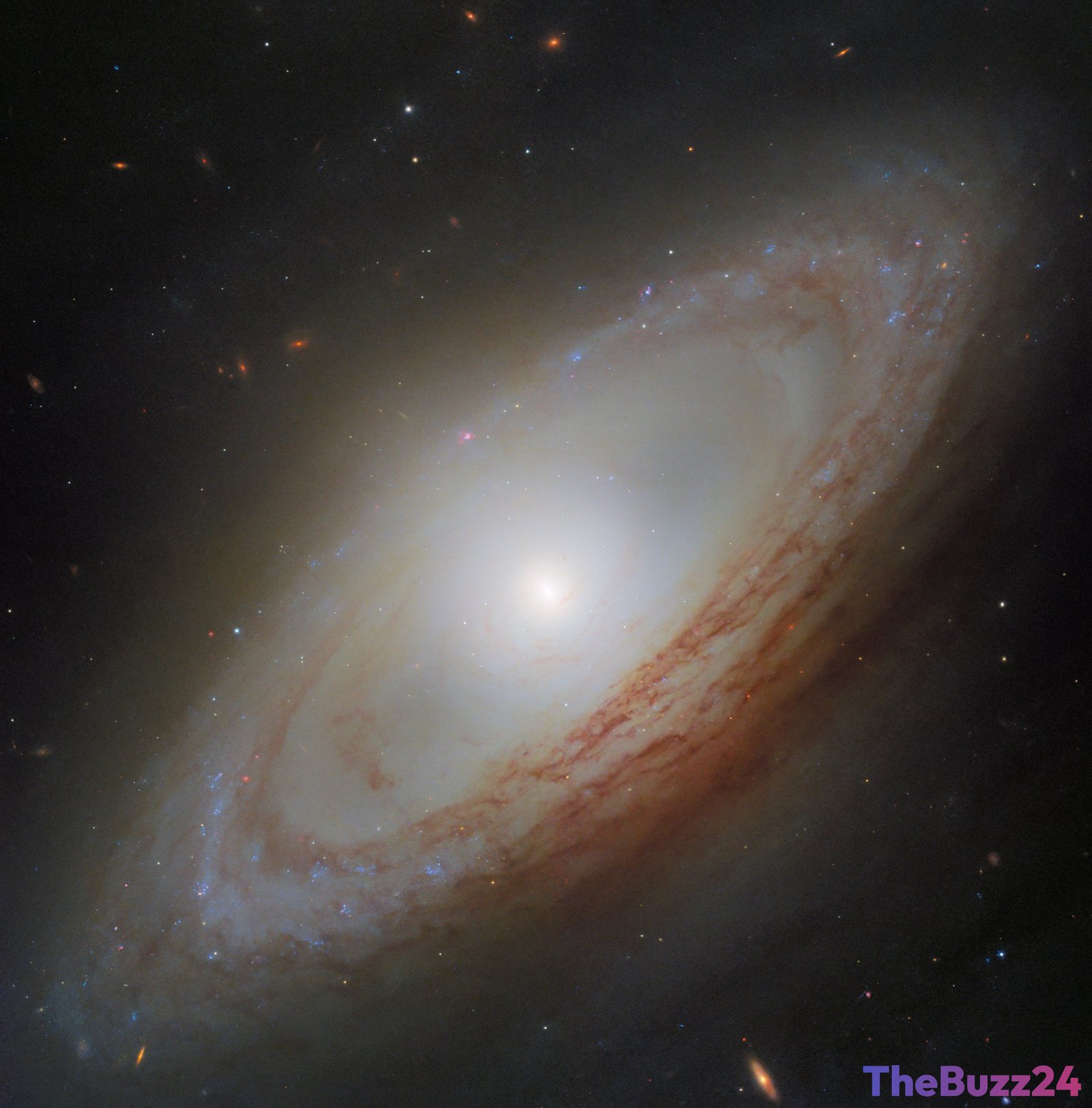
Astronomers utilizing the advanced capabilities of the NASA/ESA Hubble Space Telescope have captured a striking image of the spiral galaxy NGC 4698, revealing a celestial body that, despite its serene appearance, harbors a profound structural and rotational anomaly. Located approximately 55 million light-years away in the constellation Virgo, this galaxy is a member of the vast Virgo Cluster, a gravitationally bound collection of over a thousand galaxies. What makes NGC 4698 particularly intriguing is its central region, which defies conventional galactic structure.
Like our own Milky Way, NGC 4698 exhibits the characteristic spiral arms composed of stars, gas, and dust, curling within a thin disk. These arms are adorned with opaque brown dust clumps and scattered with bright blue stars, though they are notably more prominent in the galaxy’s outer reaches, shying away from its glowing core. The galaxy’s center is dominated by an elongated galactic bulge, a dense concentration of older, cooler stars orbiting a supermassive black hole. This black hole is believed to be actively growing, drawing in surrounding gas. However, the most perplexing feature is that this bulge extends from the galaxy’s disk at an almost perfect right angle, and the stars and gas closest to the center rotate perpendicularly to the rest of the galaxy’s disk.
This “out-of-sync” behavior suggests an external influence rather than internal dynamics. Scientists hypothesize that NGC 4698 may have funneled in gas from an outside source, leading to the formation of a new disk of gas and stars in its center, oriented at an angle to the primary galactic disk. Evidence supporting this theory includes observations hinting at a past minor galactic merger, marked by a short ‘tail’ of hydrogen streaming from one side of the galaxy. The study of NGC 4698 is part of a larger observational program focused on the Virgo Cluster, aiming to understand how a galaxy’s journey through such a dense environment impacts its evolution and its capacity for new star formation. These detailed observations provide crucial insights into the complex processes shaping galaxies across the universe.
Key Takeaways
- NGC 4698, a spiral galaxy 55 million light-years away, exhibits a unique structural anomaly where its central bulge extends perpendicularly to its main disk.
- The stars and gas in the galaxy's core rotate at a right angle to the rest of the galactic disk, a highly unusual phenomenon.
- Astronomers suggest this "out-of-sync" behavior is likely due to external factors, possibly a past minor galactic merger that introduced gas at an unusual angle.
Editor’s Analysis & Impact
This discovery by the Hubble Space Telescope offers significant insights into galactic evolution and the dynamics of galaxy clusters. The identification of NGC 4698’s perpendicular core rotation challenges existing models of spiral galaxy formation and stability, suggesting that external interactions, even minor ones, can profoundly reshape a galaxy’s internal structure and kinematics. This finding underscores the complex interplay of gravitational forces within galaxy clusters and highlights the role of mergers in driving galactic diversity. Future observations, potentially with next-generation telescopes like the James Webb Space Telescope, could provide higher resolution data to confirm the merger hypothesis and explore the chemical composition of the misaligned gas, offering a deeper understanding of how such cosmic anomalies arise and evolve over billions of years. This pushes the boundaries of our understanding of the universe’s vast and dynamic structures.
Frequently Asked Questions
Q: What is unique about the galaxy NGC 4698?
A: NGC 4698 is unique because its central galactic bulge extends at a right angle to its main disk, and the stars and gas in its core rotate perpendicularly to the rest of the galaxy. This "out-of-sync" behavior is highly unusual for a spiral galaxy.
Q: What is believed to be the cause of NGC 4698's unusual rotation?
A: Astronomers hypothesize that the unusual rotation and structure are likely caused by external factors, specifically a past minor galactic merger. It's thought that the galaxy funneled in gas from an outside source, which then formed a new, misaligned disk of gas and stars in its center.
Q: Where is NGC 4698 located?
A: NGC 4698 is located approximately 55 million light-years away from Earth in the constellation Virgo. It is part of the Virgo Cluster, a large collection of over a thousand galaxies bound together by gravity.
AI Disclosure: This article is based on verified data and official reports. Our Team and AI have cross-referenced every financial detail with primary sources to ensure total accuracy.
More from this Category