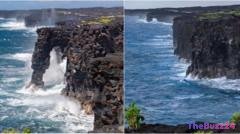
Iconic 550-Year-Old Hōlei Sea Arch Collapses Into the Pacific Ocean
A legendary natural wonder on the coast of Hawaii has vanished. The Hōlei Sea Arch, a massive 90-foot-tall lava rock formation that stood for approximately 550 years, has collapsed into the Pacific Ocean. Located at the southern edge of Hawaii Volcanoes National Park at the end of the Chain of Craters Road, the iconic landmark was a major draw for tourists and photographers from around the globe.
While the exact moment of the collapse remains unknown, park officials noted the arch was still standing on September 23 but had completely disappeared by September 27. The collapse coincided with a temporary closure of the park during Tropical Storm Nolo, which brought heavy winds and rough seas to the region. Geologists and park rangers had long warned of the structure’s instability, which was exacerbated by environmental factors over the years.
The integrity of the surrounding cliffs had been severely compromised in recent years, notably by seismic activity during the 2018 Kīlauea volcano eruption and subsequent summit collapse. In 2020, deep fractures prompted authorities to move the visitor viewing platform further back for safety. Later that same year, powerful storm waves battered the arch, breaking off a significant portion of its base.
Despite the loss of this beloved geological feature, experts emphasize that such events are a natural part of the island’s dynamic and ever-changing coastline. As ocean waves continue to erode the volcanic cliffs, older structures will inevitably crumble, making way for new formations to take their place over the coming centuries.
Key Takeaways
- Hawaii's famous 90-foot-tall Hōlei Sea Arch has collapsed into the ocean after standing for over five centuries.
- The collapse likely occurred during Tropical Storm Nolo, following years of structural degradation from earthquakes and wave action.
- Park officials had previously relocated visitor viewing areas due to growing cracks and instability along the volcanic cliffs.
Editor’s Analysis & Impact
The collapse of the Hōlei Sea Arch highlights the fragile and dynamic nature of volcanic coastlines. While the loss of such an iconic landmark is a blow to Hawaii’s tourism, it serves as a stark reminder of the relentless power of natural erosion and climate-induced weather events. Increased frequency and intensity of tropical storms, combined with ongoing seismic activity from active volcanoes like Kīlauea, accelerate the degradation of coastal geological features worldwide. For the travel and tourism industry, this event underscores the necessity of adaptive safety infrastructure. As natural monuments inevitably degrade, park management must balance public access with safety, utilizing geological monitoring to predict collapses before they pose a threat to visitors. Ultimately, this transition paves the way for new geological formations, illustrating the earth’s continuous cycle of creation and destruction.
Frequently Asked Questions
Q: What caused the Hōlei Sea Arch to collapse?
A: The collapse was the result of long-term erosion, exacerbated by seismic activity from the 2018 Kīlauea volcanic eruption and battering waves from recent storms, including Tropical Storm Nolo.
Q: How old was the Hōlei Sea Arch?
A: The volcanic rock structure was approximately 550 years old, having formed from ancient lava flows meeting the Pacific Ocean.
Q: Will a new arch form in its place?
A: Yes. Geologists note that while this specific arch is gone, the continuous erosion of the retreating coastline will eventually carve out new sea arches in the future.
AI Disclosure: This article is based on verified data and official reports. Our Team and AI have cross-referenced every financial detail with primary sources to ensure total accuracy.
More from this Category