Inside the Chinese Robot Fleets Transforming British Retail Warehouses
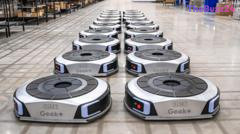
Modern e-commerce relies heavily on speed, turning the interval between an online customer clicking ‘buy’ and the fulfillment process beginning into a matter of minutes. Increasingly, this journey starts with compact, mobile floor robots gliding beneath storage racks, lifting heavy shelves, and transporting them directly to waiting fulfillment workers.
At manufacturing facilities in eastern China, fleets of these autonomous mobile robots are assembled and thoroughly tested before being exported to logistics hubs across the globe. Major British retailers—including household names like Tesco, Asda, and Next—now heavily rely on this advanced technology. By automating repetitive transit tasks, these robotic systems allow companies to accelerate picking speeds, utilize hard-to-reach vertical storage spaces, and drastically reduce human error.
Unlike traditional warehouse infrastructure that relies on fixed conveyor belts and permanent installations, autonomous mobile robots offer high flexibility. They can be deployed rapidly using simple floor markers and basic safety fencing. This adaptability has propelled companies like Geek+ to become leading global suppliers in the sector, fueled by surging international demand for streamlined supply chain operations.
Meanwhile, the United Kingdom has grappled with stagnant productivity growth for over a decade. Economic analysts and organizations such as the OECD emphasize that widespread adoption of industrial robotics is vital for boosting business efficiency. Despite a strong manufacturing legacy, British firms have historically lagged behind in robotics implementation compared to digital tech adoption, creating a fertile market for international automation providers. Partnerships between warehouse tech firms and local distributors have already seen thousands of automated units deployed across numerous British fulfillment sites to combat persistent labor shortages.
Key Takeaways
- Chinese-built autonomous mobile robots are increasingly powering major UK retail warehouses for Tesco, Asda, and Next.
- The UK faces persistent productivity challenges and labor shortages, making warehouse automation an urgent priority for businesses.
- While wheeled and mobile rack-carrying robots dominate current logistics, developers are actively experimenting with advanced humanoid robots for future applications.
Editor’s Analysis & Impact
The integration of Chinese-built autonomous robotics into Western retail supply chains represents a profound shift in global logistics. As labor shortages persist and consumer expectations for rapid delivery intensify, retailers have little choice but to embrace automation to remain competitive. However, this trend also intersects with broader geopolitical tensions, particularly regarding trade restrictions and national security concerns surrounding advanced technologies. Looking ahead, the evolution from simple wheeled transport robots to more complex humanoid solutions will likely redefine labor markets, forcing policymakers and industry leaders to balance efficiency gains with workforce retraining and economic resilience.
Frequently Asked Questions
Q: Why are UK retailers adopting warehouse robots?
A: UK retailers are increasingly adopting warehouse robots to combat labor shortages, increase picking speeds, store goods more efficiently, and boost overall productivity.
Q: How do autonomous mobile robots differ from traditional warehouse automation?
A: Unlike traditional systems that rely on fixed conveyor belts and permanent infrastructure, autonomous mobile robots can be deployed quickly using flexible floor markers and safety fencing.
Q: What is the next major focus for robotics developers in warehouses?
A: Developers are expanding beyond basic shelf-moving robots toward end-to-end unmanned solutions, which include picking, handling, packing, and eventually humanoid robotics designed to work in human-centric environments.
AI Disclosure: This article is based on verified data and official reports. Our Team and AI have cross-referenced every financial detail with primary sources to ensure total accuracy.
More from this Category